Ghanaian Muslims in Berlin Mark Eid-ul-Adha at Tempelhofer Feld
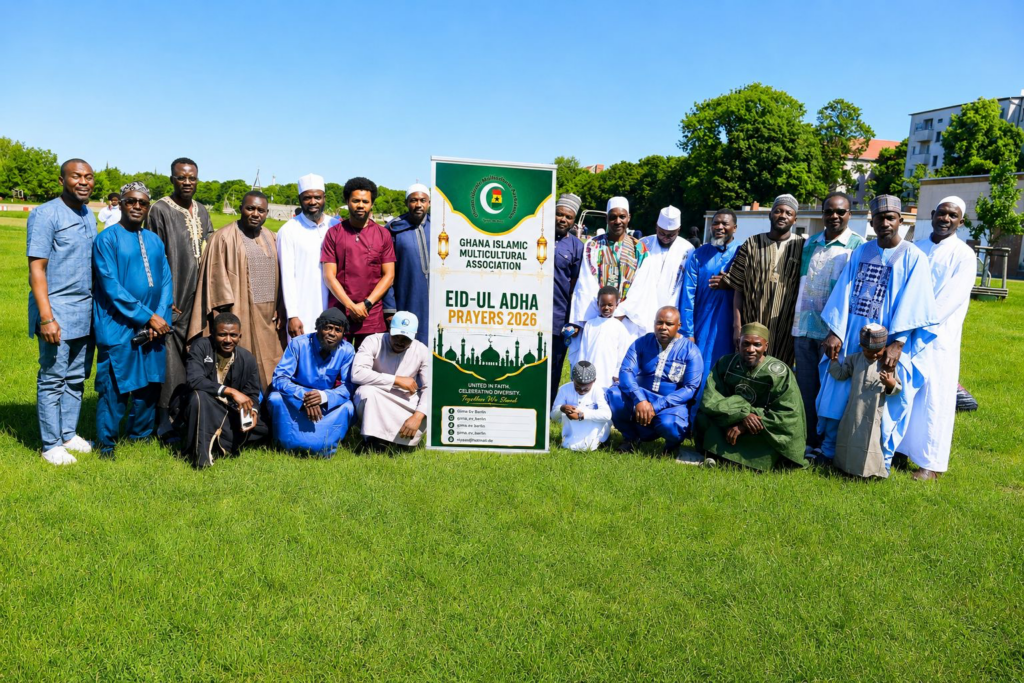
At Tempelhofer Feld, the vast former airport turned public park in the heart of Berlin, several hundred members of the Ghanaian Muslim community gathered on Wednesday morning to mark Eid-ul-Adha, the Festival of Sacrifice. The event, organised by the Ghana Islamic Multicultural Association, known by its German abbreviation GIMA e.V., drew men, women, and children for prayers that began at ten in the morning and concluded at noon.
The gathering was one of several Eid celebrations held across Germany’s capital, but its distinctly Ghanaian character set it apart. Congregants dressed in colourful traditional attire — flowing kaftans, kente-accented fabrics, and embroidered gowns — created a visual tapestry that reflected both Islamic devotion and West African cultural identity.
Prayers Led by Ghanaian Imams
The Eid prayers were led by Dr Sheikh Nurudeen and Sheikh Ahmed Musah, who guided the congregation through the ritual worship and delivered sermons centred on the themes of sacrifice, unity, and devotion to Allah. Eid-ul-Adha commemorates the willingness of Prophet Ibrahim to sacrifice his son in obedience to God, a narrative that resonates across Islamic traditions worldwide.
For the Ghanaian diaspora in Berlin, the occasion carried an additional layer of meaning. It served as a moment to strengthen bonds within a community that, while geographically distant from home, maintains deep cultural and spiritual ties to Ghana. The gathering at Tempelhofer Feld offered a rare opportunity for Ghanaians of various ethnic and regional backgrounds to come together in shared worship.
A Diaspora Celebration with Local Roots
The Ghana Islamic Multicultural Association has established itself as a key institution within Berlin’s Ghanaian community, organising religious and cultural events that serve both spiritual and social functions. Its choice of Tempelhofer Feld as a venue reflects practical considerations — the open space can accommodate large congregations — but also symbolic ones. The park, once a site of Cold War-era airlifts, has become a symbol of Berlin’s openness to diverse communities.
Ghana’s own Eid-ul-Adha celebrations this year were marked by national prayers and calls for unity from political and religious leaders. Former Vice-President Mahamudu Bawumia urged Muslims to uphold the values of sacrifice and compassion, a message that echoed across the diaspora. Similarly, thousands gathered at Independence Square in Accra for a national celebration attended by President Mahama and traditional leaders.
Cultural Diversity on Display
What distinguished the Berlin gathering was its multicultural dimension. While the event was organised by a Ghanaian association, participants included Muslims from other West African nations and beyond, reflecting the diverse character of Islam in Germany’s capital. The organisers emphasised unity and cultural exchange as central themes of the celebration.
Following the prayers, participants exchanged greetings, shared food, and engaged in community interaction. Leaders of GIMA e.V. expressed gratitude to all who attended and supported the event’s organisation. Prayers were offered for peace and prosperity — both for the diaspora community and for Ghana and the world at large.
For many attendees, the event was a reminder that religious and cultural identity can thrive far from home, provided there are institutions willing to create spaces for collective expression. The Ghana Islamic Multicultural Association’s Eid-ul-Adha celebration at Tempelhofer Feld was precisely that kind of space — a moment of faith, fellowship, and cultural affirmation in the heart of Europe.
Image Source: MYJOYONLINE