Duale Defends Laikipia Ebola Facility, Says It Will Serve Kenyans and Americans Alike
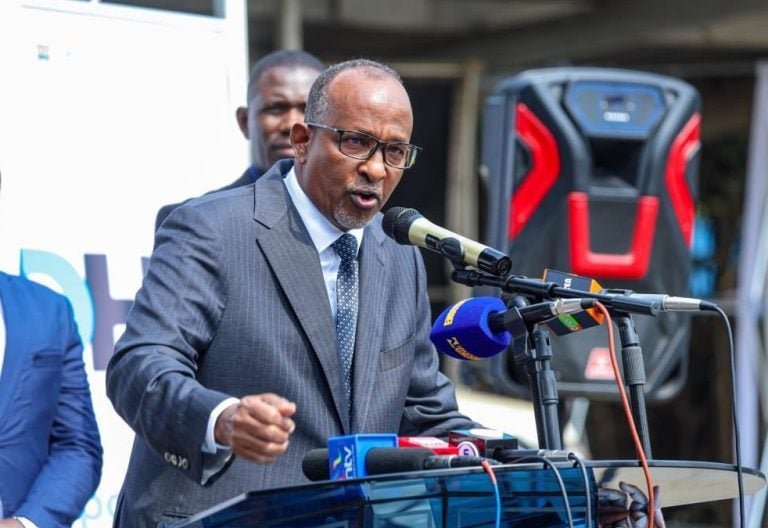
Health Cabinet Secretary Aden Duale has moved to quell mounting public anxiety over a planned health facility in Laikipia County, insisting the installation is a jointly operated military medical centre designed to protect both Kenyan and American personnel stationed in high-risk regions — not a dumping ground for Ebola patients from abroad.
The facility, developed in partnership with the United States, has attracted scrutiny in recent weeks amid speculation that it would be used to quarantine American nationals exposed to Ebola, raising fears among local communities about the safety implications of hosting such a site on Kenyan soil.
Speaking in a television interview on Saturday, May 30, 2026, Duale sought to reframe the narrative. “The facility is a military facility. KDF soldiers and other Kenyans will use that facility,” he said, pointing to the large number of Kenyan troops deployed in the Democratic Republic of Congo, where Ebola outbreaks have been recurrent. “In DRC, where the epicentre of Ebola is, I had an opportunity to visit there when I was Defence CS. Over 350 KDF soldiers are working for the UN today. We have a huge population of Kenyans working in DRC. Why is it said we’re bringing Ebola patients to Laikipia?”
The CS framed the Laikipia installation as one component of a broader national preparedness strategy. The government, he disclosed, is establishing 11 quarantine, isolation and treatment centres across the country, alongside an Incident Management Centre and an Emergency Response Centre in Nairobi to coordinate any potential response. More than 1,000 healthcare workers have already been trained on Ebola preparedness and response protocols.
“There is nothing shrouded about this Ebola quarantine process,” Duale said. “We are putting in place 11 quarantine, isolation and treatment centres across the country as a safety measure just in case we get affected. It is our duty to ensure Kenyans are protected.”
The choice of Laikipia was deliberate, the CS explained, noting that the site is located far from densely populated communities, making it suitable for isolation and emergency response operations should the need arise. The remote location, critics have argued, is precisely what fuels suspicion about the project’s true purpose — a charge the government firmly rejects.
Duale also mounted a broader defence of Kenya’s health partnership with the United States, which he described as one of the country’s most consequential bilateral relationships. “If there’s one country that has contributed between 25 and 35 per cent of the health budget since independence, it is the US,” he said. “That’s why today, the cooperation agreement we’ve signed is worth Ksh206 billion.”
The CS pointed to institutions such as the Kenya Medical Research Institute (KEMRI) as evidence that international health partnerships deliver tangible domestic benefits, helping Kenya build what he described as some of the region’s strongest laboratory and disease surveillance systems.
“Kenya is part of the global health security system, and we’re one of the countries with the best healthcare systems in terms of laboratories and surveillance,” he remarked, underscoring that the country has not recorded any confirmed cases of Ebola despite heightened vigilance across the region following outbreaks in neighbouring countries.
The government’s challenge now is convincing a sceptical public that the Laikipia facility is a shield, not a target. Duale’s remarks signal a determination to press ahead with the project while addressing the misinformation that has clouded it — a balancing act that will test both the administration’s communication strategy and the depth of public trust in its health security commitments.
Image Source: GHANAMMA