Afenyo-Markin Accuses NDC Government of Losing Control as Ministries Clash
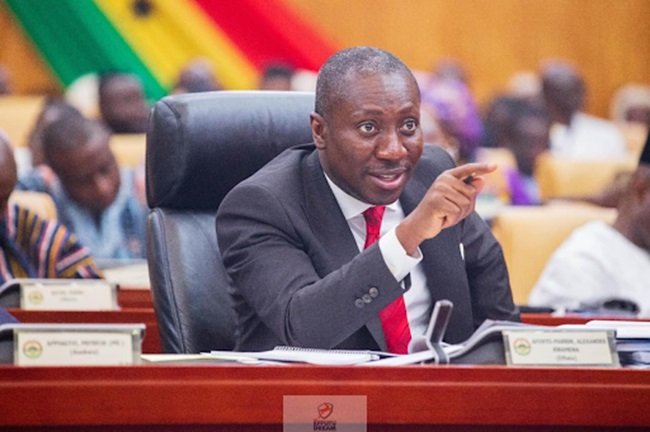
Minority Leader Alexander Afenyo-Markin has delivered a stinging rebuke of the governing National Democratic Congress, accusing the administration of having lost its grip on the machinery of government amid visible infighting among senior appointees.
Speaking in Parliament during deliberations on a statement by the Finance Minister regarding the economy and the formal conclusion of Ghana’s International Monetary Fund programme, Mr Afenyo-Markin pointed to a recent public disagreement between the Ministry of Finance and the Ministry of Food and Agriculture as evidence of a government struggling to coordinate its own officials.
“The Agric Ministry and the Finance Ministry are at war. Mister Speaker, whereas one ministry is saying funds have been released, the other ministry says that no,” the Minority Leader told the House. “This is a government that has lost control; it cannot even take care of each other in this chamber.”
The accusation landed at a moment the NDC administration has been celebrating what it describes as economic recovery and the successful closure of Ghana’s extended credit facility arrangement with the IMF. For the Minority, however, the spectacle of two cabinet-level ministries contradicting each other in public undermines the narrative of disciplined governance.
Mr Afenyo-Markin went further, characterising the NDC’s parliamentary majority as one that exists only on paper. “Mr Speaker, the NDC majority is a majority on paper,” he declared, suggesting that internal divisions have eroded the government’s ability to present a united front on even routine policy matters.
The clash over agricultural funding is not merely an administrative embarrassment. The Ministry of Food and Agriculture oversees critical programmes tied to food security, farmer subsidies, and the planting for food and jobs initiative. Any breakdown in the flow of funds from the Finance Ministry directly affects the livelihoods of millions of Ghanaians who depend on agricultural support.
Political observers have noted that such public disagreements between ministries are unusual in Ghana’s Westminster-influenced system, where collective cabinet responsibility typically requires that internal disputes be resolved behind closed doors. The fact that the disagreement spilled into public view suggests either a breakdown in coordination or a deeper rift within the administration’s economic management team.
The Minority’s critique comes at a sensitive time. President Mahama’s approval rating recently slipped to 58.9 per cent, according to an IEA poll, signalling that while a majority of Ghanaians still back him, confidence is not unconditional. Episodes of visible disarray within government could accelerate that downward trend.
The administration’s supporters would argue that disagreements between ministries are a natural feature of complex governance and do not necessarily indicate systemic failure. They might also point to the government’s reported payment of GH₢13 billion towards inherited road projects as evidence that fiscal coordination is, in fact, functioning.
Nevertheless, the optics of warring ministries at a time the government is touting macroeconomic stability present a political vulnerability the Minority appears eager to exploit. Whether the administration can restore the appearance of coherence will depend on whether the Finance and Agriculture ministries can resolve their funding dispute without further public acrimony.
Image Source: MYJOYONLINE