Ghana’s Fisherfolk Face Rising Maritime Heatwaves as Ocean Temperatures Soar
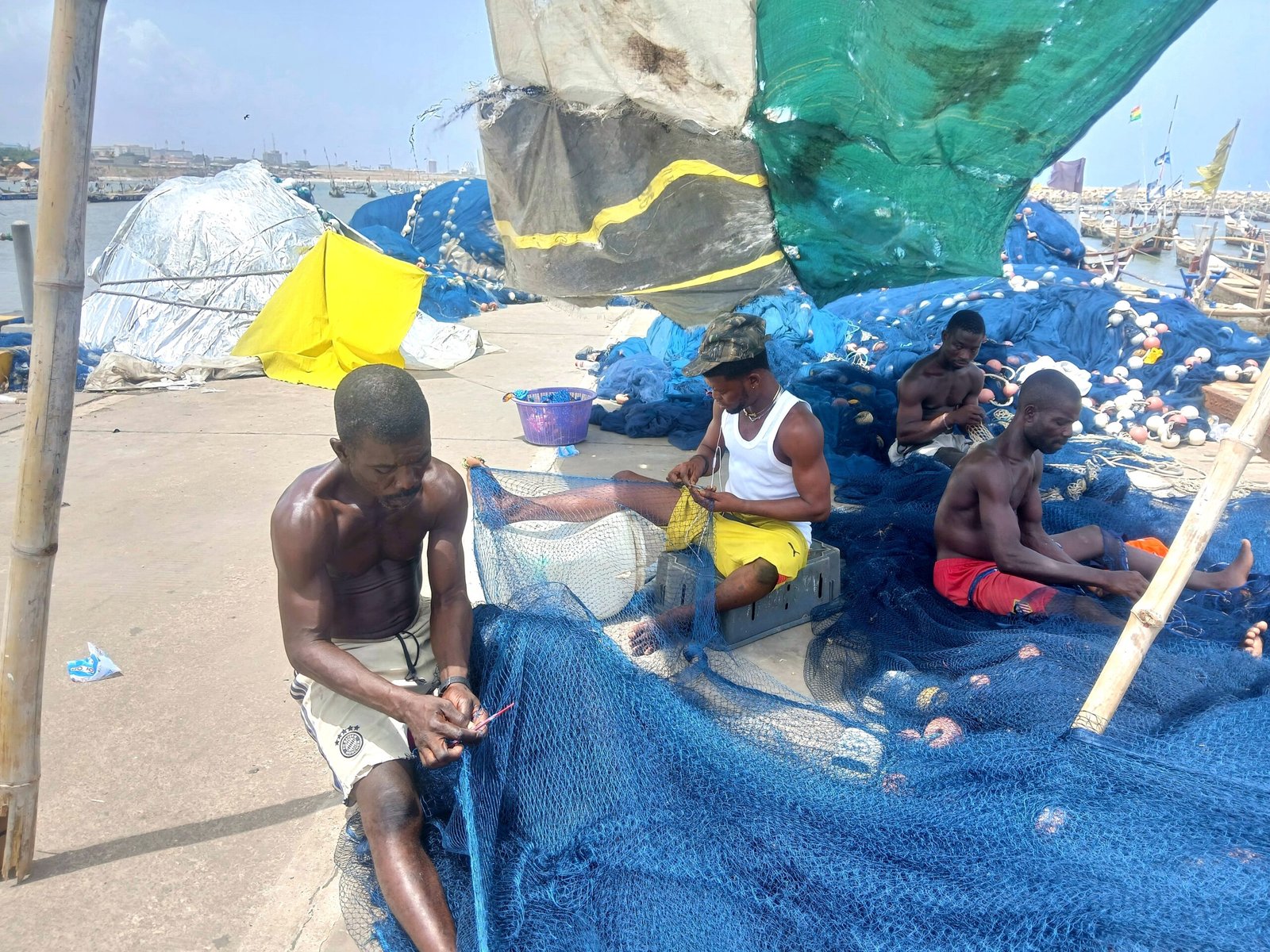
On a recent Wednesday at the Jamestown Fishing Harbour in Accra, the thermometer read 31 degrees Celsius. Beneath a bleached sky, fishermen laboured along the shore, their chests glistening with sweat under low tarps that offered only partial shade. For many, the daily work of mending nets has become as gruelling as the pre-dawn expeditions at sea.
Fisherman Okai Addo had just returned from a trip offshore. When the heat aboard his boat became unbearable, he resorted to pouring seawater over his body. On the worst days, his only relief was to plunge briefly into the ocean before climbing back aboard to continue working.
“On the boat, there is no shade, so the sun is directly on us,” said Nii Atimkpa, another fisherman at the harbour. “On days when it is too hot, I take off my shirt and cover my head with it.” His colleague Ankamah Abola put it more bluntly: “It is constant headaches from direct exposure to the sun, but I have to feed my family.”
These improvised strategies — seawater dousing, shirt-hoods, shortened shifts — are the everyday adaptations of a community on the front lines of climate change. But the heat that fishermen feel on the surface is only part of a larger, more ominous story unfolding beneath the waves.
The Invisible Crisis Below
Marine heatwaves — prolonged periods during which ocean temperatures exceed the 90th percentile of historical averages for at least five consecutive days — are intensifying across the Gulf of Guinea. These events cause coral bleaching, fish die-offs, disrupted migration patterns, and increased stress on the fisheries that millions of West Africans depend upon.
The ocean absorbs roughly 90 per cent of the excess heat generated by global warming and about 30 per cent of carbon dioxide emissions. According to the Intergovernmental Panel on Climate Change’s Sixth Assessment Report, marine heatwaves doubled in frequency between 1982 and 2016 and have grown more intense and longer-lasting since the 1980s.
A 2022 study by Mamadou Koné and colleagues found that marine heatwaves along the Gulf of Guinea coast have increased in frequency since 2015, with recurring cycles of three, six, and eight years linked to broader tropical Atlantic temperature fluctuations. The Guinea Current, which carries warm water close to shore, appears to be losing its capacity to support the cooling upwelling that coastal ecosystems historically relied upon.
Compounding Pressures
The effects ripple far beyond the ocean surface. Prof. Yaw Agyeman Boafo of the University of Ghana’s Centre for Climate Change and Sustainability Studies explains that coastal humidity slows the evaporation of sweat, leaving people hotter for longer and increasing the risk of heat-related illness. Fisherfolk, who spend hours under open skies with minimal shade, are especially vulnerable.
Rising ocean temperatures also intensify existing threats to Ghana’s fisheries, including illegal fishing, overfishing, and marine pollution. “Climate stress weakens marine ecosystems, and destructive fishing practices make it harder for fish populations to recover,” said Kwesi B. Randolph Johnson, an environmental and fisheries consultant.
For aquaculture practitioners, the risks are equally stark. Both extreme heat and unexpected cold snaps can trigger outbreaks of diseases such as Streptococcus and Infectious Spleen and Kidney Necrosis Virus, which can wipe out entire fish stocks. Ghana’s broader agricultural sector faces similar data and capacity gaps, as the CSIR has warned that weak use of scientific knowledge continues to undermine productivity.
Searching for Solutions
Ghana took a significant step in April 2026 by declaring its first Marine Protected Area, a 700-square-kilometre zone in the Greater Cape Three Points region. The initiative aims to conserve marine biodiversity and support fish stock recovery, though experts caution that marine heatwaves demand both global climate action and local ocean governance.
Innovation is also emerging from within the sector. Oceanographer Peter Teye Busumprah and his team have developed the African Ocean Biodiversity Atlas, a GPS-enabled platform that creates a detailed repository of marine species data to support policymaking. Meanwhile, aquaculture researcher Jedida Osei Bediako has built a solar-powered oxygen delivery system for fish farms, equipped with smart sensors that activate water circulation when oxygen levels drop to critical thresholds.
At Jamestown, the fishermen carry on. Maame Fante, a fish seller, credits a cold store facility with reducing spoilage and shielding sellers from prolonged heat. But she, like everyone at the harbour, knows that the fundamental challenge — a warming ocean that is reshaping the marine environment — will not be solved by refrigeration alone.
Marine heatwaves have shifted from a future concern to a present reality in the Gulf of Guinea. Closing the gaps in monitoring, research, and emergency response will determine whether Ghana’s coastal communities can sustain their way of life in a rapidly warming world.
Image Source: GHANA BUSINESS NEWS