Mahama’s Approval Rating Drops to 58.9% But Majority of Ghanaians Still Back Him — IEA Poll
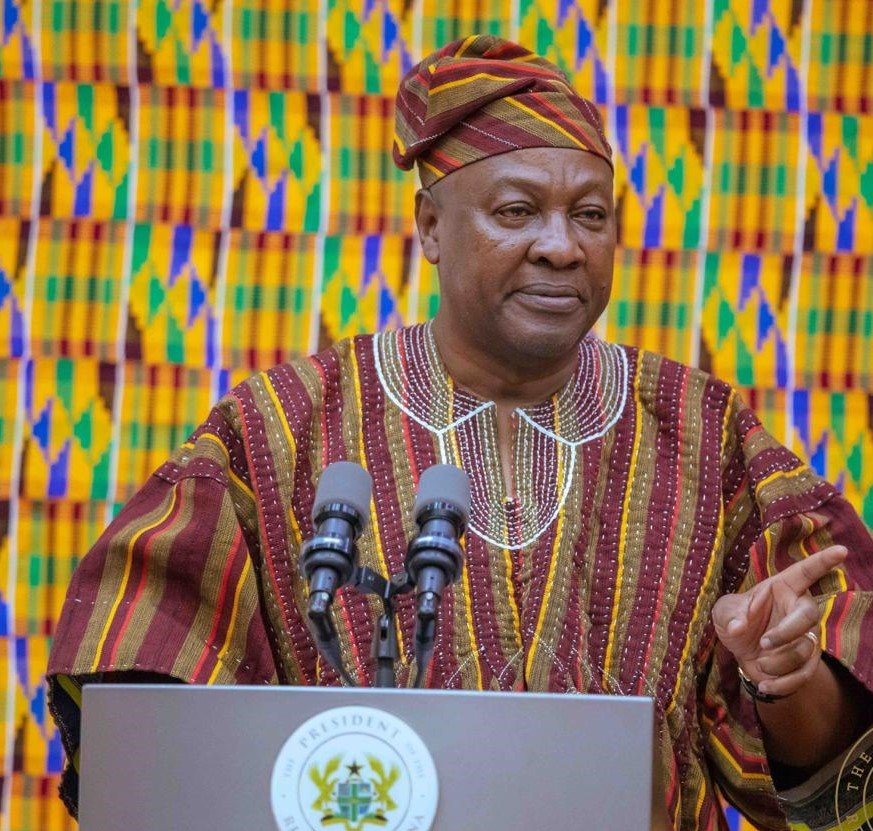
President John Dramani Mahama continues to enjoy broad public support, but his approval rating has slipped significantly over the past six months, according to a nationwide poll released on Wednesday by the Institute of Economic Affairs (IEA).
The survey, conducted in May 2026 across all sixteen regions with more than 1,000 respondents, places Mahama’s job approval at 58.9 percent — a notable decline from the 68 percent recorded in December 2025. Disapproval stands at 28.4 percent, while 12.8 percent of respondents expressed no opinion.
Despite the drop, the IEA noted that the more than 30 percentage-point gap between approval and disapproval suggests that positive assessments of the President’s performance remain well ahead of critical ones. The institute described the overall picture as one of broad support tempered by rising public expectations.
Economy Drives Approval
Among those who approve of the President’s performance, the economy is the overwhelming reason. Nearly three in four approvers — 73.5 percent — credit the government’s handling of economic affairs, followed by road infrastructure at 16 percent and energy and electricity supply at 2.7 percent.
The findings reflect a period of notable macroeconomic improvement under the Mahama administration. Since January 2025, inflation has fallen from 23.5 percent to around 3.4 percent, the cedi has appreciated by 26 percent against major currencies, and the Bank of Ghana’s policy rate has been cut from 27 percent to 14 percent. Average commercial bank lending rates have declined from around 32 percent to approximately 20 percent, while Ghana’s debt-to-GDP ratio dropped from 61.8 percent at the end of 2024 to 45.3 percent by the close of 2025.
Those gains have drawn international recognition, with Fitch, Moody’s, and S&P all upgrading Ghana’s sovereign credit rating — what the IEA described as the first triple upgrade in many years.
Cost of Living and Power Supply Trouble Disapprovers
Among those who disapprove, the economy still tops the list at 30.9 percent. However, the IEA cautioned that this does not necessarily reflect a rejection of the government’s macroeconomic record. Rather, it may point to the lived experience of Ghanaians for whom falling inflation and a stronger cedi have not yet fully translated into lower costs of living, more jobs, or higher household incomes.
Electricity supply was cited by 29.9 percent of disapprovers, a finding the IEA linked directly to a temporary power supply constraint in May 2026 that brought frequent outages to homes and businesses across the country. Corruption was raised by 19.1 percent of disapprovers — a signal, the IEA noted, that the government’s anti-corruption rhetoric has yet to fully convince a significant portion of the public.
A Base That Remains Solid
“The findings suggest that Ghanaians are broadly supportive of the President’s leadership but are expectant that the progress recorded at the macro level will increasingly be felt in their daily lives,” the IEA stated.
The poll is the latest in the institute’s regular series tracking presidential job performance. Its release comes at a politically significant moment, as the government seeks to consolidate its economic gains while managing public expectations around the tangible impact of reform.
Image Source: MYJOYONLINE