Ebola Outbreak in DR Congo Reaches Alarming Scale, MSF Warns
Just two weeks after health authorities declared an Ebola outbreak in the Democratic Republic of Congo’s Ituri Province, the scale of the crisis has already surpassed anything previously recorded at this stage of an outbreak, according to Médecins Sans Frontières (MSF).
The medical charity’s deputy director, Dr Alan Gonzales, described the situation as “deeply alarming” on Saturday, warning that the response on the ground has not kept pace with the virus’s rapid spread. More than 1,000 suspected cases have now been documented, with at least 246 deaths. Neighbouring Uganda has confirmed nine cases and one death, raising fears of cross-border transmission.
“Never before has an Ebola outbreak recorded so many cases so soon after its declaration,” Gonzales said in a statement. “The reality today is that nobody knows the true scale and severity of this outbreak. New suspected cases are being reported daily, yet hundreds of samples remain untested.”
World Health Organization Director-General Dr Tedros Adhanom Ghebreyesus arrived in Bunia, Ituri’s provincial capital, on Saturday to personally oversee containment efforts. His visit underscores the gravity of the situation and the international alarm it has generated.
Tedros urged local communities to take a more active role in combating the disease, noting that residents “understand the problems better and they know the solution as well.” He also addressed the sensitive issue of funeral practices, acknowledging the cultural importance of honouring the dead while warning that traditional rituals involving physical contact with corpses pose a serious transmission risk.
“Certain practices including touching of bodies of those who have died from Ebola, can spread the virus further,” Tedros said. “While we grieve for those we’ve lost, we must do everything we can so that we don’t lose another, and get into a cycle of grief.”
The current outbreak involves the Bundibugyo strain of Ebola, a rare variant for which no proven vaccine exists. The strain kills approximately one-third of those infected. Ebola spreads through direct contact with the bodily fluids of infected individuals — blood, vomit, diarrhoea, saliva, urine, semen, and sweat — and can also be transmitted through contaminated objects such as needles, bedding, or clothing.
Containment efforts have been significantly hampered by major logistical constraints, including border and airport closures. Ongoing armed conflict in eastern DR Congo has further complicated the response, a point the WHO has repeatedly emphasised.
On a more encouraging note, the National Institute for Biomedical Research laboratory in Bunia is now able to return test results within 24 hours, a significant improvement from the previous arrangement in which samples had to be transported more than 1,500 kilometres to Kinshasa for analysis. That delay had been a major concern for health workers who feared it could cost lives and accelerate the virus’s spread.
The outbreak’s implications extend beyond central Africa. Health officials in Brazil’s São Paulo state are investigating a suspected Ebola case involving a 37-year-old man who recently returned from the DR Congo. The patient has been placed in isolation at an infectious diseases institute.
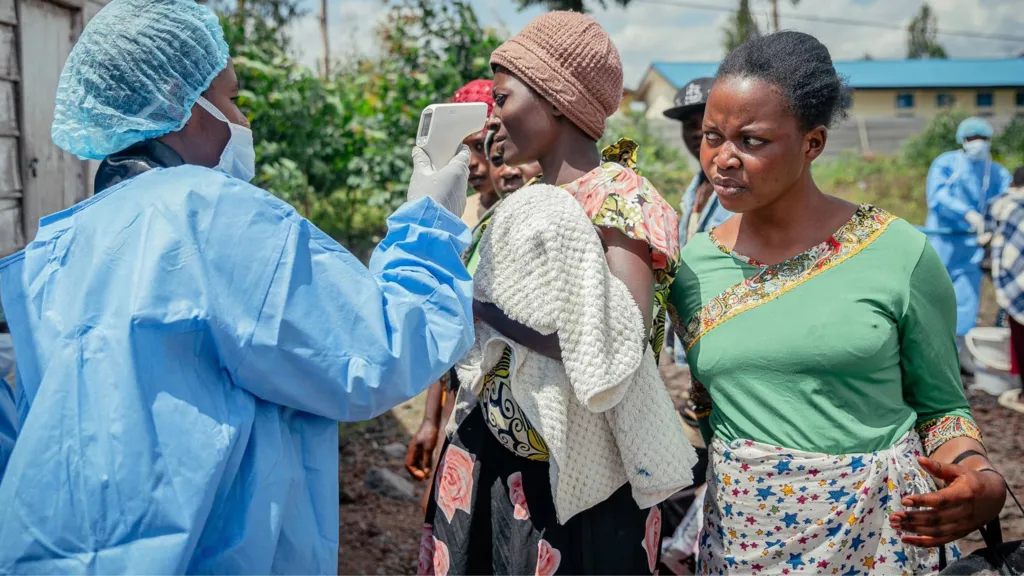
In Bunia itself, daily life appears largely undisturbed. Residents continue to trade and move freely, though handwashing stations have been installed at the airport and public health advisories are being broadcast on radio and television in both local languages and French.
The regional anxiety has also manifested in East Africa. Kenya recently moved to defend a planned Ebola quarantine facility in Laikipia County, signalling how seriously neighbouring governments are treating the threat of further spread.
The WHO and MSF have called for a rapid scale-up of testing, contact tracing, and community engagement if the outbreak is to be brought under control. With cases rising daily and the true extent of the crisis still unknown, the coming weeks will be critical in determining whether the response can catch up with the epidemic’s pace.
Image Source: MYJOYONLINE