Oye Bampoe Addo leads presidential staffers to present ₵6.1m cheque to Ghana Medical Trust Fund
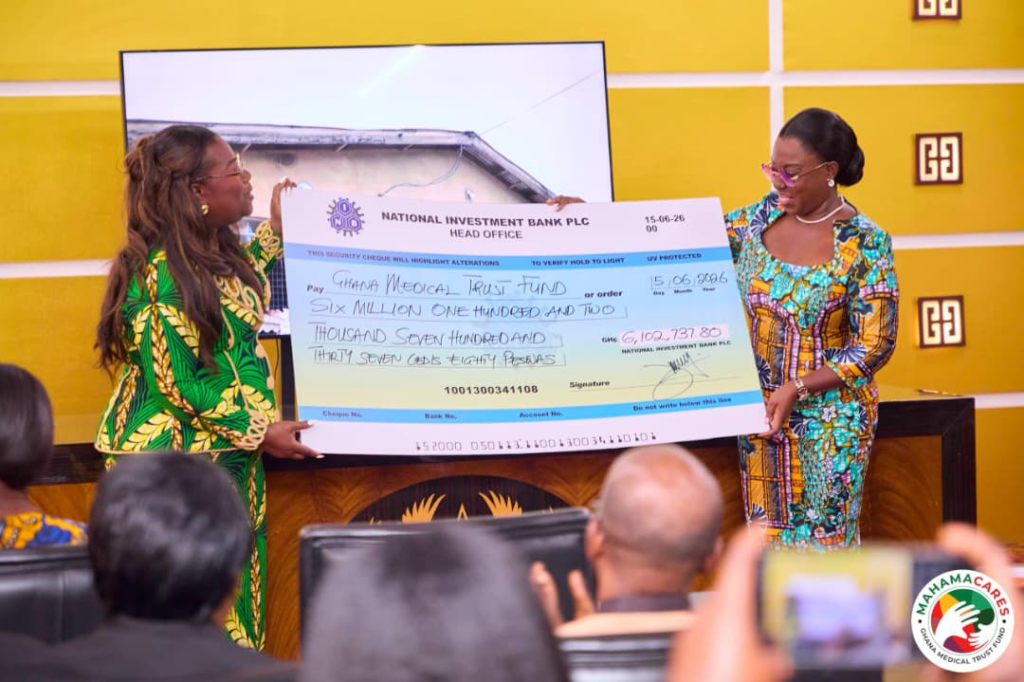
In a rare display of leadership by example, senior officials from Ghana’s Presidency have presented a GH¢6.1 million cheque to the National Medical Trust Fund, popularly known as Mahama Cares. The donation, made up of President John Mahama’s six months’ salary and one month’s salary contributions from presidential appointees and staffers, underscores a growing commitment to public service rooted in sacrifice rather than privilege—a stark contrast to the perception of governance as a path to personal enrichment.
The presentation, led by Deputy Chief of Staff Nana Oye Bampoe Addo, took place on June 15, 2026, at Jubilee House. Beyond the monetary value, the gesture carries profound symbolic weight in a nation grappling with uneven healthcare access, rising chronic disease burdens, and persistent inequities in medical resource distribution. As Bampoe Addo remarked during the ceremony, “Leadership is not a title; it is a disposition. It is the willingness to put your hand in your pocket when the country needs you. It is the recognition that public service, at its core, is about giving and not receiving.” This sentiment echoes a growing demand across Africa for leaders who prioritise communal welfare over individual gain.
The funds are earmarked to strengthen specialist healthcare delivery nationwide, with explicit plans to invest in cancer research, state-of-the-art medical equipment, and specialised training programmes for healthcare professionals. A key component of the initiative is the development of a digital platform designed to assist chronic-disease patients, particularly those suffering from diabetes, hypertension, and kidney ailments, by improving access to care, medication adherence, and remote monitoring. The government’s vision is ambitious yet specific: within the next five years, every region in Ghana will boast at least ten specialists capable of providing advanced care for people living with chronic diseases—a significant leap from the current concentration of specialists in urban centres like Accra and Kumasi.
This initiative aligns seamlessly with the administration’s broader Reset Agenda, a comprehensive drive to improve public services through personal sacrifice, institutional reform, and collective effort. By contributing from their own earnings, presidential staff are not merely funding a programme—they are reinforcing a foundational principle: that governance begins with accountability to the citizenry and that leaders must embody the values they seek to instill in society. As President Mahama noted in a separate address, “When leaders lead by sacrifice, they inspire a culture of responsibility that transcends political cycles.”
This initiative also complements domestic health efforts such as the [community-backed push for Ghana-made vaccines](/community-leaders-back-ghana-made-vaccines), which aims to strengthen national self-reliance in immunisation.
The donation arrives at a critical juncture for Ghana’s healthcare system. Non-communicable diseases (NCDs) such as cancer, diabetes, and hypertension are rising at an alarming rate, disproportionately affecting the poor and rural communities where access to specialised care remains limited. While the National Health Insurance Scheme (NHIS) covers essential consultations and basic medications, it often falls short in covering the high costs of chemotherapy, dialysis, or advanced surgical interventions. Consequently, many patients face catastrophic health expenses that push households into poverty—a reality the Medical Trust Fund aims to alleviate by targeting those who fall through the cracks of existing safety nets.
Interestingly, this move resonates with recent community-backed efforts to bolster local vaccine production, where Ghanaian leaders have endorsed self-reliance in immunisation as a cornerstone of health security. Both initiatives reflect a shared belief: sustainable health solutions must be rooted in domestic ownership, collective responsibility, and a rejection of aid dependency. As Dr. Anita Asamoah, a public health expert at the University of Ghana, observed, “When leaders invest their own resources into public health, it signals a commitment that goes beyond policy papers—it builds trust and encourages community participation.”
As the cheque changed hands amid applause from beneficiaries and healthcare workers, the message was unambiguous: true leadership is measured not in accolades or authority, but in the willingness to serve. In a political landscape often criticised for excess and opacity, this act of giving offers a refreshing counter-narrative—one where public office is seen not as an entitlement to wealth, but as an opportunity to give back to the nation that entrusted them with power. It remains to be seen whether this initiative will spark a broader culture of philanthropy among public officials, but for now, it stands as a testament to what is possible when leadership is rooted in empathy and sacrifice.
Image Source: MYJOYONLINE