Afari Military Hospital Left to Rot as Contractual Dispute Stalls Completion
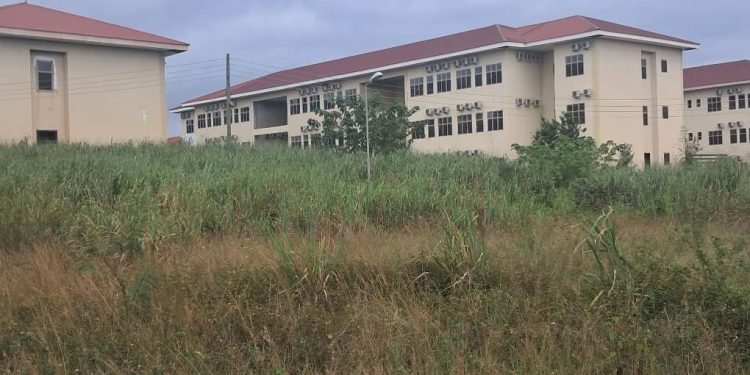
The abandoned Afari Military Hospital in Kumasi has become a symbol of unfinished ambition. During a visit by minority members of Parliament’s Select Committee on Health, the 500-bed facility stood overgrown with weeds, its offices colonised by reptiles, and bags of cement left to harden under the open sky.
Ranking member Nana Ayew Afriyie, who led the delegation to the Ashanti Region, used the visit to explain why the previous NPP government never operationalised the hospital despite years of construction. “We couldn’t complete it due to a contractual dispute,” Mr Afriyie said, adding context to what has become a recurring political accusation about abandoned health infrastructure.
The Afari Military Hospital, situated in the Atwima Nwabiagya district, was conceived over a decade ago as a major military and civilian healthcare facility. Construction progressed far enough to produce a structurally complete building, but the project stalled before equipment installation and commissioning could begin. Today, iron rods rust in the open air, and building materials have been claimed by algae and neglect.
The visit took a tense turn when soldiers guarding the abandoned facility confronted the MPs, questioning their authorisation to tour the site. The incident, though quickly resolved, underscored the sensitivity surrounding the project and the political stakes involved in its fate.
The minority MPs’ trip was framed as an audit of health facilities they say the Akufo-Addo administration initiated and substantially completed but that the current Mahama government has failed to operationalise. Their central demand is that President Mahama honour his stated commitment to completing existing health infrastructure before launching new projects.
This demand echoes a broader debate about healthcare infrastructure priorities in Ghana. The Health Committee Chair, Dr Mark Kurt Nawaane, previously accused the previous government of prioritising Agenda 111 over the Afari and Sewua hospitals, a charge that the NPP has consistently rejected.
The state of the Afari hospital is particularly painful given the chronic overcrowding at the Komfo Anokye Teaching Hospital, one of only two tertiary health facilities in the Ashanti Region. Former Presidential Advisor on Health Dr Anthony Nsiah-Asare has argued that Agenda 111 hospitals are ready for operation, but the Afari facility remains conspicuously absent from that conversation.
The visit also followed a recent industrial action by doctors at Komfo Anokye Teaching Hospital, a stoppage that highlighted the consequences of inadequate healthcare capacity in the region. Every day that Afari sits unused is a day that patients at overburdened facilities bear the cost of delayed investment.
Whether the contractual dispute that Mr Afriyie cited can be resolved, and whether the current government will allocate the resources needed to bring the hospital to operational status, remains unclear. What is certain is that the longer the facility remains dormant, the greater the deterioration — and the higher the eventual cost of completion.
Image Source: MYJOYONLINE