Health Committee Chair Accuses Previous Government of Prioritising Agenda 111 Over Afari, Sewua Hospitals
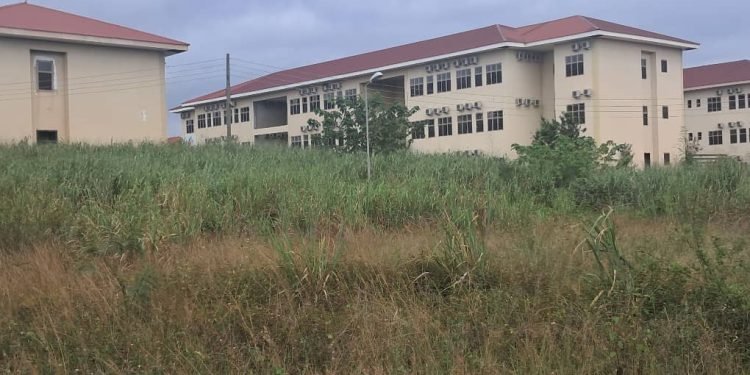
Chairman of Parliament’s Health Committee, Dr Mark Kurt Nawaane, has levelled a sharp accusation at the previous administration, alleging that the government deliberately deprioritised the completion of two critical hospital projects—the Afari Military Hospital in the Ashanti Region and the Sewua Regional Hospital—in favour of its flagship Agenda 111 initiative.
Dr Nawaane’s remarks, made during a parliamentary engagement on health infrastructure, have reignited debate over the strategic choices made under Ghana’s ambitious hospital-building programme, which aimed to construct 111 district and regional hospitals across the country.
A History of Delays
The Afari Military Hospital, located in the Atwima Nwabiagya District of the Ashanti Region, has been under construction for well over a decade. Originally conceived as a modern military medical facility to serve both armed forces personnel and civilians in the surrounding communities, the project has suffered repeated delays, funding shortfalls, and shifting government priorities. Similarly, the Sewua Regional Hospital—intended to ease the enormous pressure on the Komfo Anokye Teaching Hospital (KATH), which serves as the main referral centre for the northern sector of the country—has languished in various stages of incompletion.
According to Dr Nawaane, the previous government’s decision to channel substantial resources into the Agenda 111 programme came at the direct expense of these two projects, which were already at advanced stages of completion. “When you have hospitals that are 70 or 80 per cent complete and you divert funds to start entirely new projects across 111 districts, you are making a political choice, not a health one,” the Health Committee Chair argued.
The Agenda 111 Controversy
The Agenda 111 programme, launched under the Akufo-Addo administration, was one of the most ambitious health infrastructure projects in Ghana’s history. It promised the construction of 101 district hospitals, seven regional hospitals, two psychiatric hospitals, and the redevelopment of the Accra Psychiatric Hospital. However, the initiative attracted significant criticism from health policy analysts and opposition figures, who questioned the feasibility of simultaneously constructing so many facilities given Ghana’s fiscal constraints.
As of mid-2026, many of the Agenda 111 sites remain at varying stages of completion, with some barely past the foundation level. Critics argue that concentrating resources on a politically branded mega-project, while leaving near-complete hospitals to rot, represented a misallocation of public funds that has had real consequences for healthcare delivery.
Implications for Healthcare Access
The incomplete state of the Afari and Sewua hospitals has tangible public health consequences. The Ashanti Region, Ghana’s most populous, continues to face severe overcrowding at KATH, where patients routinely share beds and corridors are converted into makeshift wards. The Sewua Regional Hospital, had it been completed, would have significantly reduced this burden and brought specialist care closer to communities in the southern part of the region.
The Afari Military Hospital, meanwhile, was designed to serve as a critical healthcare hub for both military personnel and civilians in the peri-urban areas surrounding Kumasi. Its prolonged incompletion has left residents dependent on overstretched district health facilities and private clinics that many cannot afford.
The Mahama administration has signalled its intention to revisit stalled health infrastructure projects and prioritise completion over new starts. Dr Nawaane’s public critique appears aligned with that agenda, suggesting that the Health Committee will push for dedicated funding lines to bring the Afari and Sewua hospitals to operational status.
Whether the current government can deliver on that promise remains to be seen. But the central question Dr Nawaane has raised—whether Ghana should finish what it has started before embarking on new ventures—is one that resonates far beyond the walls of Parliament.
Image Source: MYJOYONLINE