We haven’t received any resignation letter from Carlos Queiroz — Sports Minister reveals
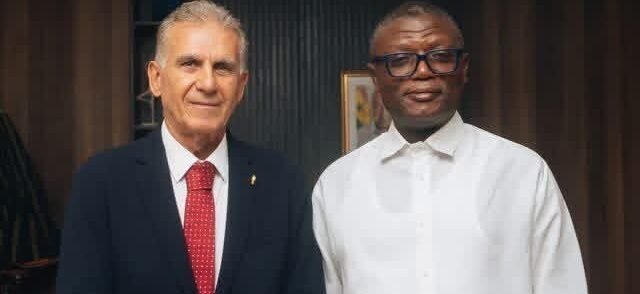
The recent statement by Ghana’s Minister for Sports and Recreation, Kofi Adams, regarding the status of Black Stars head coach Carlos Queiroz offers a refreshing reminder of due process in an era of instant reactions and social media verdicts.
In an interview with Joy FM’s News Night, Adams confirmed that his office has not received any formal resignation letter from the Portuguese coach, despite Queiroz’s evocative social media post suggesting the end of his tenure with the national team. The minister’s insistence that official communication, not social media speculation, should determine the coach’s future stands as a principled stance against the turbulent nature of modern sports discourse.
Queiroz’s message, shared across platforms, carried the weight of a valediction: he spoke of leaving “this journey with pride in what we achieved, but also with the healthy dissatisfaction of those who always wanted more.” Such language, while emotive, does not constitute a resignation under standard employment practices, particularly for a position of national significance appointed through formal channels. The minister’s refusal to interpret social media activity as an official employment decision reflects a commitment to procedural integrity that serves both institutional stability and individual fairness.
This approach is particularly significant in the context of Ghanaian football, where passionate fan engagement often blurs the lines between informed analysis and emotional reaction. By maintaining that decisions must be based on documented communication rather than viral posts, Adams establishes a boundary that protects the national team program from the whims of public sentiment that can change with a single update or tweet.
More substantively, Adams highlighted Queiroz’s own call for stronger off-field structures around the Black Stars—a point that transcends the immediate question of the coach’s future and touches on systemic challenges facing Ghanaian football. The Portuguese tactician argued that national team success cannot be built solely on pitch performance but must also encompass environments that prepare, protect, and develop football talent. This holistic view acknowledges that athletic achievement exists within a broader ecosystem that includes quality training facilities, effective administration, medical support, youth development programs, and coherent football philosophy.
Adams echoed this sentiment, noting that the future of Ghana’s football depends on both on-field performance and off-field structures. He anticipates that Queiroz will submit a comprehensive report detailing the team’s World Cup preparation, activities, and challenges—a document that could prove invaluable for future planning regardless of the coach’s ultimate decision. Such a report would not only evaluate tactical approaches but also assess logistical preparations, player welfare considerations, and the effectiveness of support systems during the tournament.
This episode raises broader questions about how sports institutions manage transitions in the digital age. When coaches communicate directly with fans via social media, bypassing traditional channels, it creates ambiguity that can destabilize teams and confuse supporters. Players may receive mixed messages about leadership continuity, while sponsors and partners might hesitate to commit long-term resources amid perceived instability. The minister’s insistence on formal processes provides stabilizing influences—documented communication, comprehensive reporting, and evidence-based decision-making—that can help maintain institutional coherence.
As Ghana reflects on its World Cup campaign and looks toward future competitions under whatever leadership emerges, the Queiroz situation presents an opportunity to strengthen institutional protocols. Clear guidelines for coach communications, standardized evaluation procedures that assess both technical and structural factors, and robust off-field development programs could help insulate the national team from the turbulence that often accompanies high-profile sporting endeavors. Establishing such frameworks would benefit not just the current situation but create lasting infrastructure for managing future transitions.
Beyond the immediate circumstances, this moment highlights a challenge facing sports administration across Africa: how to balance transparent communication with institutional stability in an era of ubiquitous social media. While direct athlete and coach engagement with fans can build valuable connections, it also risks undermining established hierarchies and creating parallel channels of information that may lack context or accuracy. Finding ways to harness the benefits of digital engagement while preserving the integrity of decision-making processes represents an ongoing challenge for sports organizations throughout the continent.
The minister’s measured response, prioritizing substance over spectacle, may well prove to be the more enduring legacy of this moment—not the resolution of one coach’s contract, but the reinforcement of how sports governance should function in an interconnected world where instant communication often outpaces thoughtful deliberation. In choosing to uphold procedural norms over reacting to social media narratives, Adams offers a model for how sports institutions can navigate the complexities of modern public engagement while maintaining their core missions.
Image Source: MYJOYONLINE