Black Stars exit from World Cup …fans blame technical team for team’s poor show
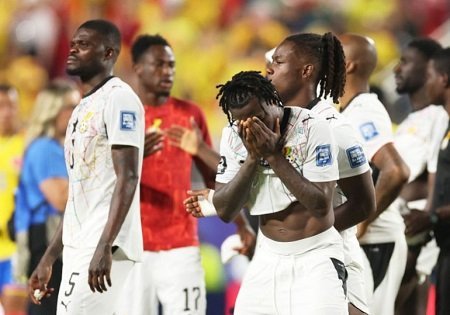
The Black Stars’ 2026 FIFA World Cup campaign ended in disappointment on Saturday as a narrow 1-0 defeat to Colombia in the Round of 32 extinguished Ghana’s hopes of progressing further in the tournament. The loss, witnessed by hundreds of frustrated fans at DABRONX Pub in Kasoa, sparked immediate calls for a thorough review of the national team’s preparations, selection, and tactics.
Supporters voiced their discontent, arguing that the technical team had failed to adequately prepare the squad for a disciplined and resolute Colombian side. Many pointed to questionable starting lineup decisions, suggesting that experienced players did not justify their inclusion. As one enthusiastic fan, Samuel Tetteh (known as Abaacha), observed, veteran performers such as captain Jordan Ayew underperformed, failing to influence the game as expected. He also criticized the team’s overly cautious approach, stating that Ghana played throughout the tournament as if afraid to lose rather than playing to win, lacking urgency, pressing, and attacking intent until falling behind.
Similar sentiments echoed at the Hi Touch Event Centre in Adade, where venue owner Uncle Attah placed direct responsibility on the coaching staff. “The coaches got the team selection wrong,” he remarked. “Colombia came with intensity, but we looked slow from the first whistle. We needed players prepared to fight for every ball.”
Despite the criticism, individual performances drew praise. Midfielder Thomas Partey was widely lauded for his leadership, composure, and experience, having carried the midfield almost single-handedly from the group stage to the Colombia game. Young prospect Caleb Yirenkyi earned commendation for his energy and composure whenever featured, while defenders Jonas Adjetey, Jerome Opoku, Marvin Senaya, and Gideon Mensah were noted for their commitment and consistency throughout the tournament.
However, fans also highlighted broader shortcomings: a lackluster attitude displayed by some players, who appeared too relaxed and struggled to maintain intensity; a dearth of creativity in attack, with the team relying too heavily on moments of individual brilliance rather than cohesive team play; and missed scoring opportunities that could have altered the outcome.
In the aftermath, supporters urged the Ghana Football Association to undertake a comprehensive review of the World Cup campaign. They called for an assessment of the technical team’s decisions, strengthened squad competition, and a selection process grounded in current form, commitment, and performance rather than reputation. Baba Adamu, also known as CRO, suggested the tournament should mark the beginning of a rebuilding process rather than another complete overhaul, advocating for retaining a core of quality players like Partey, Yirenkyi, Opoku, Senaya, and Mensah while integrating younger, hungrier talent.
Although the defeat ended Ghana’s World Cup journey, optimism remained among supporters that the lessons learned would help the Black Stars rebuild into a more competitive side capable of challenging the world’s best in future competitions. This perspective aligns with earlier analyses suggesting that Ghana’s recent World Cup exit was anticipated given recent performances, as discussed in [an assessment that the outcome was expected based on the team’s recent form]. Furthermore, the sports minister has since defended the technical team’s independence amid the fallout, emphasizing the importance of allowing coaches to operate without undue interference while acknowledging the need for continuous evaluation and improvement, as explored in [a recent discussion on the balance between accountability and autonomy in Ghanaian football leadership].
Image Source: GHANAIAN TIMES