England Injury Risk: Players Advised on Safe Celebrations
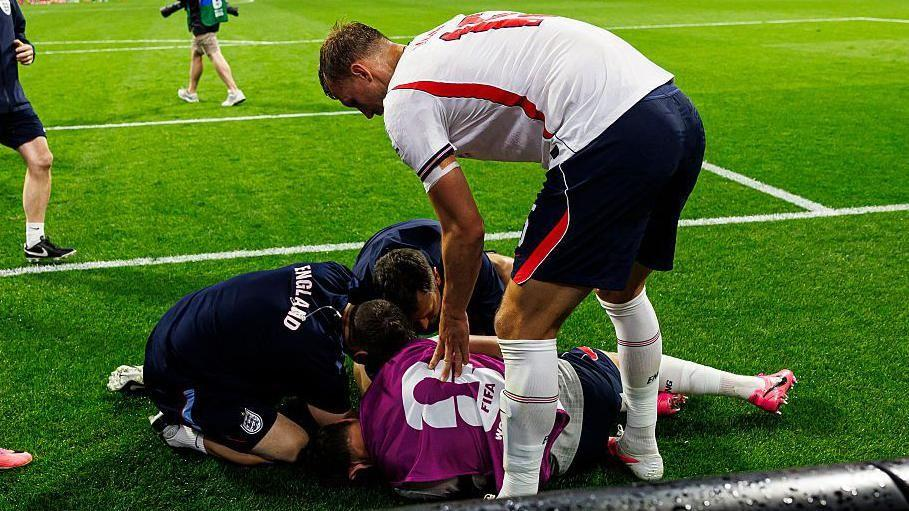
When Jordan Henderson landed awkwardly on his arm while attempting to hurdle an advertising hoarding during England’s celebrations after their 3-2 World Cup victory over Mexico, few could have anticipated that the incident would prompt a tactical reconsideration of how players celebrate victory. Yet that is precisely what has occurred, with England manager Thomas Tuchel reportedly preparing to instruct his players to avoid jumping over advertising hoardings in future celebrations.
The incident, which saw the 36-year-old Brentford midfielder stretchered off the field and subsequently hospitalized in Mexico City, appears to have resulted in a wrist injury requiring surgery. Henderson’s absence represents not just a personal blow to the experienced midfielder but a potential tactical disadvantage for England as they progress through the tournament. His absence from the squad’s return to their Kansas City base underscores the severity of the situation, with Henderson remaining under medical observation in Mexico City.
Tuchel’s reported reaction – describing the injury as “really bad” and noting that it “doesn’t fit the evening that Jordan is now not with us” – captures the bizarre juxtaposition of triumph and injury that characterizes such moments. The manager’s reported plan to address this specific celebration method reflects a growing awareness among elite sports teams that celebration rituals, while emotionally significant, carry inherent risks that professional organizations have a duty to mitigate.
This incident raises broader questions about the intersection of sport, commerce, and player welfare. Advertising hoardings, by their very nature, are designed to be immobile, rigid structures – the antithesis of what a celebrating athlete needs when attempting an acrobatic celebration. The commercial imperative that places these structures pitchside creates an inherent tension: the very elements that help fund modern football also present potential hazards to the athletes whose performances generate that value.
What makes this incident particularly noteworthy is how it illuminates the often-overlooked occupational hazards that exist beyond the obvious risks of collision and competition. Professional athletes routinely navigate environments filled with potential hazards – from rigid advertising boards and unforgiving concrete surfaces to the unpredictable elements of outdoor stadiums. While much attention is rightly directed toward on-field dangers such as concussions and muscular injuries, off-field celebration rituals represent a less studied but nonetheless real area of risk management.
The response from England’s management represents a pragmatic approach to risk mitigation. Rather than attempting to suppress the natural human impulse to celebrate victory – an impulse that serves important psychological and team-bonding functions – the focus is on modifying the specific behavior that led to injury. This approach acknowledges both the emotional legitimacy of celebration and the professional responsibility to protect player welfare.
As England prepares for subsequent matches in the tournament, the incident serves as a reminder that in elite sport, the margins between triumph and adversity can be extraordinarily narrow. A moment of collective joy can, in an instant, become a source of concern for medical staff and tactical planners alike. This dynamic is not unique to England’s campaign; other teams have faced similar challenges during this World Cup. For instance, Ghana’s Black Stars recently saw their own tournament hopes ended by a narrow defeat, prompting discussions about technical decisions and preparation. Similarly, the tournament has seen veteran players like Neymar confront potential international retirements after surprising results, highlighting how tournament outcomes can reshape national team futures.
The challenge for modern sports management lies not in eliminating risk entirely – an impossible task in any physical endeavor – but in intelligently managing those risks while preserving the essential human elements that make sport compelling. For Henderson, the immediate future involves medical assessment and potential surgery, with his tournament participation now in doubt. For England, the incident necessitates both tactical adjustment and a renewed focus on the seemingly mundane details that can, in high-stakes competition, prove unexpectedly significant. And for football more broadly, it offers a case study in how even the most joyous moments in sport require careful consideration of the environments in which they occur.