Takoradi Traders Trapped in Debt and Distress as Market Redevelopment Stalls
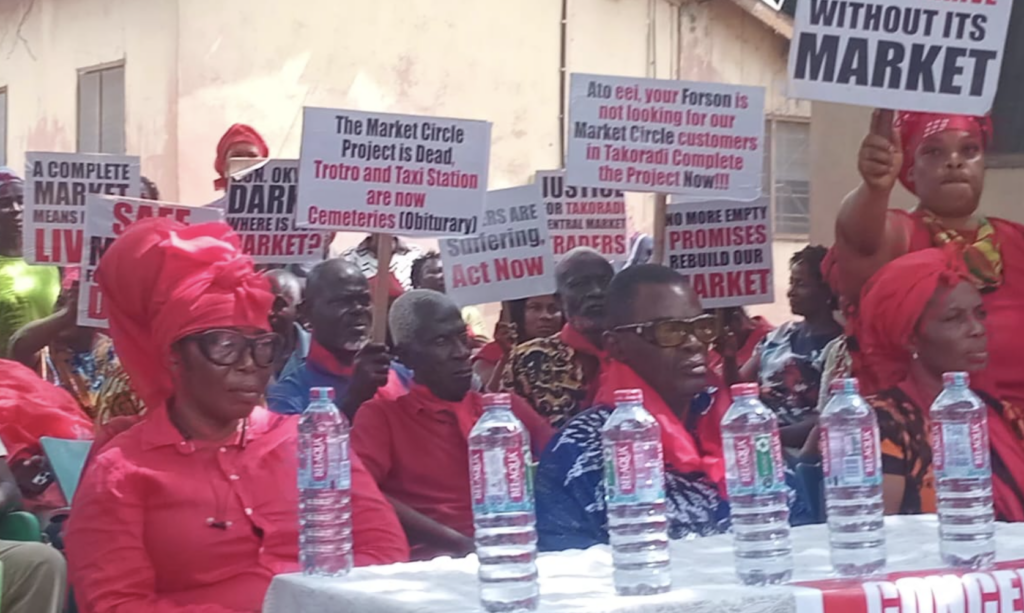
Takoradi’s market traders, displaced half a decade ago, find themselves ensnared in a cycle of debt and deteriorating health, prompting urgent calls for the government to complete the long-stalled redevelopment of their trading hub. The relocation of the market circle traders to a new site, intended to modernize the city’s commercial infrastructure, has instead precipitated a socio-economic crisis that threatens the livelihoods of hundreds of families and underscores the human cost of incomplete urban development projects.
Five years after their move, traders report a precipitous decline in patronage, translating into mounting debts that have pushed many into hypertension and depression, with some alleging that the stress has contributed to premature deaths. The situation has deteriorated to the point where traders have collectively resolved to withhold market tolls beginning July 1, 2026, and have organized protests to demand immediate government intervention.
Madam Lamisi Adam, speaking on behalf of the traders’ association, articulated the collective frustration with the perceived indifference of local authorities, the Member of Parliament for Takoradi, and traditional leaders. She highlighted the stark contrast between the neglected state of their current market and the concurrent progress on other commercial projects, including the construction of a 24-hour market elsewhere in the city. This disparity, she argued, has fostered a sense of abandonment among the traders, who feel their plight is overlooked despite their central role in Takoradi’s economy.
Beyond the immediate financial strain, leaking roofs, rampant theft, and inadequate security have further eroded their ability to conduct business. “Livelihoods, families and dependents and even transportation continue to feel the pinch of the delayed projects,” Adam lamented, encapsulating the systemic nature of the crisis that extends beyond individual vendors to affect entire households and the local transport network.
The traders’ ultimatum — to cease toll payments and embark on sustained protests — reflects a growing desperation born of years of unfulfilled promises. Their demand is clear: the government must prioritize the completion of the abandoned market project, which was intended to provide a safe, dignified, and commercially viable environment for Takoradi’s trading community.
This impasse is not merely a local grievance but a symptom of broader challenges in urban planning and execution. When infrastructure projects are initiated without adequate foresight into the socio-economic realities of the affected communities, the consequences can be severe and long-lasting, disrupting not only individual livelihoods but also the broader economic ecosystem that depends on market activity. The Takoradi market, historically a vital hub for the distribution of goods across the Western Region, plays a crucial role in the city’s revenue generation and employment. Its dysfunction has ripple effects that extend to transporters, suppliers, and ultimately, the cost of living for residents.
As Takoradi grapples with this dilemma, the resolution must balance the imperatives of urban development with the immediate needs of those whose daily survival depends on the market’s functionality. A timely intervention that addresses the structural deficiencies of the current site, while providing adequate compensation and support during the transition, could transform this crisis into an opportunity to build a more inclusive and resilient urban economy. Until then, the traders’ plight serves as a stark reminder that development, to be truly sustainable, must place people at its core.
Image Source: MYJOYONLINE