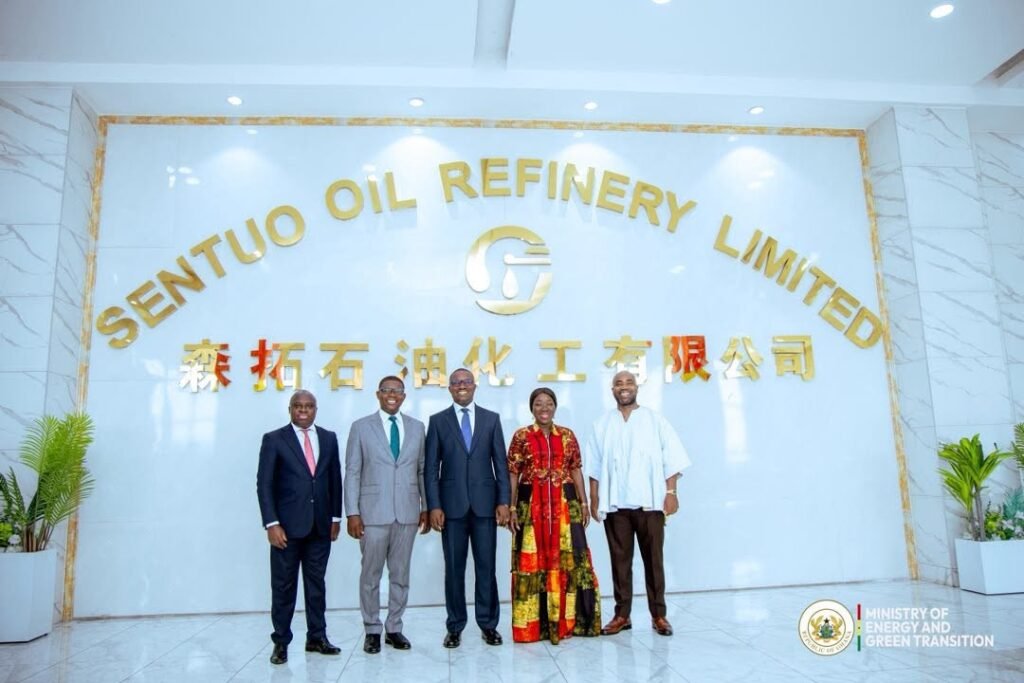
The Sentuo Oil Refinery is rapidly establishing itself as a cornerstone of Ghana’s downstream petroleum industry, following the delivery of locally produced Jubilee crude oil to the facility, according to Energy Minister Dr John Abdulai Jinapor.
Sharing the development on Facebook on Tuesday, June 9, the Minister said the refinery’s growing capacity demonstrates Ghana’s progress in building a stronger and more resilient petroleum sector capable of processing its own natural resources.
The delivery of Jubilee crude — extracted from Ghana’s flagship offshore oilfield — to a domestic refinery represents a significant step in the country’s efforts to capture greater value from its petroleum resources. Rather than exporting crude oil only to re-import it as refined products, Ghana is increasingly moving towards processing at home.
Dr Jinapor explained that the ability of local refineries to process Ghanaian crude oil represents a major advancement in reducing the country’s reliance on imported refined products while simultaneously supporting industrial growth and energy security.
The Minister noted that the latest crude oil delivery builds on earlier efforts to strengthen domestic refining capacity and follows a similar supply arrangement involving a local refinery in 2016. That earlier precedent, though limited in scope, laid the groundwork for the more ambitious approach now being pursued.
The Sentuo facility’s emergence comes alongside the resumption of operations at the state-owned Tema Oil Refinery, creating a dual-track refining landscape that could fundamentally alter Ghana’s petroleum supply dynamics. Together, these facilities have the potential to significantly reduce the country’s fuel import bill — a persistent drain on foreign reserves.
According to Dr Jinapor, the continued growth of facilities such as Sentuo Oil Refinery is helping position Ghana to capture greater value from its petroleum resources while supporting the government’s broader industrial transformation agenda.
For the broader business community, the implications are substantial. Reliable domestic fuel production can stabilise prices, reduce supply uncertainty, and create downstream opportunities in logistics, distribution, and petrochemicals.
However, challenges remain. Sustaining refinery operations requires consistent crude oil supply, competitive pricing, and the technical expertise to maintain complex processing equipment. The government’s commitment to supporting these facilities through policy and supply arrangements will be tested in the months ahead.
Image Source: MYJOYONLINE