Scholars Warn Africa’s Traditional Care Systems Are Disappearing — and the Consequences Could Be Severe
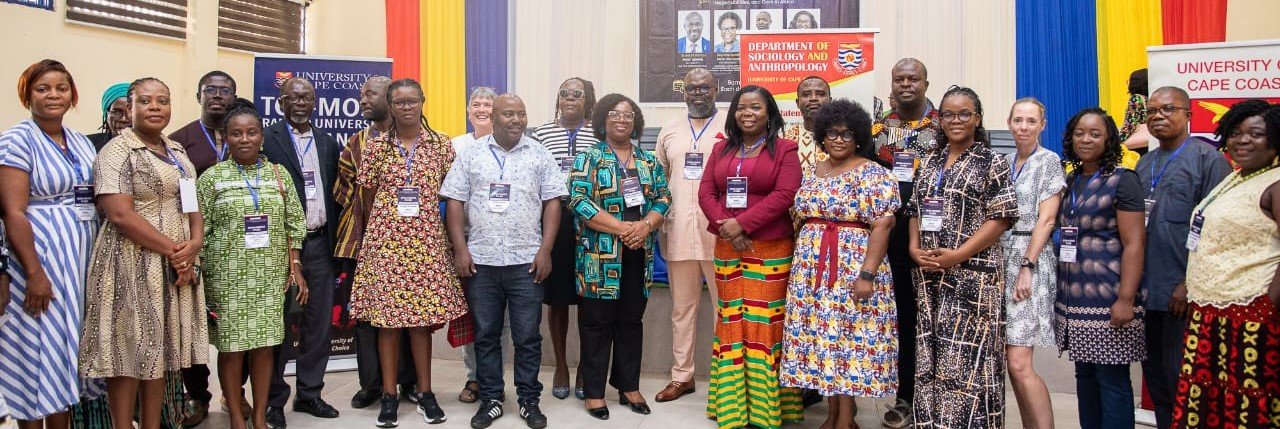
Africa’s communal caregiving traditions — the extended family networks, community support systems and intergenerational bonds that once ensured the young, the sick and the elderly were never left without care — are quietly eroding, and a growing chorus of academics and practitioners is warning that the consequences could be profound.
The alarm was raised at a two-day international conference on care organised by the Department of Sociology and Anthropology at the University of Cape Coast, in partnership with the Centre for the Advancement of Scholarship at the University of Pretoria. The gathering, held under the theme “Reimagining Care: Relationships, Responsibilities and Care in Africa,” brought together scholars from across the continent as part of a broader five-year research project funded by the Wellcome Trust.
Professor Georgina Yaa Oduro, Head of the Department of Sociology and Anthropology at UCC, described caregiving as an integral part of African society that had long been taken for granted. She pointed to the gradual erosion of Ghana’s extended family structure and the rise of nuclear family arrangements as developments that had weakened the foundation for caregiving and intergenerational bonds — changes driven largely by social upheaval and economic pressure, with technology filling the gaps that human connection once occupied.
“Caregiving remains largely undervalued because it is often unpaid and seen as an obligation of women rather than meaningful labour,” Professor Oduro said, highlighting a gender dimension that has received insufficient attention in mainstream policy discussions.
Invoking the Akan concept of Sankofa — the principle that looking to the past can guide positive progress in the future — she called for a return to communal living and shared responsibility. Care homes, she argued, could not replace the emotional connection and dignity that came with living among one’s family.
That view was echoed by Professor Rofela Combey, Provost of the College of Agriculture and Natural Sciences at UCC, who drew on her own experience of caring for her late parents. Although challenging, particularly as a career woman, she described it as profoundly fulfilling. “Reimagining care means recognising the weight and true worth of care,” she said. “When we distribute care equitably and invest in infrastructure, it becomes one of Africa’s greatest engines for human development.”
Professor Simon Mariwah, Dean of the Faculty of Social Sciences at UCC, offered a stark warning about the direction the continent is heading. “We used to have a situation where we cared for children, and the child did not necessarily have to be your own child. The entire family would rally around when somebody was sick, but now everybody is busy and engaged in different forms of work,” he said.
He cautioned against drifting towards Western-style institutional care homes where elderly people are left in the hands of strangers because relatives lack the time to care for them. “When you are sick and family members come around to support you, it is even part of the healing process. If we lose that, people may die earlier than they are supposed to because they do not have the emotional and social support they need,” he told delegates.
Professor Nolwazi Mkhwanazi, Professor of Anthropology and Director of the Centre for the Advancement of Scholarship at the University of Pretoria, stressed the importance of holding such academic discussions in Africa to enable local scholars to contribute to knowledge founded on African realities and experiences. She called for greater appreciation of everyday caregiving roles in African societies, noting that many acts of care were often overlooked despite their importance to families and communities.
Dr Saibu Mutaru, Senior Lecturer at UCC’s Department of Sociology and Anthropology and Chairman of the Local Organising Committee, framed the conference’s purpose plainly: “In many parts of the Western world, the dynamics of care have shifted towards institutional care homes. We do not want that to become the norm in Africa, and so there is the need to promote conversations around care within our families, communities and institutions.”
The conference is expected to produce recommendations to guide policy, academic research and social practices on caregiving across the continent. Similar gatherings have already been held in South Africa, Tanzania, Kenya and Zimbabwe as part of the broader Reimagining Reproduction research project.
Whether these academic conversations translate into tangible policy change is, of course, another matter. The forces driving the erosion of communal care — urbanisation, economic migration, the globalisation of Western social norms — are not easily reversed by conference resolutions. But the scholars gathered in Cape Coast made a compelling case that the stakes are too high for the conversation to remain confined to university halls. The wellbeing of Africa’s most vulnerable citizens — its children, its sick and its elderly — depends on whether the continent can find a way to modernise without sacrificing the communal bonds that have sustained it for generations.
Image Source: GHANA BUSINESS NEWS