Nigerian Politician Yakubu Adamu Claims a PhD From a University That Says It Does Not Award Degrees
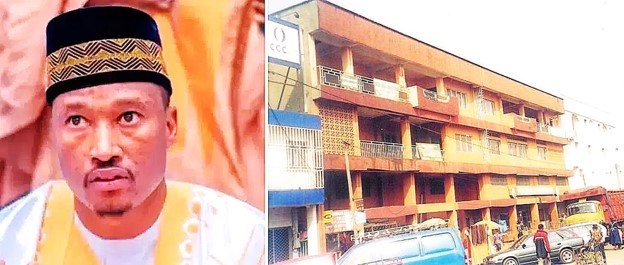
A Nigerian politician who styles himself as “Dr. Yakubu Adamu PhD” is facing serious questions about the authenticity of his doctoral credential after an investigation revealed that the Cameroonian institution he says awarded the degree has never been authorised to offer doctoral programmes and was shut down by regulators for issuing false diplomas.
Adamu, who served as Bauchi State Finance Commissioner and currently holds a political position in Nigeria, claims to have received his PhD from the International University of Bamenda (IUB) in Cameroon in 2020. But according to Cameroon’s Ministry of Higher Education (MINESUP), no private institution in the country is permitted to train students at the doctoral level.
“No private higher-education institution in Cameroon is authorised to deliver training at the doctorate level,” the ministry stated in an April 2026 press release, a position it has maintained since at least September 2024.
The investigation, conducted by Nigerian investigative outlet WikkiTimes, uncovered a web of irregularities that casts doubt not only on Adamu’s credential but on an entire network of questionable academic qualifications. Cameroon’s National Commission for Private Higher Education sanctioned IUB in 2024 for “issuance of false diplomas and refusal to compensate a learner,” ordering the institution closed for three years.
Adamu’s name does not appear on any of IUB’s published alumni lists, despite the institution maintaining a roster of 1,115 graduates—the overwhelming majority of them Nigerian, with a large share drawn from Bauchi State’s public sector. The thesis Adamu submitted was found to have matched a commercial project sold online, with plagiarism checks showing similarity scores of up to 91 per cent across multiple platforms.
Perhaps most striking is the revelation about Adamu’s alleged thesis supervisor. Alhaji Kawugana, the man Adamu names as having overseen his doctoral work, appears in IUB’s own records not as a faculty member or supervisor but as a registered doctoral student himself, with the registration number IUB/2014/2015/AKG/001. Kawugana confirmed supervising Adamu’s thesis “in accordance with the arrangements and academic procedures communicated to me by the institution,” but said he was unaware of any regulatory findings about IUB’s invalid doctoral authorisation.
Adamu ignored all outreach attempts from WikkiTimes, including emails, phone calls, and WhatsApp messages. The thesis itself was redacted by Adamu, who claimed it was “for internal use only,” preventing independent verification.
The case raises broader concerns about the integrity of academic credentials among public officials in West Africa. Since taking office, Adamu has published more than 20 academic papers, many in low-scrutiny journals that charge as little as $20 per article for rapid publication. IUB’s own digital footprint is inconsistent and difficult to verify: its website does not load, its social media presence is minimal, and its claimed founding year varies between 1990 on its website and 1981 on its Twitter account.
The investigation also highlights the vulnerability of cross-border academic verification in the region. IUB’s alumni roster is overwhelmingly Nigerian, yet the institution operates under Cameroonian jurisdiction where different regulatory standards apply. The gap between what Cameroon’s regulators permit and what Nigerian students believe they are receiving appears to have created an exploitable space for credential fraud.
For Ghana, which has invested heavily in strengthening its own higher education institutions and research capacity, the case serves as a cautionary tale about the importance of robust credential verification. President Mahama recently launched the Ghana National Research Fund with a mandate to produce research that creates jobs and informs policy—a vision that depends on the integrity of academic qualifications across the region.
As West African nations deepen their economic and political integration through frameworks like the African Continental Free Trade Area, the mutual recognition of academic qualifications will become an increasingly important issue. Cases like Adamu’s, where the institution itself denies the credential exists, underscore the need for stronger verification mechanisms and greater transparency in cross-border education.
Image Source: GHANA BUSINESS NEWS