Minority Demands Briefing on Ghanaians’ Evacuation from South Africa Amid Xenophobic Attacks
The Minority in Parliament has demanded an immediate briefing from Foreign Affairs Minister Samuel Okudzeto Ablakwa over reports of a government-sponsored evacuation of Ghanaian nationals from South Africa, following a wave of xenophobic violence that has targeted foreign nationals across the country.
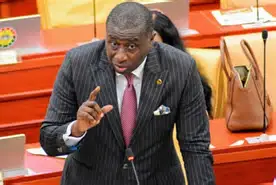
Patrick Yaw Boamah, a member of the Foreign Affairs Committee, made the call on the floor of Parliament, arguing that lawmakers must be fully apprised of the situation to prevent misinformation and ensure a coordinated diplomatic response. With an estimated 25,000 to 30,000 Ghanaians living in South Africa, the scale of the crisis demands parliamentary scrutiny, he said.
Evacuation Numbers Raise Questions
Central to the Minority’s concern is the gap between the number of Ghanaians registered for evacuation and those who have actually been repatriated. Mr Boamah revealed that while more than 1,500 nationals had registered, only approximately 300 had been evacuated.
“If you registered over 1,500 Ghanaians, and you’ve been able to evacuate only 300, what is happening to the rest of our nationals? What is going to happen with those who did not register?” he asked pointedly.
The questions come against the backdrop of a broader crisis in South Africa, where xenophobic attacks have intensified in recent weeks. The violence has drawn regional condemnation and raised alarm among African governments with large diaspora communities in the country. The situation carries echoes of earlier incidents in Johannesburg, where a mass shooting at an informal settlement recently claimed 12 lives, underscoring the volatile security environment facing both South Africans and foreign nationals.
Diplomatic Stakes at Play
Mr Boamah was careful to frame the issue within the broader context of Ghana-South Africa relations, which he described as bearing “enormous” diplomatic and economic significance. He pointed to the substantial investments South African companies have made in Ghana — including MTN, Stanbic Bank, and Gold Fields — as evidence of the relationship’s depth and the need to manage the current tensions carefully.
“Ghana and South Africa have enjoyed an enormous diplomatic relationship. Look at the investment South Africans have in Ghana — MTN, Stanbic Bank, a lot of investment, Gold Fields, and other companies, and what they’ve brought into this country in terms of jobs, in terms of revenue,” he said.
The Minority’s call also follows a pattern of parliamentary engagement on diaspora welfare issues. Members of the caucus have recently held discussions with Ghana’s High Commissioner to Canada on diaspora welfare and bilateral relations, signalling a broader push by the Minority to assert parliamentary oversight over the government’s handling of citizens abroad.
Conflicting Narratives
Adding complexity to the situation are apparent inconsistencies between statements from Ghanaian and South African officials. Mr Boamah noted that South Africa’s foreign minister has publicly disputed some of the claims made by his Ghanaian counterpart — a discrepancy he said could only be resolved through formal parliamentary engagement.
“If you listen to some of the press conferences by the South African foreign minister, he is not accepting what our Foreign Minister is putting out there. So it means there’s some issue that has to be addressed if the Foreign Minister appears and we ask him questions,” he stated.
Many Ghanaians in South Africa occupy senior positions across a range of institutions, including municipal administrations, the defence sector, and financial organisations — a fact that Mr Boamah said raises the stakes of the crisis beyond immediate humanitarian concerns.
With the situation approaching a month without a formal parliamentary briefing, the Minority is increasing pressure on the Speaker to summon the Foreign Affairs Minister. “We don’t want this situation to derail our relationship with South Africa,” Mr Boamah said. “So it’s very important that the Foreign Minister appears before the House.”
Image Source: MYJOYONLINE