KAIPTC Splits Research and Academic Units to Tackle West Africa’s Fast-Moving Security Landscape
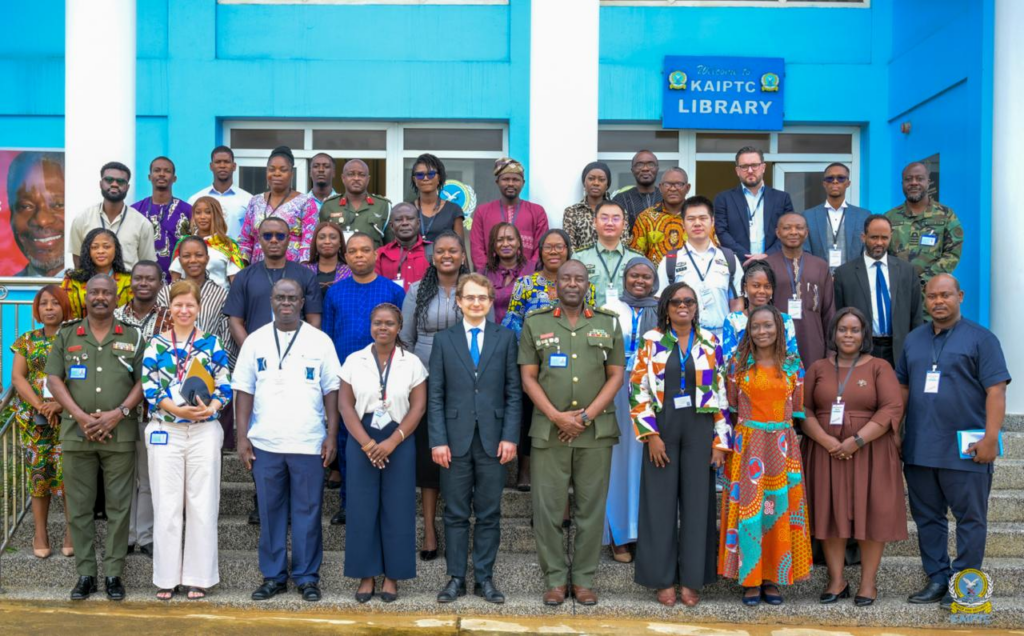
The Kofi Annan International Peacekeeping Training Centre has completed a major institutional restructuring, splitting its combined research and academic unit into two specialised bodies in what leaders describe as a necessary move to keep pace with the rapidly evolving security landscape across West Africa.
The reorganisation, announced during a Partners’ Meeting at the centre’s Accra campus on June 18, dissolves the former Faculty of Academic Affairs and Research and replaces it with a standalone Academic Faculty and a newly established Department of Applied Research and Innovation in Peace and Security, known by its acronym DARIPS.
Brigadier General Zibrim Ayorrogo, KAIPTC’s Deputy Commandant, said the decision was designed to sharpen the centre’s institutional focus and ensure that both its training programmes and research outputs are more responsive to the operational realities confronting governments, security agencies, and communities across the sub-region.
“The decision to separate FAAR into two specialised units was intended to sharpen institutional focus, enhance policy relevance, and improve the Centre’s ability to deliver both academic training and applied research in a more targeted manner,” Brig. Gen. Ayorrogo explained.
The restructuring is anchored in KAIPTC’s 2024-2028 Strategic Plan, which positions the centre as an ECOWAS Centre of Excellence for sustainable peace and security capacity building. It comes at a time when West Africa faces an increasingly complex web of threats, from the southward spread of violent extremist networks out of the Sahel to a wave of unconstitutional changes of government and deepening humanitarian crises.
DARIPS, which will serve as the centre’s primary engine for applied research and innovation, has been organised around four thematic programmes that mirror the multidimensional drivers of insecurity in the region. These are conflict, governance and leadership; technology and security; climate security and migration; and peace operations, stabilisation and peacebuilding.
Dr. Emma Birikorang, appointed as DARIPS’ founding Director, acknowledged that traditional research and training cycles have struggled to keep up with the speed at which threats are evolving. “These challenges are moving faster than our traditional research and training cycles have been able to keep up,” she observed.
The reorganisation reflects a broader trend in peace and security institutions across Africa, where the distinction between academic research and operational policy-making has become increasingly untenable. By creating a dedicated applied research department, KAIPTC is signalling that it intends to produce knowledge that can be translated directly into policy recommendations and field interventions, rather than remaining confined to academic journals.
The reforms were reviewed and discussed with a broad range of partners at the June 18 meeting, including representatives from the Government of Germany and the Deutsche Gesellschaft für Internationale Zusammenarbeit, which has been a long-standing facilitator of KAIPTC’s training and research activities.
KAIPTC’s leadership expressed optimism that the restructuring will lead to stronger alignment of strategic priorities, clearer delineation of partner roles, and more concrete collaboration on joint research initiatives in the months ahead. The centre’s Research Director has previously defended the split as essential to counter fast-moving threats that do not respect national borders or traditional institutional boundaries.
Image Source: MYJOYONLINE