Parliament Acts to Save Rubber Industry Amid Factory Closure Threat
Ghana’s rubber industry faces a significant crisis as the Ghana Rubber Estates Limited (GREL) warns it may be forced to shut down one of its two major processing factories by 2026 due to severe raw material shortages.
A Parliamentary Select Committee on Trade, Industry and Tourism, during a recent visit to the Western Region, heard that GREL’s factories, each capable of processing 10 tonnes of rubber per hour, are operating far below capacity. Production has plummeted, a situation management attributes to the large-scale export of raw rubber and the increasing devastation of rubber farmlands by illegal mining, locally known as ‘galamsey’.
The company has already scaled back operations, halting Saturday shifts in 2024 and reducing a three-shift system to two this year. If the supply of raw materials doesn’t improve, a complete factory closure looms, potentially rendering hundreds jobless.
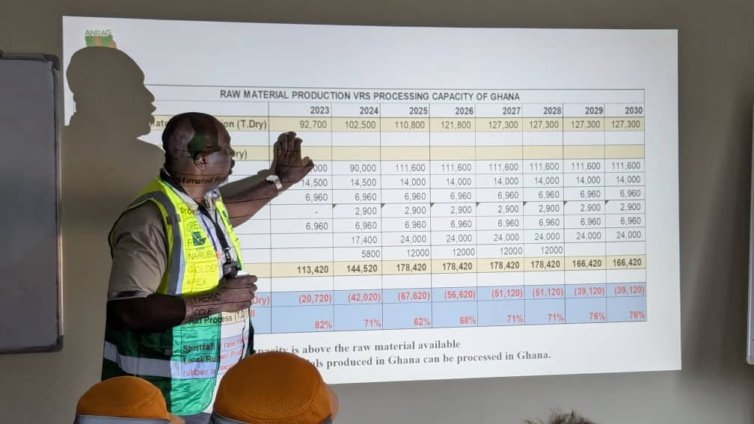
Perry Acheampong, Secretary of the Association of Natural Rubber Actors Ghana (ANRAG), lamented the industry’s decline. “The trend is collapsing the industry,” he stated, adding that Ghana produces approximately 110,000 tonnes of dry rubber annually, while its processing capacity is 178,000 tonnes.
According to data presented to the committee, GREL has processed only 54,297 tonnes as of September 2025. This shortfall is largely due to over 45% of raw rubber being exported, starving local factories of essential input. “When we export the raw rubber, we are exporting jobs, losing foreign exchange and government revenue,” Acheampong explained.
The impact on the workforce is already being felt, with a nearly 25% reduction in jobs within processing factories this year. Many workers, facing unemployment, are reportedly turning to illegal mining for survival.
Alexander Gabby Hottordze, Chairman of the Parliamentary Committee and MP for Central Tongu, described the situation as “alarming.” “Parliament is ready to support government’s decision to restrict the export of raw rubber in line with the 2026 Budget Statement,” he assured.
“This situation has a very negative impact on Ghana as a whole. It has led to job losses, and because people must survive, some are turning to illegal mining – something we do not want to hear of,” Hottordze added. He pledged close collaboration with the Ministries of Finance, Agriculture, and Trade and Industry to find an immediate solution.
During the site visit, GREL management showcased the underutilized processing plants. Officials highlighted how dwindling farm yields, exacerbated by illegal mining encroachment, are causing prolonged periods of machine inactivity. What was once a bustling, three-shift operation is now struggling to maintain even two shifts.
The Committee’s fact-finding mission revealed a broader chain reaction of economic and social risks. They warned that continued raw rubber exports could lead to the collapse of local processing companies, resulting in significant job losses and reduced income for communities reliant on the rubber value chain.
Furthermore, the committee anticipates a decline in foreign exchange earnings and government tax revenue. These economic pressures, they fear, could drive more unemployed youth towards illegal mining, intensifying the environmental damage in rubber-producing areas. “Ghana cannot allow raw rubber to leave the country unprocessed while factories, workers and communities suffer,” a committee member stated.
The team is expected to present its recommendations to Parliament in the coming weeks, advocating for urgent policy measures to safeguard the rubber value chain and restore economic stability to affected communities.
Image Source: MYJOYONLINE