Ghana’s Black Stars Arrive at World Cup 2026 Carrying Two Decades of Unfinished Business
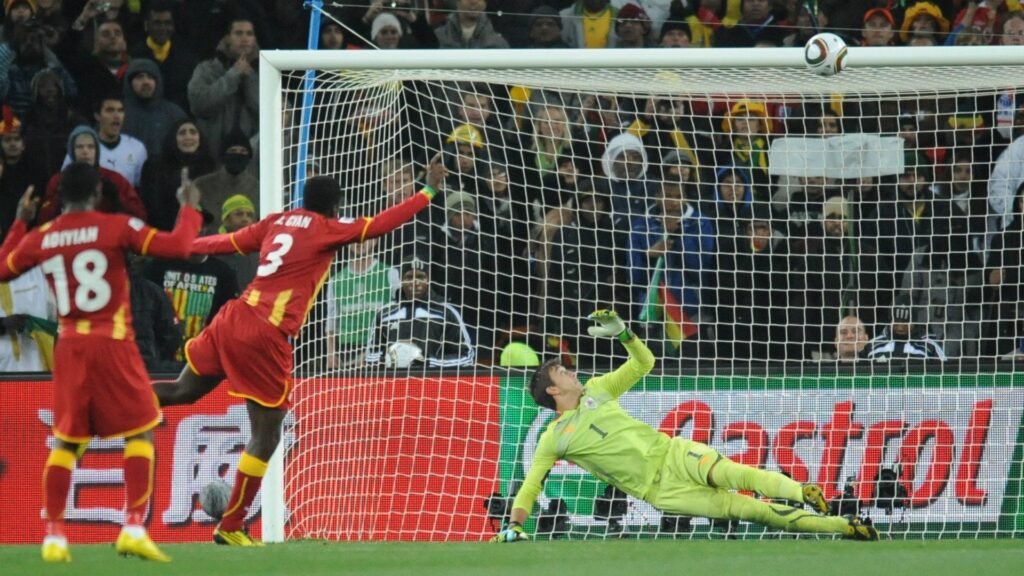
Twenty years after Asamoah Gyan chested down a through ball against the Czech Republic and fired past Petr Cech inside 68 seconds to score Ghana’s first-ever World Cup goal, the man who defined everything that followed will watch from the stands as an official ambassador. The generation that inherits his legacy arrives in the United States not as standard-bearers, but as a team still searching for the coherence that made 2010 feel like an arrival rather than an anomaly.
Ghana’s fifth World Cup campaign carries a weight that no tactical briefing can lift. The country that came within a penalty kick of becoming the first African nation to reach a World Cup semi-final has spent the sixteen years since that night in Johannesburg drifting through bonus disputes, coaching turnover, and performances that grew inconsistent, then predictable, then forgettable. The thread that connected the 2006 and 2010 squads — a shared purpose that transcended individual talent — has proven maddeningly difficult to reclaim.
A Squad Stripped by Injury
Before a ball was kicked in America, Ghana had already lost three automatic starters. Mohammed Kudus, the creative heartbeat who scored twice against South Korea in Qatar and sealed 2026 qualification, was ruled out by a quadriceps injury sustained in January that never healed. Mohammed Salisu suffered a ruptured ACL at Monaco. Alexander Djiku, the other half of the central defensive partnership that played every minute of Ghana’s three matches in Qatar, picked up a knock in Spartak Moscow’s Russian Cup final and never recovered.
Three players. Three different injuries. Three different months. The same result: Ghana arrives without their best creative player, without their starting centre-back partnership, and with a coach who has had less than two months to learn the names.
The Queiroz Appointment
The Ghana Football Association appointed Carlos Queiroz in April 2026 from a pool of over 600 candidates, a choice that signals a deliberate shift — less about inspiration, more about control. At 73, with five World Cups as a coach across Portugal, Iran, and other nations, Queiroz knows exactly what tournament football demands. His preference for compact systems suggests a Ghana side built on discipline and restraint, not because that is Ghana’s natural expression, but because it is the only responsible response to what the injuries have left him with.
Antoine Semenyo and Iñaki Williams now carry Ghana’s attacking ambitions. Jordan Ayew provides structure and leadership in the final third. Thomas Partey, whose visa complications for the Panama opener in Toronto have already generated diplomatic friction, still dictates tempo with authority when fully engaged. The Ghanaian government has also released over GH¢76 million to fund the Black Stars’ campaign, signalling the political stakes attached to the tournament.
Group L Offers Little Room for Error
Ghana’s group presents no soft landing. England and Croatia bring structure, experience, and tournament maturity. Panama, while less heralded, provides the kind of disciplined opposition that punishes hesitation. The opening match against Panama on June 17 in Toronto will define the campaign. A convincing result creates possibility. Anything less forces Ghana into chasing outcomes against opponents built to control games.
Then comes England on June 23 at Gillette Stadium in Massachusetts. Gyan acknowledged the weight of it clearly: “Ghanaians are optimistic, but there is pressure back home.” That sentence carries fourteen years.
Beyond the Crossbar
In Ghana, the national team has never been just a team. It is one of the country’s few shared languages. When the Black Stars play, daily life reorganises itself — markets close early, radios stay on longer, conversations narrow to a single subject. The disappointment of the past decade has not simply been about results. It has been about disconnection, a widening gap between what the Black Stars represent and what they deliver.
A strong performance in 2026 would not just restore credibility. It would re-establish meaning. You cannot judge a man for hitting a crossbar. You cannot judge a generation for coming closer than any African team had come before. What you can say is that the generation that followed never found the same coherence, the same collective belief, the same sense that something permanent was within reach.
On June 23, at Gillette Stadium, Ghana faces England. The crossbar will be in the room without being mentioned. And somewhere in the stands, the man who scored the first goal and missed the most important penalty in the country’s football history will watch a new generation attempt what he came agonisingly close to achieving — not to erase 2010, but to finally move beyond it.
Image Source: MYJOYONLINE