FWB trains stakeholders on sustainable fisheries amid threat
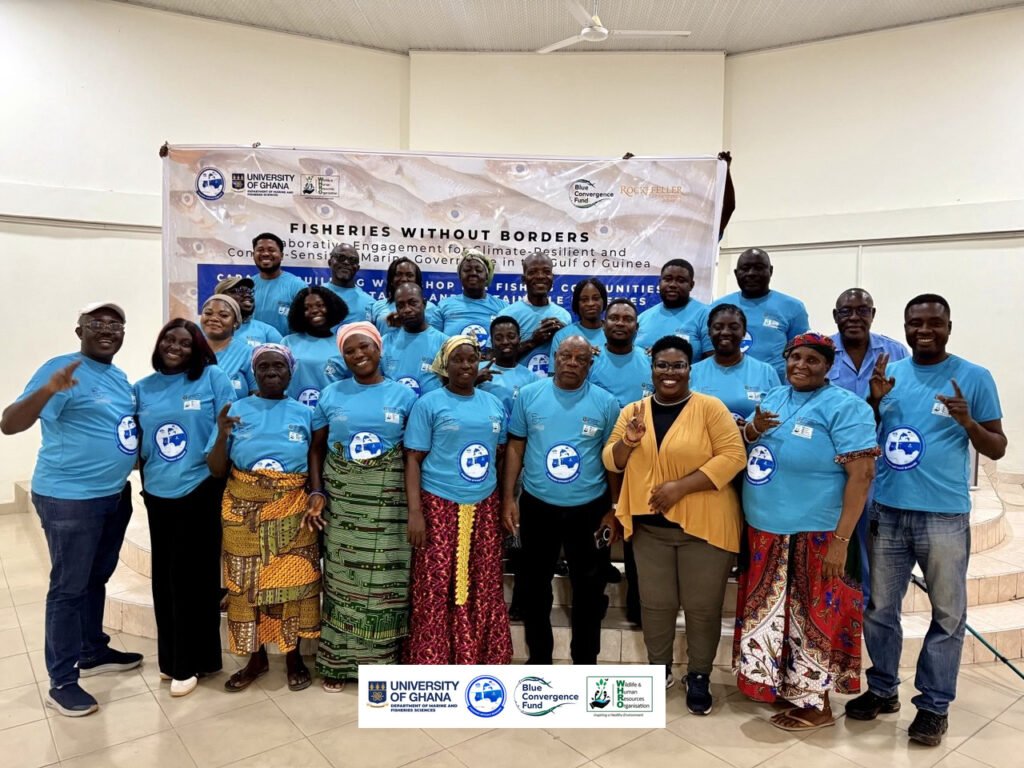
Fisheries Without Borders (FWB) recently convened a capacity‑building workshop in Ghana aimed at strengthening sustainable fisheries management in the face of mounting climate threats. Held at the Conference Hall of the National Fisheries Association of Ghana (NAFAG) on 3 July 2026, the event brought together fishermen, fish processors, community leaders and marine scientists from across Ghana’s coastal communities, alongside partners from Nigeria and Benin. The three‑country initiative seeks to address declining fish stocks in the Gulf of Guinea through collaborative fisheries management.
Over the past three decades, Ghana’s marine landings have fallen from roughly 900,000 tonnes to about 400,000 tonnes, a decline that threatens food security and the livelihoods of more than two million people who depend on the fisheries value chain. Fish supplies roughly 60 % of animal protein in many Ghanaian households, underscoring the sector’s importance to national nutrition.
Professor F.K.E. Nunoo, Ghana Country Lead for FWB and a faculty member at the University of Ghana’s Department of Marine and Fisheries Sciences, stressed that effective co‑management requires more than just institutional arrangements; it demands that fishing communities understand both the mechanics and the pitfalls of shared governance. “We need communities to understand what makes it work, and what makes it fail,” he said.
Dr Angela Lamptey, Senior Lecturer at the University of Ghana and Chairperson of the Scientific and Technical Committee of the Fisheries Commission, guided participants through topics including fisheries co‑management, ethical principles, rights‑based approaches, climate resilience and community governance. She emphasized that regulations are more effective when fishers help shape them, and that women and young people must have a seat at the decision‑making table. Lamptey also highlighted the enduring value of traditional knowledge held by elders and experienced fishers, arguing that it should complement scientific data in management plans.
The workshop examined how climate change is already reshaping Ghana’s fisheries. Experts noted that the ocean has absorbed more than 90 % of the excess heat generated by greenhouse‑gas emissions since industrialisation, triggering a cascade of impacts. Rising sea temperatures are pushing fish species farther offshore and into deeper waters, reducing accessibility for artisanal fishers who operate close to shore. Additional stresses — sea‑level rise, coastal erosion, flooding of fishing settlements, erratic rainfall patterns and toxic algal blooms — further erode the resilience of coastal communities.
Participants pointed out that fishing bans are sometimes introduced without adequate explanation, disproportionately affecting women processors whose livelihoods depend entirely on fish sales. They also raised concerns about weak enforcement of regulations once they are announced. Nana Jojo Solomon, President of NAFAG, urged attendees to disseminate the knowledge gained within their own communities.
The FWB project, funded by Rockefeller Philanthropy Advisors through the Blue Convergence Fund, runs until 2027 and includes parallel training programmes in Nigeria and Benin. Findings from the three countries will feed into a regional synthesis report and a cross‑border policy brief designed to improve fisheries governance across the Gulf of Guinea.
As the sea knows no borders, the workshop underscored a simple truth: sustainable fisheries management in the region can only succeed through cooperation among Ghana, Nigeria and Benin.