Free SHS: Education Minister Hails End of School Food Shortages
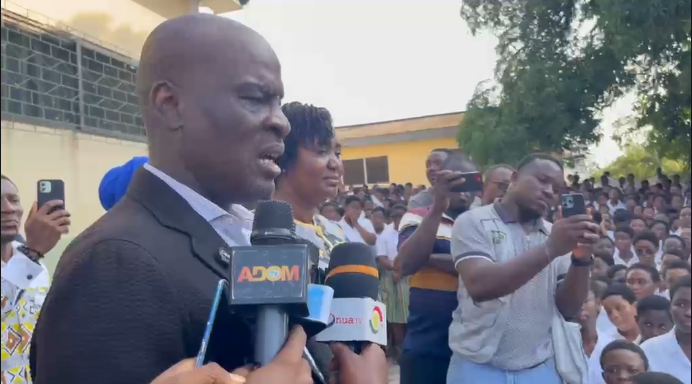
The Minister for Education, Haruna Iddrisu, has expressed satisfaction with improvements in Ghana’s school feeding programme, declaring that schools across the country are no longer experiencing the food shortages that plagued the sector in previous years.
Speaking on June 9 at Aburi Girls’ Senior High School, Mr Iddrisu described the turnaround as a significant achievement in the management of food supply under the Free Senior High School programme.
“I’m also happy to note that at least for the first time in many years we are not suffering from food shortages in school,” the Minister stated.
He attributed the improvement to the government’s decision to decap the Ghana Education Trust Fund (GETFund), a move he said had strengthened the financing of school feeding operations through the Ghana Commodity Exchange and the Buffer Stock Company.
“Thanks to the de-capping of the GETFund, the GETFund through Ghana Commodity Exchange and the Buffer Stock is adequately making sufficient provisions for food,” Mr Iddrisu explained, adding that the feeding component of the Free SHS programme is now being more effectively managed through sustained GETFund support.
The government has allocated GH₵4 billion this year specifically to cater to school feeding across the country, a figure that underscores the scale of investment required to sustain the programme that has expanded access to secondary education for hundreds of thousands of Ghanaian students.
“This year alone, we allocated four billion Ghana cedis to take care of your feeding across the country,” the Minister said.
The announcement will come as relief to parents, students and school administrators who have in past academic terms endured weeks of disrupted meals, sometimes forcing schools to send students home or rely on emergency supplies. Food shortages under the Free SHS programme have been one of the most persistent criticisms levelled against the policy’s implementation.
Beyond feeding, Mr Iddrisu also unveiled ambitious plans for educational infrastructure expansion. He disclosed that the World Bank is expected to consider approval for a major infrastructure initiative on June 16, involving a US$300 million investment to upgrade schools across the country.
Under the proposed programme, 30 Category C schools would be upgraded to Category B, while 20 Category B schools would be elevated to Category A. Category A schools would also receive additional infrastructure support.
“We intend to convert 30 category C schools to B and 20 category B schools to A with 300 million U.S. dollars for expanded infrastructure across the country,” the Minister said.
The planned upgrades represent a significant step in addressing the chronic infrastructure deficit that has long constrained the quality of secondary education in Ghana. For years, overcrowding in classrooms, inadequate dormitory space and limited laboratory facilities have been cited as factors undermining learning outcomes, even as enrolment numbers have surged under the Free SHS policy.
Mr Iddrisu commended the leadership of Aburi Girls’ School, particularly the headmistress, for her role in maintaining discipline and supporting academic development, suggesting the school as a model for others to emulate.
Image Source: MYJOYONLINE