Bank of Ghana Urges Journalists to Combat Misinformation and Strengthen Economic Reporting
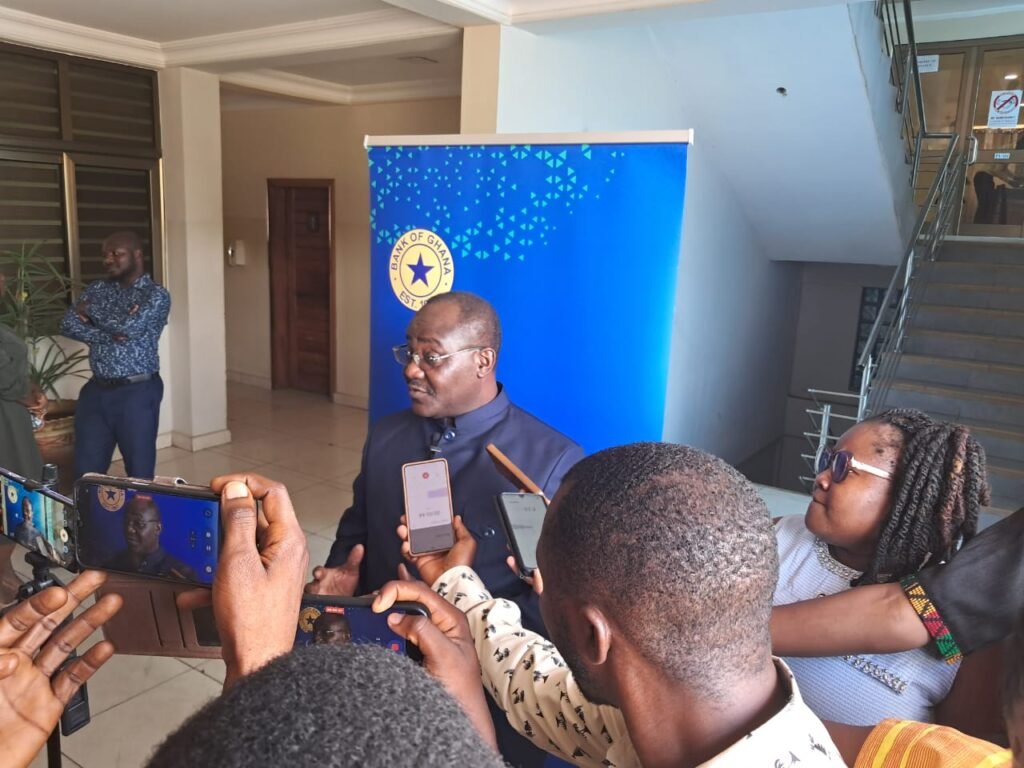
The Bank of Ghana has issued a pointed appeal to the country’s media professionals, warning that misinformation and disinformation about economic policy pose a growing threat to public confidence and market stability.
Bernard Otabil, the central bank’s Director of Communications, told journalists gathered in Koforidua for a three-day capacity-building programme that false narratives about monetary policy can trigger panic-driven behaviour with real economic consequences.
“If you ask me what keeps me awake at night as Communications Director, I will tell you it is misinformation and disinformation,” Otabil said. “Every day, we find ourselves correcting false narratives and fake news that can mislead the public and undermine confidence in the economy.”
The training programme, sponsored by Governor Dr Johnson Pandit Asiama, brought together journalists from the Central, Volta, Eastern and Ashanti regions. Sessions covered monetary policy transmission mechanisms, banking sector operations, financial market dynamics, exchange-rate behaviour and ethical journalism practices.
Otabil’s warning was blunt in its specificity. When people hear unverified reports suggesting the cedi will sharply depreciate, he explained, they rush to buy and hold foreign currency. When that behaviour is repeated across a population, individual decisions become collective panic, creating pressure on the market and affecting the wider economy.
The appeal comes against a backdrop of cautiously encouraging economic indicators. The Composite Index of Economic Activity recorded 12.6 per cent growth in March 2026, inflation stood at 13.7 per cent, and gross international reserves reached approximately US$14.4 billion—a buffer the central bank considers strong enough to absorb external shocks.
Yet the Bank of Ghana appears to recognise that positive data alone cannot sustain public confidence if the narrative around it is distorted. “How economic policies are understood, debated and reported ultimately shapes public confidence, investor sentiment and behaviour in the real sector,” Otabil told participants. “That is why the Bank of Ghana values partnerships such as this.”
The central bank’s frustration with misinformation is not new, but the decision to invest in journalist training suggests a strategic shift—from reactive correction to proactive capacity-building. Rather than merely rebutting false claims after they circulate, the bank is attempting to equip reporters with the knowledge to produce accurate, contextual coverage from the outset.
Otabil urged journalists to verify information rigorously before publishing, avoid sensationalism and headline-only reporting, provide context that explains the human impact behind statistics, and highlight opportunities in sectors such as agriculture, manufacturing and exports rather than dwelling exclusively on challenges.
“Numbers alone do not tell the full story,” he said. “Behind every statistic are people, livelihoods and businesses. The role of the media is to explain how policy decisions affect access to credit, the cost of doing business, employment and household welfare.”
The initiative reflects a broader tension in Ghana’s economic communication landscape. Central banks worldwide face the challenge of maintaining credibility in an era of rapid information flow, where social media can amplify unverified claims faster than official institutions can respond. For Ghana, where mobile penetration is high and digital news consumption is rising, the stakes are particularly acute.
Whether the training programme translates into measurably improved economic coverage remains to be seen. But the Bank of Ghana’s willingness to open its institutional doors to journalists—rather than simply issuing press releases from behind them—marks a notable step in the right direction.
Image Source: MYJOYONLINE