Sogakope Residents Storm ECG Office Over Alleged Overbilling and Poor Service Delivery
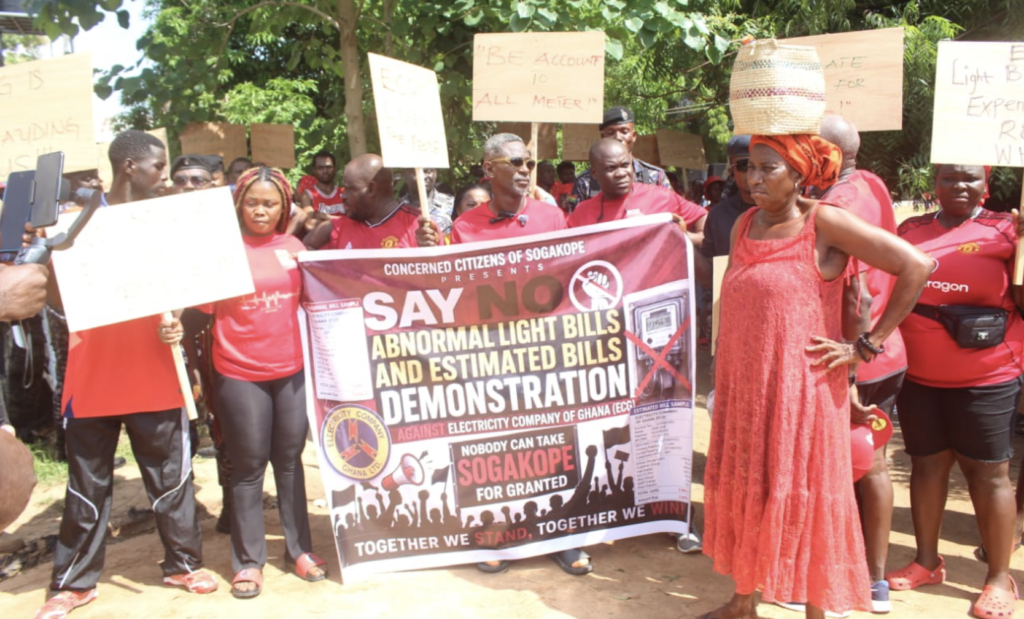
More than 200 residents of Sogakope in the South Tongu District of the Volta Region marched through the town’s principal streets on Friday before converging on the district office of the Electricity Company of Ghana, delivering a blunt message: years of alleged overbilling, estimated metering, and indifferent customer service have exhausted the community’s patience.
The demonstration, organised by the Concerned Citizens of Sogakope, saw residents clad in red and black attire carry placards with inscriptions such as “ECG is exploiting us,” “Stop the abnormal light bills now,” and “We need correct readings for every meter.” The protest was conducted peacefully under heavy security, with more than 50 police officers deployed for traffic management and crowd control.
Bills That Defy Explanation
The residents’ grievances centre on a pattern they describe as systemic. Electricity bills that previously ranged between GHS150 and GHS300 have, in some cases, surged to between GHS2,000 and GHS4,000, with others reportedly receiving bills exceeding GHS10,000. The protesters attribute these increases to estimated billing systems that impose charges based on consumption projections rather than actual meter readings.
The distinction between estimated and actual billing has become a flashpoint for electricity consumers across Ghana. Under estimated billing, ECG calculates charges based on historical usage patterns rather than real-time meter data, a practice the company has attributed to staffing shortages and faulty meters. For consumers, however, the result is bills that bear little resemblance to actual consumption and a dispute resolution process that many describe as slow and opaque.
A Petition and an Ultimatum
Bernard Cudjoe, spokesperson for the Concerned Citizens of Sogakope, presented a formal petition to Mawunyo Kudzo Akwetey, the Sogakope District Manager of ECG. The petition outlined demands including accurate billing based on actual meter readings, timely communication on planned and unplanned outages, prompt resolution of customer complaints, improved customer service, faster replacement of faulty meters, and fair disconnection and reconnection procedures.
The group gave ECG a three-month ultimatum to address the concerns raised, warning that failure to respond could trigger further demonstrations. Cudjoe was clear about the stakes: “Consumers deserve accurate billing, quality service and prompt resolution of complaints. We are demanding fairness, transparency and accountability from ECG.”
A Familiar Pattern
The Sogakope protest is not an isolated incident. Similar complaints about ECG’s billing practices have surfaced in communities across the country, reflecting a deeper tension between the utility’s operational challenges and the expectations of consumers who depend on reliable and affordable electricity. The company’s infrastructure, much of it ageing, struggles to keep pace with demand in rapidly growing communities, and the gap between service delivery and public expectation continues to widen.
Energy infrastructure reliability has been a persistent concern elsewhere in the country as well. The recent fire at the GRIDCo Power Station in Techiman underscored the fragility of the systems that underpin Ghana’s power supply, reminding consumers and officials alike that the challenges extend well beyond billing disputes.
Whether ECG’s district management can respond meaningfully within the three-month window will depend on resources, institutional will, and a willingness to engage with a community that has made clear it will not accept the status quo indefinitely.
Image Source: MYJOYONLINE