Obuobia Darko-Opoku to Champion Sustainable Financing for Specialised Healthcare at Ghana–UK Investment Summit 2026
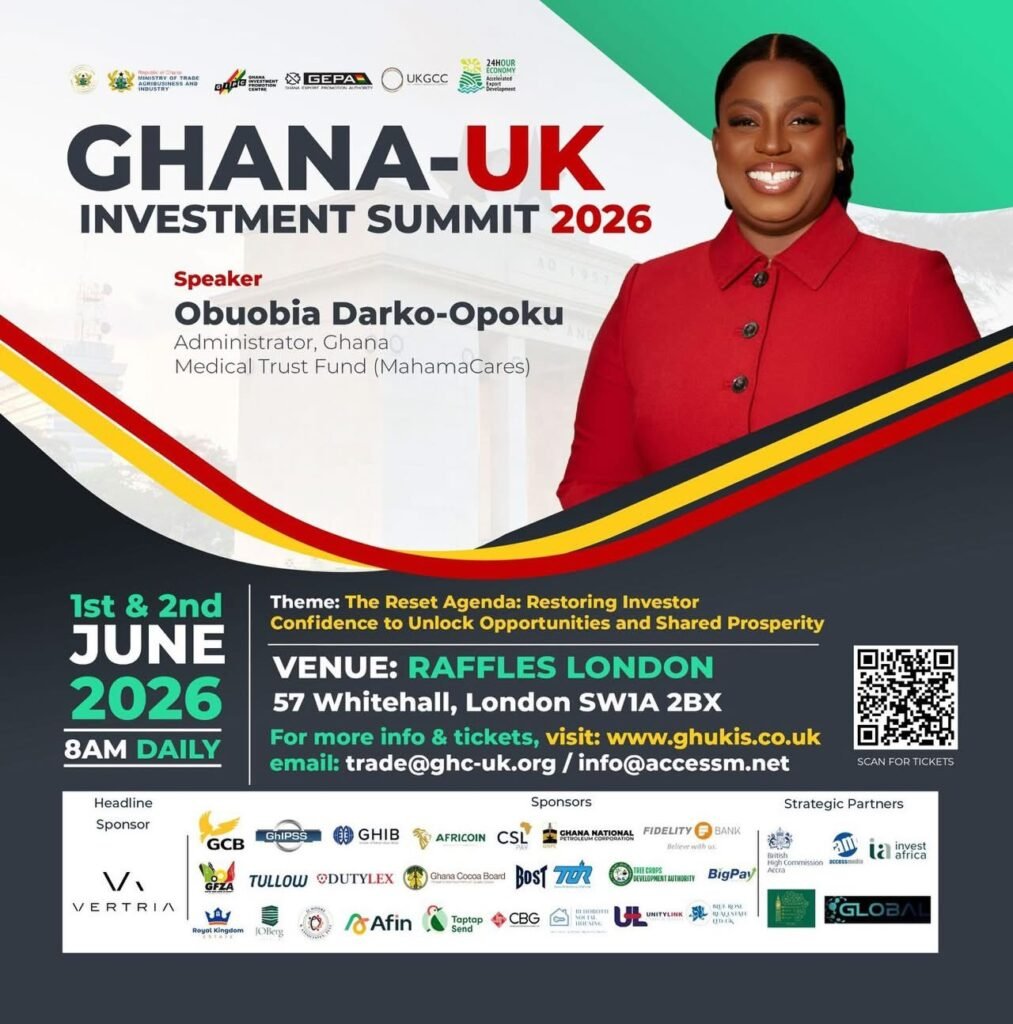
The Administrator of the Ghana Medical Trust Fund, Obuobia Darko-Opoku, is set to take centre stage at the Ghana–UK Investment Summit 2026, where she will advocate for increased and sustainable financing for specialised healthcare, with a particular focus on the treatment of non-communicable diseases (NCDs).
The two-day summit, which brings together investors, policymakers, business leaders and development partners from both countries, represents a critical opportunity to bridge the financing gap that continues to hamper Ghana’s ability to deliver world-class specialist medical care to its citizens.
Darko-Opoku’s participation signals the growing recognition that healthcare financing in Ghana cannot rely solely on government budgetary allocations and donor support. The Ghana Medical Trust Fund, which she administers, was established to provide financial support for Ghanaians requiring specialised medical treatment — a mandate that has become increasingly urgent as the burden of non-communicable diseases continues to rise across the country.
Non-communicable diseases, including cancers, cardiovascular conditions, diabetes and chronic respiratory illnesses, now account for a significant and growing share of Ghana’s disease burden. Yet the country’s healthcare infrastructure remains largely configured to address infectious diseases and maternal health, leaving a substantial gap in specialist care capacity.
The financing challenge is stark. Ghana’s health expenditure as a proportion of GDP has historically lagged behind the Abuja Declaration target of 15 per cent, and out-of-pocket payments continue to account for a disproportionate share of total health spending. For patients requiring specialised treatment — many of whom must travel abroad for care — the financial burden can be devastating.
At the summit, Darko-Opoku is expected to make the case for innovative financing mechanisms that could unlock private capital for healthcare infrastructure development. These include blended finance models, social impact bonds and public-private partnerships that have shown promise in other developing economies.
Ghana has been strengthening its international health partnerships in recent months. The country recently deployed 400 nurses to Jamaica under a bilateral health agreement, demonstrating both the quality of Ghanaian healthcare professionals and the potential for health sector collaboration across borders.
The summit also comes at a time when the government has been making targeted investments in healthcare infrastructure. The Ministry of Health recently received a donation of advanced bedside pulse oximeters valued at more than $100,000 to bolster the free primary healthcare programme, reflecting a broader push to strengthen the health system from the ground up.
For Darko-Opoku, the pitch at the Ghana–UK Investment Summit is straightforward: Ghana’s healthcare sector offers both a compelling social investment case and a viable commercial opportunity. With a young and growing population, rising incomes and increasing health awareness, the demand for quality specialist care will only intensify in the coming decades.
The question, as she will put it to investors and development partners in London, is not whether Ghana needs better specialised healthcare — it is how to mobilise the capital and expertise to deliver it sustainably.
Image Source: MYJOYONLINE