Ageing Fire Tenders and Missing Hydrants Cripple Emergency Response in Tema Region
The Ghana National Fire Service in the Tema Region is sounding the alarm over a mounting crisis that threatens to undermine its ability to respond to emergencies: a fleet of fire tenders that has long outlived its usefulness, a near-total absence of functional fire hydrants across the industrial enclave, and road infrastructure so poor that response times routinely triple international benchmarks.
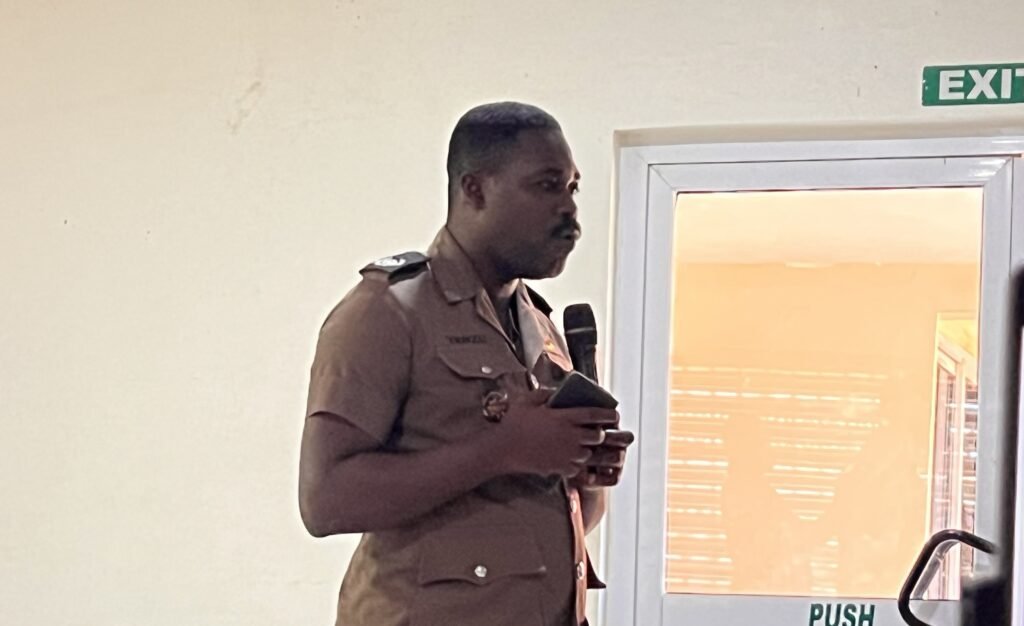
Divisional Officer Grade II Ebenezer Yenzu, the Tema Regional Public Relations Officer of the GNFS, laid bare the scale of the problem at an intersectoral review meeting organised by the Kpone-Katamanso Municipal Assembly. The region last received a major allocation of fire tenders roughly 15 years ago, he said — well beyond the five-year operational lifespan that international standards mandate before vehicles should be replaced or completely re-engined.
The consequences of that neglect are not abstract. During a recent fire outbreak in Prampram, six fire tenders were dispatched to the scene. Four broke down with mechanical faults before operations were completed, leaving just two functional vehicles to battle the blaze. The Service was forced to call in private water tankers to keep firefighting efforts going and prevent the fire from spreading further.
The problem extends well beyond ageing vehicles. The industrial zone within the Tema Region has no active fire hydrants, a deficiency that forces fire crews to improvise with alternative water sources during emergencies — a situation that introduces dangerous delays when every minute counts. The GNFS has repeatedly appealed to Ghana Water Limited to install functional hydrants in strategic locations, but progress has been slow.
Road conditions compound the equipment shortfall. International benchmarks recommend emergency response times of eight minutes or less. In the Tema Region, reinforcement crews travelling from Katamanso to Akuse can spend upwards of 30 minutes on the road, hampered by poor surfaces and chronic traffic congestion. When nearby stations experience their own mechanical breakdowns, tenders must be dispatched from even more distant locations, further stretching response times.
Despite the severity of these operational constraints, the GNFS has found some cause for encouragement. Of the 318 fire incidents recorded in the region during the first quarter of 2026, 126 — roughly 40 per cent — were extinguished by community members before firefighters arrived on the scene. Officials attribute this to sustained public education and community sensitisation campaigns that are teaching residents to identify and respond to fires at their earliest stages.
The figure is a reminder that public awareness can serve as a force multiplier in the absence of adequate equipment. But it is no substitute for functional infrastructure. A community that extinguishes a kitchen fire before the engines arrive is one thing; an industrial blaze or a multi-storey building fire is quite another.
The GNFS has urged residents in the Tema Region to contact the Tema Regional Control Room directly during fire outbreaks via the emergency line 0303 202 554, bypassing national call-routing systems that can introduce additional delays. It is a practical measure, but one that underscores a broader truth: when the systems meant to protect citizens are themselves in need of rescue, the burden falls disproportionately on the communities least equipped to bear it.
Image Source: MYJOYONLINE