US, UK and Australia to Develop Underwater Drone Technology Under Aukus Defence Pact
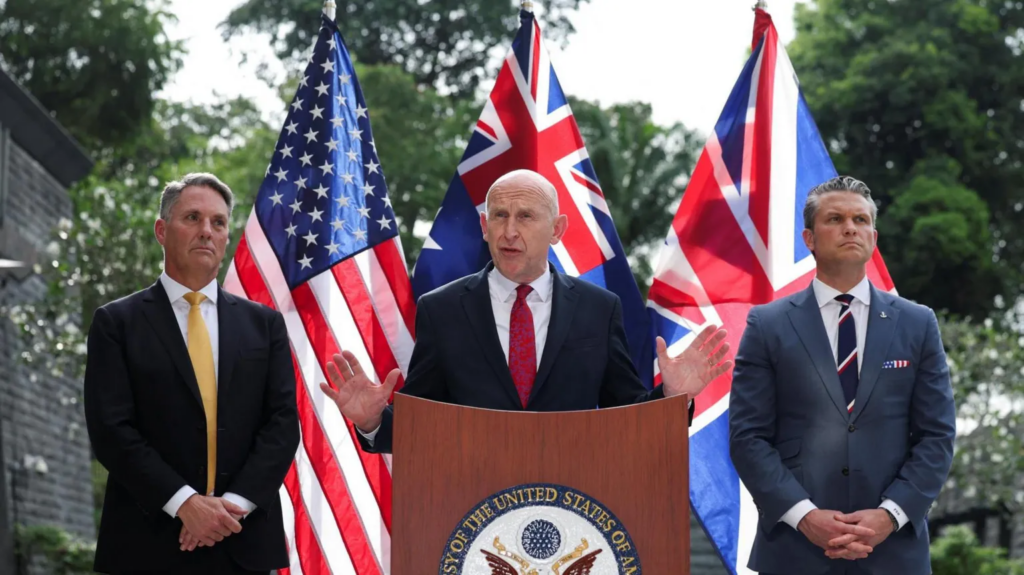
The United States, United Kingdom and Australia have announced a joint programme to develop uncrewed undersea vehicles, a move that marks the first major project under the advanced-technology pillar of their Aukus military alliance and signals an escalating commitment to protecting seabed infrastructure from sabotage.
The announcement came on Saturday at the Shangri-La Dialogue security summit in Singapore, where the three countries’ defence ministers unveiled plans for what they described as cutting-edge underwater drones capable of protecting undersea cables and pipelines, conducting surveillance and reconnaissance, carrying out strikes, and supporting logistics operations.
British Defence Secretary John Healey said the UK would contribute £150 million ($201 million) to the project, with the technology expected to be operational by next year. The total cost of the programme was not disclosed.
“For too long in Aukus, we talked too much and delivered too little,” Healey acknowledged, before adding: “That has now changed under our three governments.”
The project represents the first signature initiative under Aukus Pillar Two, which focuses on the development of advanced military capabilities including long-range hypersonic missiles, undersea robotics and artificial intelligence. Pillar One, the better-known component of the pact, involves the construction of nuclear-powered attack submarines for the British and Australian navies.
The UUV programme will develop sensors and weapons systems designed, in Healey’s words, to “rapidly give our forces advanced battle technologies.” A joint statement from the three ministers said the drones would carry “cutting-edge payloads and enabling systems” for a range of military and security tasks.
The emphasis on protecting undersea infrastructure is no coincidence. In April, Healey accused Russia of running a covert operation targeting cables and pipelines in waters north of the UK, allegations Moscow has denied. In December, Britain and Norway signed a bilateral pact to hunt Russian submarines in the North Atlantic, driven by concerns over the security of undersea communications links. The UK is connected by approximately 60 undersea cables, and British officials say Russian vessel activity in UK waters has risen by 30 per cent in recent years.
The threat is not limited to European waters. Chinese ships are suspected of damaging undersea cables near Taiwan and in Swedish territory, and multiple incidents of cable damage have been reported in the Baltic Sea. The vulnerability of these arteries of global communication and energy supply has become one of the defining security challenges of the decade.
When pressed by reporters on whether the UUV project was specifically aimed at countering Russian and Chinese undersea activities, the three defence ministers declined to answer directly. They also sidestepped questions about whether progress on Aukus projects had been too slow.
In Australia, the Aukus submarine programme — the country’s largest-ever defence project — has faced growing scrutiny over timelines and feasibility. The nuclear-powered submarines are not scheduled to enter service until the 2040s, raising questions about whether they can be delivered in time to replace Australia’s ageing fleet. Defence Minister Richard Marles addressed the criticism directly in the days before the Singapore summit, declaring there was “no plan B” and that construction of the submarines would proceed.
US Defence Secretary Pete Hegseth confirmed that the rotation of American and British nuclear-powered submarines through Australian waters was “still on track,” with the first US Navy personnel due to arrive later this year. Marles said the HMAS Stirling naval base in Western Australia would be ready to host the rotational force by the end of 2027, and that work was proceeding at pace on a construction yard in South Australia for the Aukus submarines.
The Aukus pact, established in 2021, is widely viewed as a counterbalance to China’s expanding maritime presence in the Indo-Pacific, particularly in disputed waters such as the South China Sea. The addition of underwater drone technology to the alliance’s portfolio underscores how seriously its members take the emerging threat beneath the waves.
Image Source: MYJOYONLINE