Telecel Ghana Employees Commission Renovated ICT Lab for Achiase District Schools
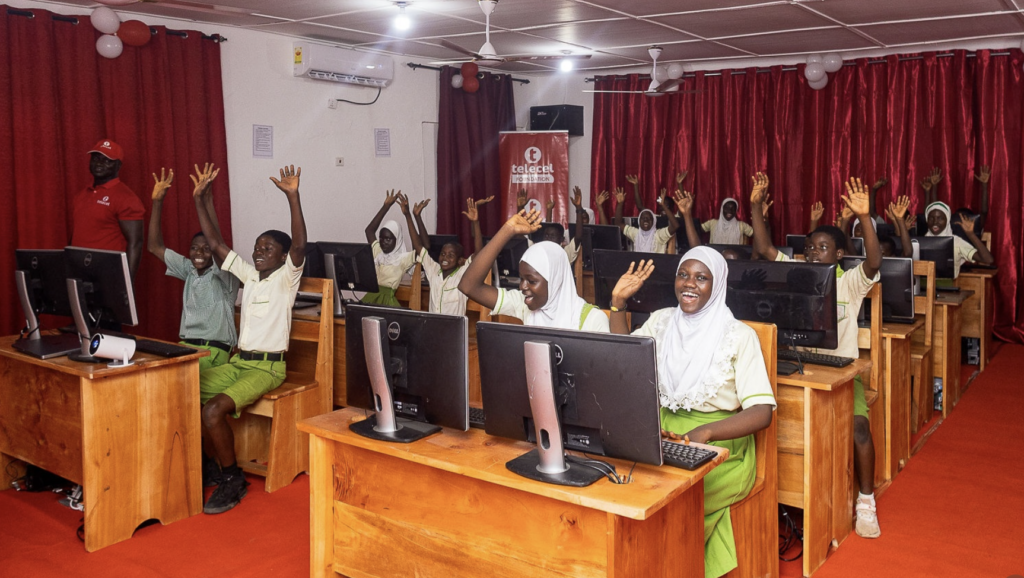
A newly renovated 30-seat information and communications technology laboratory has been handed over to the Islamic Basic School in Akim Achiase, marking what local leaders are calling a transformative moment for digital education in the Eastern Region district.
The facility, equipped with 30 desktop computers, modern furniture, and a year of free internet connectivity, was funded entirely through voluntary donations from employees of Telecel Ghana’s Consumer and Business units. The project falls under the company’s Employee Volunteering Programme, branded as Red Hearts, in which staff crowdfund social interventions in underserved communities of their choosing, with seed money from the Telecel Ghana Foundation.
At the commissioning ceremony, the district chief executive, education directorate officials, religious and traditional leaders, teachers, students, and community members gathered to witness what project lead Carlos Asare-Okoh described as proof that collective employee action can yield meaningful change.
“This project is proof that when employees come together with a shared purpose, meaningful impact can happen,” said Mr Asare-Okoh, who is Propositions and Segments Manager at Telecel Ghana. “The Employee Volunteering Programme allows us to directly support communities in ways that are life-changing.”
The Islamic Basic School’s headteacher, Emmanuel Larbi Nyarko, said the lab would bridge a longstanding gap between theoretical ICT instruction and practical experience. “This is a dream come true for our students. This IT centre will help them access digital learning opportunities they need to compete with the rest of the world,” he said.
For students who had relied largely on textbook-based ICT lessons, the computers offer a first real encounter with the tools that now underpin virtually every sector of the economy. Among those touring the lab was Hafisatu, a basic seven pupil who said she hopes the facility will help her pursue a career as a pilot.
“I have always wanted to learn how to use computers properly because it will help us learn faster and make our lessons easier,” she said.
Rita Agyeiwaa Rockson, Head of Foundation, Sustainability and External Communications at Telecel Ghana, framed the intervention as part of a broader push to deploy technology for social inclusion. “What makes this project special is that it was driven by employees who understand social impact and helped make it a reality,” she said, urging the community to maintain the facility for future generations.
The District Chief Executive, Samuel Owusu Brako, praised the initiative as a statement that children in rural communities deserve equal digital opportunities. “The world our children will inherit is digital, and every child deserves to be connected to the world, not isolated from it,” he said.
The commissioning also featured cultural performances and poetry recitals by students celebrating education and technology, a fitting backdrop for a district that now has, for the first time, a fully equipped digital learning space of its own.
Image Source: MYJOYONLINE