Ghana Extractive Sector Faces Monumental Decision: Nationalise or Transform Mining Future
The Ghana extractive sector stands at a defining crossroads as Joy Business convenes a landmark national roundtable to debate whether outright nationalisation or structural transformation offers the best path forward for a country that has mined gold for over a century while sitting on vast reserves of bauxite, manganese, and newly strategic critical minerals.
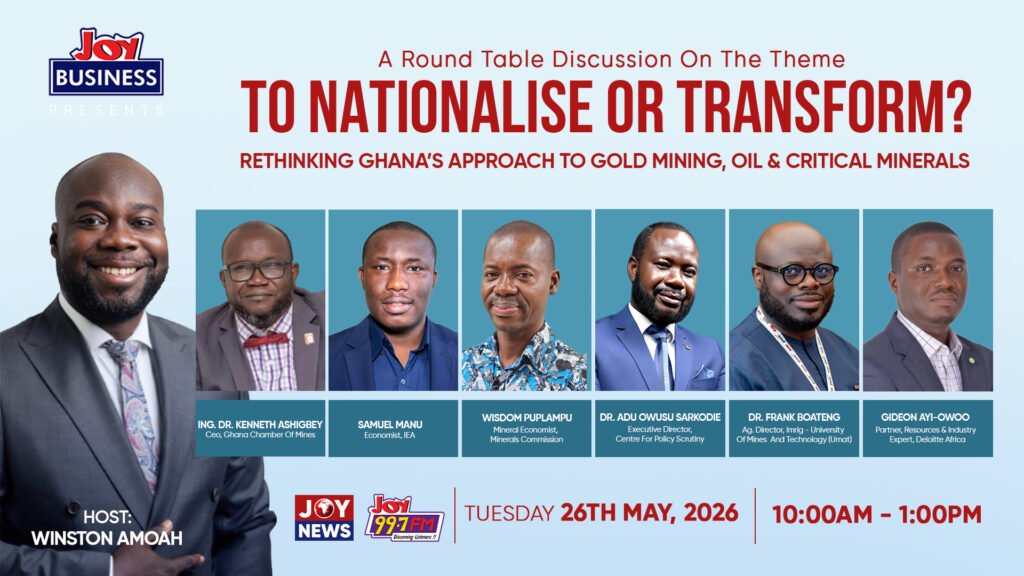
The high-level discussion, titled “To Nationalise or Transform? Rethinking Ghana’s Approach to Mining, Oil and Critical Minerals,” brings together voices from industry, policy, academia, and governance to confront a question that has haunted resource-rich African nations for generations: who truly benefits from the wealth beneath the soil?
Why the Ghana Extractive Sector Debate on Nationalisation Has Intensified
Calls for greater Ghanaian control over the extractive sector have grown louder in recent years, driven by rising commodity prices, increasing global demand for critical minerals, and a growing sense among citizens that the country’s natural wealth has not translated into proportional national prosperity. The Joy Business roundtable arrives at a moment when resource nationalism is gaining momentum across the entire African continent.
Ghana has been mining gold for more than 100 years and began commercial petroleum production when crude oil first flowed from the offshore Jubilee Field in December 2010. Now, the country is racing to stake a claim in lithium and other critical minerals that power the global energy transition. Yet the fundamental question persists: are existing ownership and governance models delivering sufficient returns to ordinary Ghanaians?
The roundtable features prominent voices on both sides of the debate. The Institute of Economic Affairs (IEA), represented by economist Samuel Manu, is leading the push for nationalisation, focusing on ownership models, sovereign wealth, and whether a Ghanaian-led extractive industry can actually finance long-term growth and development. Opposing the blunt calls for nationalisation is Ing. Dr. Kenneth Ashigbey from the Ghana Chamber of Mines, who brings the industry perspective on investor confidence, competitiveness, and what resource nationalism actually means for mining operations on the ground.
Our previous analysis of the Gold Fields Tarkwa Mine lease renewal scrutiny demonstrated how government demands for tougher oversight of mining concessions are already reshaping the relationship between the state and international mining companies. The roundtable represents the next chapter in that evolving dynamic.
How Ghana Extractive Sector Governance Could Determine National Wealth
Beyond the headline debate over nationalisation versus private enterprise lies a more nuanced discussion about governance, accountability, and the mechanisms through which extractive wealth reaches ordinary citizens. Dr. Adu Owusu Sarkodie of the Centre for Policy Scrutiny will address accountability, transparency, and how Ghana can avoid elite capture while maximising national benefit.
The concept of elite capture — where the benefits of natural resource extraction are concentrated among a small political and economic elite rather than distributed broadly — is a persistent concern across resource-rich developing nations. Ghana’s extractive sector has not been immune to these dynamics, with civil society organisations regularly questioning whether mining revenues, royalties, and petroleum proceeds are being managed transparently and in the public interest.
Wisdom Puplampu of the Minerals Commission will provide regulatory perspectives on Ghana’s extractive framework, local content policies, and mineral governance. His input is particularly significant given the Minerals Commission’s central role in overseeing the sector and ensuring compliance with both domestic legislation and international best practices.
The governance question extends beyond mining to encompass Ghana’s emerging role in the global critical minerals supply chain. As countries worldwide scramble to secure supplies of lithium, cobalt, and rare earth elements for electric vehicle batteries and renewable energy technologies, Ghana’s ability to manage its critical mineral endowment responsibly could determine whether the nation captures genuine long-term value or merely serves as a raw material exporter for wealthier economies.
Recent developments in the extractive sector underscore the urgency of these governance questions. The ongoing debate over mining tax reform and small-scale miners highlighted by industry leaders like Ken Ashigbey demonstrates that existing frameworks are already under significant stress.
What Global Lessons Teach About Ghana Extractive Sector Transformation
Dr. Frank Boateng, Acting Director of the Institute of Mineral Resource Investment and Governance at the University of Mines and Technology (UMaT), will bring critical international perspective to the roundtable by examining global lessons from resource-rich countries that pursued various approaches to managing their extractive wealth.
The historical record offers both cautionary tales and success stories. Countries like Norway and Botswana have leveraged natural resource wealth into broadly shared prosperity through strong institutions, sovereign wealth funds, and transparent governance. Others — including several nations across West and Central Africa — have struggled with the so-called “resource curse,” where abundant natural wealth correlates with poor governance outcomes, inequality, and economic underperformance.
Ghana occupies an interesting middle ground. While it has avoided the worst excesses of the resource curse, the country has not fully translated its mineral wealth into the kind of transformative economic development that citizens reasonably expect. The Jubilee Field oil discovery in 2010 raised hopes of a petroleum-driven economic boom, but those expectations have been tempered by production challenges, declining output, and the complexities of managing petroleum revenues.
The roundtable also features Gideon Ayi-Owoo, Partner and Resources and Industry Expert at Deloitte Africa, who will provide continental and global industry insight on financing realities, investment trends, and critical minerals strategy. His perspective on how Ghana can remain globally competitive while increasing local value retention is particularly relevant as the country seeks to attract investment while demanding greater local participation.
Our coverage of the Eni Baleine project in neighbouring Ivory Coast illustrates how West African nations are competing fiercely for extractive sector investment, making Ghana’s policy choices all the more consequential for its regional competitiveness.
Why the Ghana Extractive Sector Roundtable Aims to Move Beyond Rhetoric
Unlike many public conversations about Ghana’s natural resources, the Joy Business roundtable explicitly aims to move beyond rhetoric and produce actionable outcomes. A major deliverable will be a policy brief capturing key recommendations from the discussion, which will be shared with government, state institutions, and the public.
This commitment to producing tangible policy outputs distinguishes the roundtable from the often heated but ultimately inconclusive debates that characterise public discourse on the extractive sector in Ghana and across Africa. By convening experts from diverse perspectives — industry, regulation, academia, policy analysis, and international finance — Joy Business is creating a forum where competing viewpoints can be rigorously examined and synthesised into coherent recommendations.
The initiative is part of Joy Business’s broader commitment to shaping Ghana’s economic conversation through evidence-based dialogue. The discussion airs live on JoyNews TV, Joy FM, and JoyNews social media handles, ensuring broad public access to what promises to be one of the most significant policy discussions of the year.
For Ghana, the stakes of getting extractive sector policy right cannot be overstated. The country’s gold mining industry alone employs hundreds of thousands of workers directly and indirectly, while petroleum revenues contribute significantly to the national budget. As the global economy transitions toward cleaner energy sources, Ghana’s ability to position itself as a responsible, competitive, and profitable destination for critical mineral investment could shape the nation’s economic trajectory for decades to come.
The question is not merely whether to nationalise or transform — it is whether Ghana can build the institutional capacity, governance frameworks, and strategic vision necessary to ensure that its extraordinary natural endowment finally delivers on its long-promised potential for all citizens.
Source: MyJoyOnline