Susan Adu-Amankwah Demands Punishment for Corrupt Elites
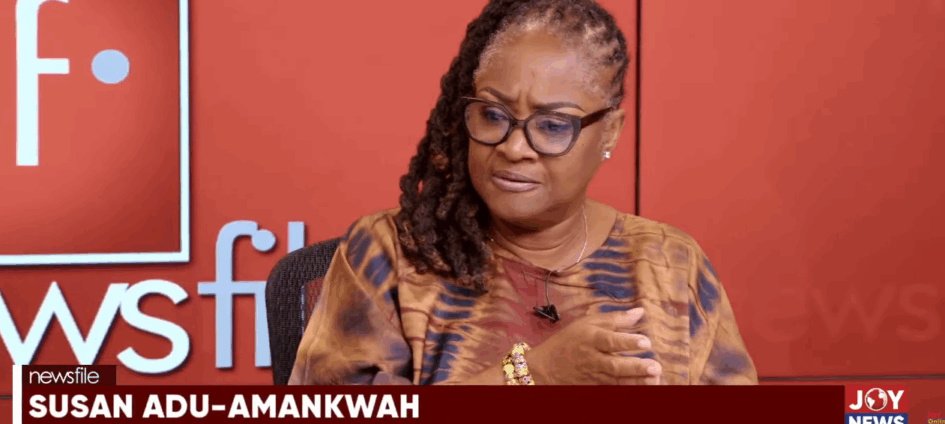
Susan Adu-Amankwah, the Executive Secretary of the National Investment Movement, has called for firm action against corruption, emphasizing that Ghana must stop shielding powerful political figures to tackle indiscipline and corruption.
Speaking on JoyNews’ Newsfile on Saturday, January 17, Madam Adu-Amankwah stressed that failure to punish political elites sends the wrong message to ordinary citizens. She said, “If we don’t start punishing the political elite, then we should forget about the people down there. They look up to the political elite to show the way. And if the political elite are going to get away with all sorts of things, then the people down there are going to say, ‘What gives? We will do as we please.’”
Madam Adu-Amankwah attributed widespread corruption and indiscipline to the perception that influential people are never held accountable. “A lot of the indiscipline and corruption you see in our society is because the political elite seem to be getting away with corruption,” she stated.
She advocated for Ghana to prioritize its interests and not worry about international embarrassment. “It’s about time that we put ourselves first before we put anybody else. And this is about us. So we don’t care whether it’s an embarrassment,” she said.
Regarding the return of convicted or accused public officials to face justice in Ghana, Madam Adu-Amankwah believed it should not be seen as shameful but as a signal that crime does not pay. Referring to former MASLOC CEO Sedina Tamakloe, she added, “She has been judged to have committed a crime. And asking her to come back and serve her sentence is good for us as a people, for people to see that crime doesn’t pay.”
Madam Adu-Amankwah also emphasized that accountability should not be confused with personal hatred. “The fact that you punish a family member for wrongdoing doesn’t mean that you hate them. It’s a deterrent for other people to see,” she explained.
She questioned claims that Ghanaians are ashamed when accused or convicted officials are brought back to face justice. “I don’t know who’s embarrassed. If you called 10 Ghanaians on the street and asked them whether it’s okay that somebody who has taken the money of poor women, of people struggling to put food on their table, is being punished, I’m sure they will say no, they are not embarrassed,” she said.
Madam Adu-Amankwah insisted that Ghana should not be concerned about external opinions. “We don’t care what other people say. For me, it’s not an embarrassment at all. We need to show that we are not going to tolerate corruption and that it is not business as usual,” she added.
On former Finance Minister Ken Ofori-Atta, who faces multiple charges, Madam Adu-Amankwah dismissed suggestions that his possible return to Ghana would disgrace the country. “I’m not with Ken Ofori-Atta. If it’s an embarrassment, it may be an embarrassment to himself. If he feels he’s innocent of all the things he’s been charged with, if he cares about his reputation, he should come and let the truth come out.”
She questioned why Ghana should feel ashamed for demanding accountability. “Why should we be embarrassed for somebody to come and answer for his tenure of office?” she asked, noting that even members of his own party may want him to return and clear his name.
Madam Adu-Amankwah hoped that the U.S. Immigration and Customs Enforcement (ICE) would facilitate the return of those accused to face charges in Ghana. “It helps their own reputation to say that we even asked him to come back. If they truly believe he’s innocent, then he should come and prove it,” she concluded.
Image Source: MYJOYONLINE