25 communities, 18 assemblies affected by floods – Interior Minister
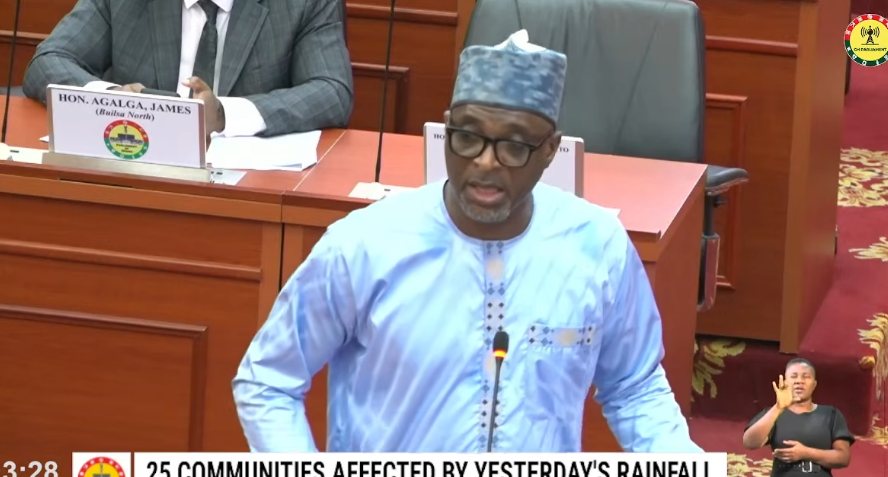
Accra, Ghana — The Interior Minister, Muntaka Mohammed-Mubarak, delivered a sobering assessment to Parliament on Tuesday, revealing that Monday’s unprecedented torrential rains had inundated 25 communities across 18 Metropolitan, Municipal, and District Assemblies (MMDAs) in the Greater Accra Region, displacing tens of thousands and leaving a trail of destruction that claimed at least twelve lives and left seven others missing.
The Minister’s address came as rescue teams continued to sift through waterlogged neighborhoods, searching for survivors and assessing the damage, a situation that echoes earlier warnings about self-inflicted flooding vulnerabilities (/accra-floods-are-self-inflicted-and-avoidable-cpp-urges-urgent-government-action). According to Mr. Mohammed-Mubarak, the flooding — described by meteorologists as a once-in-a-generation event — had overwhelmed the city’s drainage infrastructure, turning streets into rivers and submerging homes up to waist level in some areas.
‘Twenty-five communities were affected. Eighteen assemblies were largely affected by the Monday rains,’ he told the House of Assembly, his voice underscoring the gravity of the situation. The affected assemblies spanned a wide swath of the region, including Ga East, Ledzokuku, Ayawaso Central, Ga Central, Ga West, Ablekuma North, Ningo-Prampram, Weija-Gbawe, Ga South, Adenta, Korle Klottey, Okaikwei South, Okaikwei North, Tema West, Tema Metropolitan Assembly, La Dade-Kotopon, and Krowor.
The human toll varied significantly across the affected areas. Ga East recorded 2,000 displaced persons from 400 households, with six individuals reported missing and five confirmed dead. In Ledzokuku, 1,200 residents were displaced across 240 households, resulting in one death but no missing persons. Ayawaso Central saw 3,021 displaced individuals from 605 households, with one person missing and three fatalities.
Other assemblies reported displacement without casualties: Ga Central (1,811 persons from 363 households), Ga West (2,300 from 460 households), Ablekuma North (651 from 131 households), Ningo-Prampram (1,377 from 276 households), Weija-Gbawe (2,500 from 500 households), Ga South (2,100 from 420 households), and Adenta (1,850 from 370 households). Korle Klottey emerged as the hardest hit, with 6,500 displaced persons from 1,300 households, while Okaikwei South and North reported 701 and 2,620 displaced persons respectively. Tema West and Tema Metropolitan Assembly recorded 3,450 and 3,601 displaced persons, with the former also suffering three additional deaths.
La Dade-Kotopon and Krowor completed the picture, with 2,020 and 1,100 displaced persons respectively, the latter recording no deaths.
Aggregating the figures, the Minister stated that a total of 7,761 households had been displaced, affecting 38,802 individuals. As of Tuesday morning, seven people remained unaccounted for and twelve had been confirmed dead.
Mr. Mohammed-Mubarak extended his condolences to the families of the deceased, emphasizing the government’s solidarity with those in mourning. He assured Parliament that recovery efforts were underway, with a focus on providing temporary shelter, food, and medical assistance to displaced families. However, he acknowledged that many residents remained unable to return to their homes due to persistent flood damage and compromised infrastructure.
The flooding has reignited debates about Accra’s vulnerability to extreme weather events, particularly in light of rapid urbanization and inadequate drainage systems, with experts repeatedly urging comprehensive waste management reforms to tackle the city’s persistent flooding (/experts-urge-comprehensive-waste-management-reforms-to-tackle-accras-persistent-flooding). As the city begins the long process of recovery, the Interior Minister’s announcement serves as both a testament to the scale of the disaster and a call to action for resilient urban planning.
The President has scheduled an emergency meeting with disaster management officials for Thursday to coordinate a comprehensive response, including the deployment of military engineers to assist in drainage clearance and the distribution of relief supplies to the most affected communities.