WHO Chief Concludes Congo Visit as Ebola Outbreak Exceeds 280 Confirmed Cases
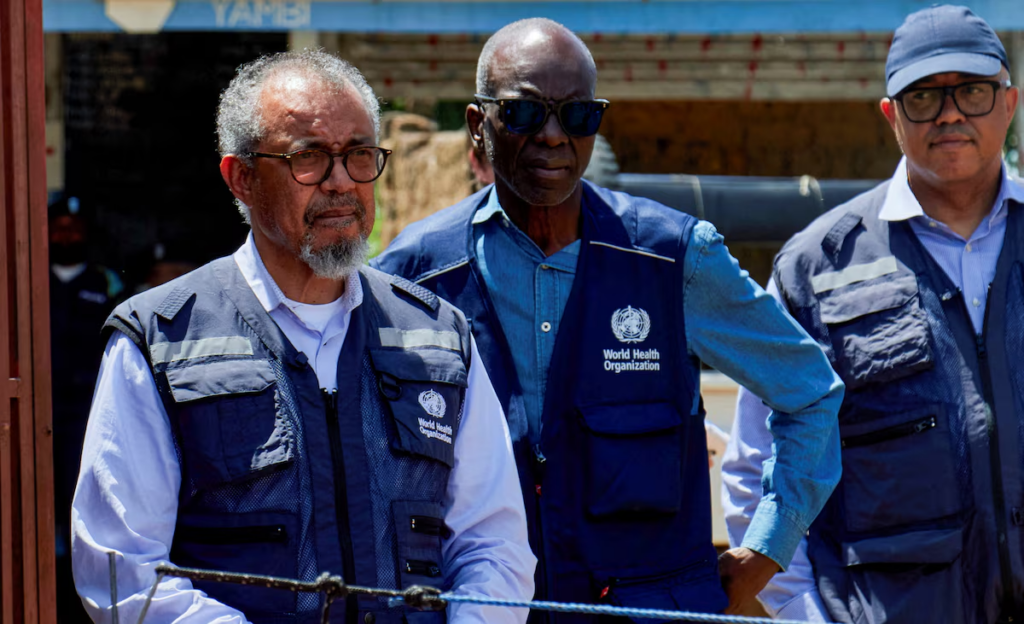
World Health Organisation Director-General Tedros Adhanom Ghebreyesus wrapped up a week-long visit to the Democratic Republic of Congo on Monday, briefing President Felix Tshisekedi on the international response to an Ebola outbreak that health officials warn may be far larger than official numbers suggest.
The visit, which took Tedros to Ituri province where the first cases were confirmed in mid-May, comes as the outbreak has already become the third-largest on record. Congo’s government reported late Sunday that confirmed cases had climbed to 282, with 42 deaths, after 19 new positive test results were recorded. The WHO separately said on Friday that 906 suspected cases, including 223 suspected deaths, remained under investigation.
“This Ebola can be stopped when the community owns the agenda and with strong government leadership,” Tedros said after meeting Tshisekedi in Kinshasa. “We need to strengthen the capacity of the health systems in the affected areas.”
During his time in Ituri, Tedros reported seeing encouraging signs, including five certified recoveries, but emphasised the urgent need to scale up testing and treatment capacity while building trust in health workers among local communities.
The International Rescue Committee offered a sobering assessment on Monday, warning that the outbreak was likely “significantly larger and more advanced” than official figures suggest. The aid agency said the virus may have been circulating for up to three months before the first official cases were detected, and that only 20 percent of contacts were currently being traced.
“When four out of five contacts are not being traced, it becomes incredibly difficult to contain the outbreak or even understand its true scale,” said Rachel Howard, the IRC’s senior technical emergency health adviser.
The response has been complicated by the nature of the virus itself. The current outbreak is caused by the Bundibugyo strain, for which there is no approved vaccine – a significant departure from the Zaire strain that responders in Congo have tackled in previous outbreaks. Global health organisation CEPI announced it would provide roughly $60 million to Moderna and two other groups to accelerate vaccine development for the Bundibugyo strain, with trials potentially ready within a couple of months.
Adding to the difficulty, all three affected provinces – Ituri, North Kivu, and South Kivu – have been wracked by armed conflict that has caused mass displacement. Over the weekend, fighters from the Allied Democratic Forces, a rebel group linked to Islamic State, killed 15 civilians and a soldier in the city of Beni in North Kivu.
Cases have also been confirmed in neighbouring Uganda, raising fears of cross-border transmission. In a sign of growing international engagement, China announced on Monday that it would send a team of medical specialists to Congo to assist with the outbreak response.
The intensified response to the Ebola outbreak across multiple provinces has required coordination between the Congolese government, international health bodies, and humanitarian organisations operating in some of the most volatile regions on the continent.
Image Source: MYJOYONLINE