Mankranso 24-Hour Market Project Stalls as Residents Demand Relocation Over Flood Risks
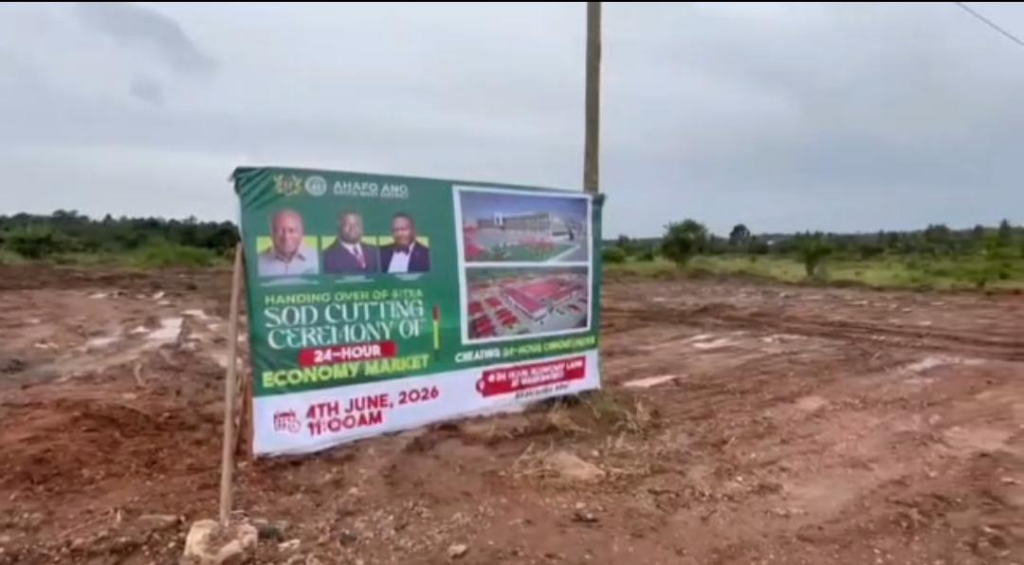
A government-backed plan to build a 24-hour market in Mankranso, the district capital of Ahafo-Ano South West in the Ashanti Region, has ground to a halt after residents raised alarm over the site’s vulnerability to flooding. The community is calling on authorities to relocate the project to higher, more suitable ground before construction begins.
The proposed market, part of a broader 24-Hour Economy initiative designed to boost local commerce and create round-the-clock trading opportunities, is earmarked for a parcel of land situated directly behind the Asuo Mankra stream. A sod-cutting ceremony has already been held, but residents say the chosen location is fundamentally unsuitable for a project of this scale.
“The land earmarked for the project is not suitable because it is waterlogged and lies on the banks of the Mankran River,” one resident explained. “It means that for the project to carry on, we need to do filling, which will block the waterway.”
Kwame Ofori, another resident, put the concern in starker terms. “The land is waterlogged, and constructing the market there would force the government to spend heavily on landfilling. Even if they manage to build the market, poor access in the future will make it difficult for traders and buyers to use it. That will make the whole project useless. Government should relocate it to a more suitable site.”
The objections are not merely about inconvenience. Residents point to a pattern of flood-related destruction across Ghana — from the Greater Accra Region to the Ashanti heartland — that has repeatedly devastated markets, homes, and public infrastructure built on floodplains and waterlogged terrain. The fear is that a multi-million-cedi investment could be washed away within a few rainy seasons if the site is not properly assessed and secured.
District Chief Executive Abubakar Sedik has pushed back against the criticism, insisting that a consultant conducted a thorough assessment before the sod-cutting and concluded that limited filling would make the project viable. He drew a comparison to the Agenda 111 hospital programme, which was built on similarly waterlogged land without subsequent flooding issues.
“This is a big project, which is why the consultant conducted all the necessary assessments,” Sedik said. “Drainage channels would be constructed to address any flooding concerns during the project’s implementation.”
Residents remain unconvinced. They are appealing to the Ahafo-Ano South West District Assembly, the Ashanti Regional Coordinating Council, and the central government to commission a thorough, independent environmental assessment before any construction proceeds. Their demand is straightforward: relocate the market to higher ground, or risk turning a promised economic lifeline into a costly monument to poor planning.
The standoff in Mankranso reflects a broader tension in Ghana’s infrastructure development — the rush to deliver visible projects versus the slower, less glamorous work of environmental due diligence. As climate patterns become more erratic and urban flooding grows more frequent, the question of where to build is becoming as important as what to build.
Image Source: MYJOYONLINE