Greater Accra Placed on High Flood Alert as Regional Minister Announces Emergency Response Measures
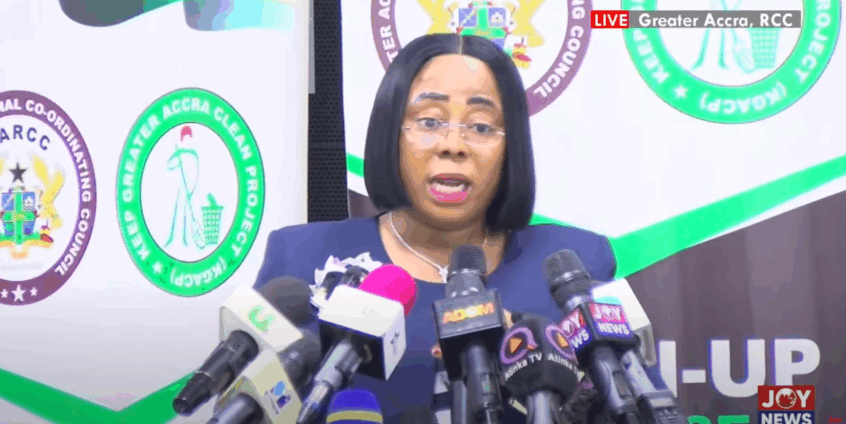
Greater Accra is bracing for a difficult rainy season. Regional Minister Linda Ocloo on Monday declared a high flood alert across the capital, warning that meteorological forecasts point to more intense rainfall in the weeks ahead and that recent downpours have already claimed lives in parts of the region.
“The situation remains critical and requires urgent collective action from both authorities and residents,” Ocloo told reporters at a press conference, outlining a sweeping set of emergency measures coordinated with the National Disaster Management Organisation, metropolitan assemblies, and security agencies.
The announcement came as the Weija Dam’s spill gates were opened following a rise in water levels caused by continuous rainfall. Ghana Water Limited confirmed the controlled release was necessary to prevent structural damage, a move that has already affected surrounding communities and prompted an immediate inspection and evacuation exercise by the Regional Security Council. The Weija Dam spillage mirrors a similar emergency earlier this season, when water levels exceeded the facility’s maximum operating threshold of 48 feet.
Communities Under Close Watch
The Regional Coordinating Council has identified more than a dozen flood-prone communities for heightened monitoring. They include Kaneshie, Alajo, Odawna, Circle, Weija, Tetegu, Ashalaja, Dansoman, Adabraka, Ashaiman, Tema Communities 1 and 2, Madina, Adenta, Lakeside, Borteyman, Pantang, and Kwabenya.
All Metropolitan, Municipal and District Assemblies have been directed to intensify flood prevention exercises immediately. The interventions include desilting gutters and drains, removing refuse from drainage channels, inspecting waterways, and demolishing unauthorised structures that obstruct the free flow of water.
“We know the rains are unavoidable, but we must all play our roles effectively to minimise the impact of flooding,” Ocloo said.
Crackdown on Illegal Structures and Transport Terminals
The Minister also announced an imminent crackdown on unauthorised transport terminals and roadside lorry stations operating in public spaces and obstructing traffic flow. “All unauthorised lorry stations and transport terminals located along roads and within unauthorised public spaces are to be removed immediately in the interest of public safety and effective city management,” she stated.
Chief Executives of all metropolitan, municipal and district assemblies have been charged to ensure sanitation taskforces are deployed after every rainfall to clear debris and prevent drains from becoming choked. “No more sitting in the office, because the work is on the grounds,” Ocloo said.
Emergency Response Infrastructure
Regional and district-level response teams have been activated in collaboration with the Ghana National Fire Service, Ghana Police Service, Ghana Armed Forces, and the National Ambulance Service. Relief items including food supplies, mattresses, blankets, first aid kits, and life jackets have been positioned at strategic locations.
Temporary shelters — schools, community centres, assembly halls, and religious facilities on safer ground — have been identified to accommodate displaced persons in the event of severe flooding.
Solar Streetlights and Infrastructure Upgrades
Beyond flood preparedness, the Regional Coordinating Council has partnered with the Ministry of Energy and Green Transition to install 3,000 solar streetlights on major roads across the region. The project, aimed at improving visibility and reducing cable theft, covers stretches including Katamanso School Junction to Botwe School Junction, Ntreh Avenue, Adjei Onanor Street, Ashyie Fulani Road, and Amanfrom to Katamanso.
A Shared Responsibility
Ocloo concluded by urging residents to stop dumping refuse into drains and waterways, stressing that flood prevention cannot rest on government alone. “Flood prevention is not the responsibility of government alone. It requires collective discipline and active participation from all residents of the region,” she said.
Motorists and pedestrians were specifically cautioned against driving or walking through flooded roads and drains. “Many lives have been lost in similar circumstances in the past,” the Minister warned.
The emergency measures represent one of the most comprehensive flood preparedness responses mounted by the Greater Accra Regional Coordinating Council in recent years, reflecting both the severity of this season’s rainfall forecasts and the hard lessons of previous flooding disasters that have devastated parts of the capital.
Image Source: MYJOYONLINE