Ghana Records Weakest Q1 Budget Execution Since 2017 as Consolidation Bites
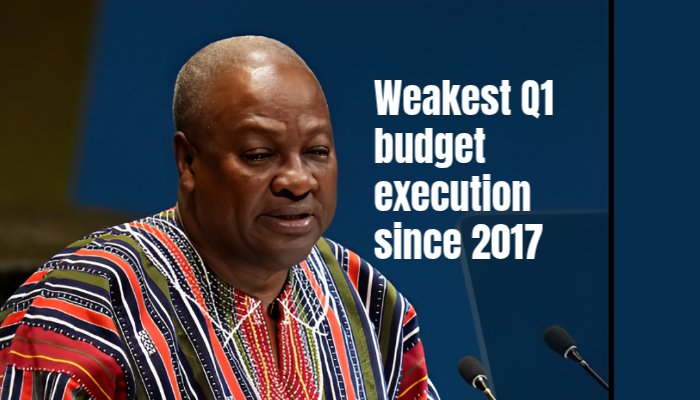
Ghana’s government spent just 73 per cent of its planned expenditure in the first quarter of 2026, recording the weakest opening-quarter budget execution in nearly a decade as fiscal consolidation measures under the country’s IMF programme continue to squeeze public spending.
Data from the Ministry of Finance, analysed by JoyNews Research, shows that GH₵66 billion was disbursed between January and March against a planned GH₵90 billion — a shortfall of GH₵24 billion. Excluding debt principal repayment, the government spent GH₵63 billion of a planned GH₵81 billion, an execution rate of 78 per cent.
The figures paint a picture of a state that is struggling to translate its budget into action. Capital expenditure bore the brunt of the cuts, with just GH₵7.3 billion disbursed against a target of GH₵12.6 billion — a gap of GH₵5.3 billion and the single largest miss in the quarter. Foreign-funded projects fared even worse, receiving only GH₵0.6 billion of the GH₵5.3 billion earmarked for them.
What the Numbers Reveal
The pattern is not entirely unfamiliar. Since 2016, the government has underspent its first-quarter budget in seven of eleven years. But the scale of the 2026 shortfall is exceptional. Wages and salaries, the most politically sensitive line item, were largely protected at 93 per cent of plan, with GH₵21 billion of a budgeted GH₵23 billion disbursed.
Interest payments reached GH₵17.2 billion against a budgeted GH₵21.7 billion, while debt principal repayment stood at just GH₵3 billion of GH₵8.8 billion due. Transfers to health, education, and district assemblies amounted to GH₵12.3 billion of the GH₵15.2 billion planned. Goods and services — the day-to-day spending that keeps institutions functioning — received only GH₵1.3 billion of a GH₵2 billion allocation.
The most troubling figure, however, may be social benefits. Spending on vulnerable households was near zero against a budgeted GH₵0.5 billion, a pattern that has persisted across multiple years and raises serious questions about the government’s ability to shield the poorest citizens from the effects of fiscal tightening.
The Consolidation Trap
Ghana entered its current IMF programme after a 2022 debt default forced a restructuring of most of the country’s foreign obligations. The programme demands fiscal discipline: the state must live within its means, even when those means are insufficient to fund the development aspirations laid out in the national budget.
The result is a consolidation trap. Revenue shortfalls force the government to protect payroll and essential services, leaving capital projects and social safety nets as the first casualties. The GRA’s push to bring the informal sector into the tax net is one attempt to broaden the revenue base, but such measures take time to yield results.
The government’s decision to hold the cocoa producer price steady despite a global market slump reflects the same tension: protecting farmers’ incomes while managing a budget that has little room for manoeuvre.
Looking Ahead
The upcoming Policy Coordination Instrument review in July 2026 is unlikely to bring additional financing, meaning fiscal tightening will persist. Without new revenue streams or a significant improvement in disbursement efficiency, the pattern of cutting capital projects and underfunding social programmes will continue.
For a country still recovering from the economic shock of 2022, the weakest first-quarter execution since 2017 is more than a statistical footnote. It is a signal that the pain of consolidation is being felt most acutely in the areas that matter most for long-term recovery: infrastructure, social protection, and the everyday operations of public institutions.
Image Source: MYJOYONLINE