MOGPA Relieves Abrafo Kokoben Basic School of Infrastructure Deficit
In the Atwima Nwabiagya North District of the Ashanti Region, Abrafo Kokoben Basic School has long embodied the infrastructure crisis that plagues countless rural and peri-urban schools across Ghana. With only six classrooms available, primary pupils occupied every usable space while Junior High School students were relegated to makeshift structures open to the elements. Kindergarten learners sat in an unfinished block with unscreeded floors. The school could not even afford to pay the salary of the security officer it had hired.
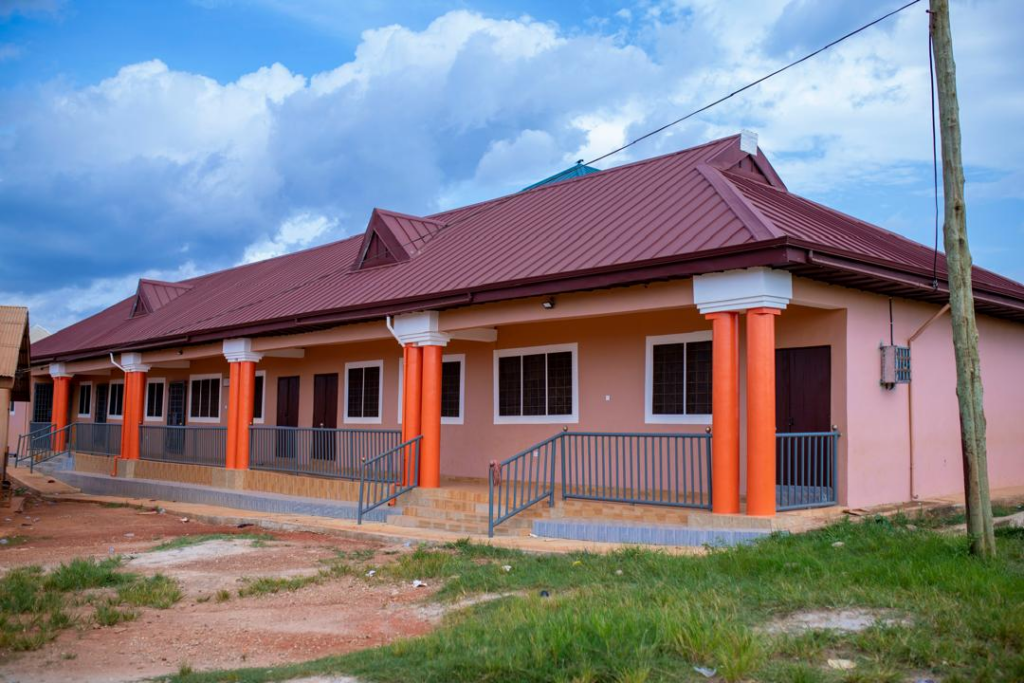
This week, a lifeline arrived from an unexpected quarter. The Moment of Glory Prayer Army (MOGPA), a faith-based organisation, completed a comprehensive intervention at the school: the roof of the three-classroom block was redone, a fully furnished ICT laboratory was installed, the headmaster’s office was equipped with a toilet facility, and a dedicated staff common room was created for teachers.
The transformation is immediate and tangible. Junior High School students, who once studied under leaking roofs and open-sided shelters, now have enclosed classrooms. The new ICT laboratory replaces an arrangement in which teachers relied on personal laptops to introduce pupils to basic computing. A proper staff room gives teachers a place to prepare lessons and collaborate — a small thing, perhaps, but one that bears directly on morale and retention in a district that struggles to hold onto qualified educators.
“If some people can help these schools with desks and other infrastructure, it will help improve the studies of these students,” said Ruby Osei Forson, Deputy Director of Education for the district. Her plea underscores a reality that government alone has been unable to address: the scale of infrastructure need across Ghana’s education system far outstrips the resources available to meet it.
The country needs between 50,000 and 90,000 additional teachers but has budgetary clearance to recruit only 7,000 this year — a mismatch that leaves existing staff stretched thin and schools in underserved areas struggling to function. When infrastructure fails alongside staffing, the burden falls hardest on children in districts like Atwima Nwabiagya North, where government resources arrive slowly and unpredictably.
Funding constraints compound the problem. Parliament has been warned that the government is diverting 42 percent of the Ghana Education Trust Fund’s budget to feed senior high school students, leaving less for the primary and junior high infrastructure that MOGPA stepped in to provide. In this environment, faith-based organisations and philanthropists have become essential partners — not optional extras — in keeping basic schools functional.
MOGPA’s Welfare Chairman, Isaac Boakye Yiadom, described the gesture as a fulfilment of the gospel, but its practical implications are far-reaching. The intervention demonstrates a replicable model: identify a school in acute need, deliver targeted infrastructure — classrooms, ICT facilities, sanitation — and do so in partnership with district education authorities who can guide priorities.
Significant needs remain. The kindergarten block’s floors still require screeding. The school needs a sustainable arrangement to pay its security officer. Water supply and other community infrastructure are still lacking. But the core learning environment has been fundamentally altered, and the partnership between MOGPA and district education officials offers a template that other organisations — and the government itself — would do well to study.
Image Source: MYJOYONLINE