Social Protection Is Indispensable for Ghana’s Development, Gender Minister Argues
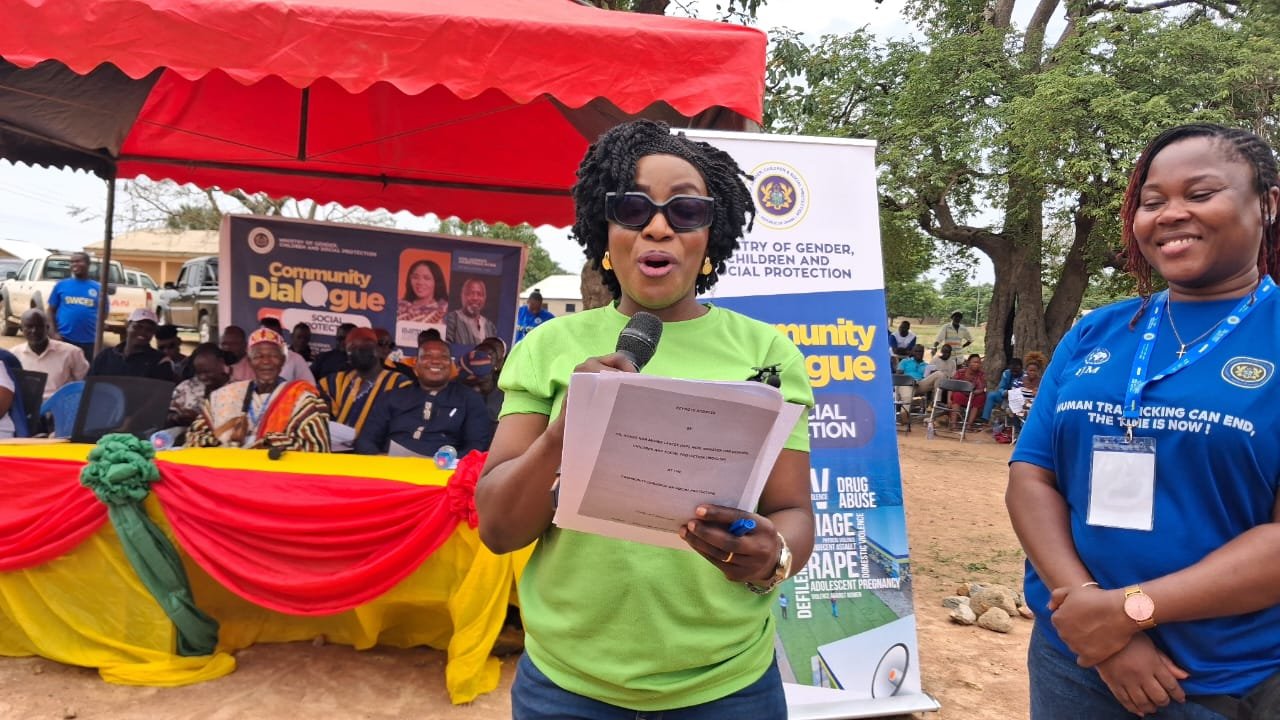
The Minister of Gender, Children and Social Protection, Dr Agnes Naa Momo Lartey, has made a forceful case for expanding Ghana’s social safety net, arguing that no nation can achieve sustainable development without robust programmes that shield its most vulnerable citizens from poverty and exclusion.
Speaking at a community dialogue in Dachio, a suburb of the Bolgatanga East District on Tuesday, Dr Lartey — whose address was delivered on her behalf by Ms Francisca Atuluk, Director of Social Protection — pointed to a growing body of international evidence: countries that have made significant strides in reducing poverty and inequality have done so by investing deliberately in social protection systems that empower citizens to participate fully in socio-economic life.
“Nations that have made significant progress in reducing poverty and inequality have done so by investing in robust social protection systems that protect vulnerable populations,” Dr Lartey told the gathering.
A Legislative Turning Point
The minister’s remarks carry particular weight given the government’s recent legislative advances. The passage of the Social Protection Act, 2025 (Act 1148) provides, for the first time, a comprehensive legal framework for coordinating and delivering social protection services nationwide. It marks Ghana’s transition from ad hoc interventions toward a more systematic, accountable approach to welfare delivery.
The range of programmes already in operation is broad. The Livelihood Empowerment Against Poverty (LEAP) programme continues to provide cash transfers to the poorest households. The School Feeding Programme reaches millions of children across the country. Disability support initiatives, free sanitary pads for schoolgirls, free primary healthcare, and the “No Fees Stress” policy for tertiary students all represent deliberate efforts to reduce barriers that keep Ghanaians trapped in cycles of deprivation.
The Gap Between Policy and Reality
Yet the dialogue in Dachio also laid bare the distance between policy ambition and lived reality on the ground. The Bolgatanga East District currently has just 126 households enrolled in LEAP — a number that the District Chief Executive, Jacob Abugri Aka-Eri, openly acknowledged as inadequate. He appealed for an expansion of coverage, noting that many of the district’s most vulnerable families remain beyond the reach of existing programmes.
The challenges facing communities like Dachio are not abstract. Teenage pregnancy, child marriage, domestic violence, substance abuse, and school dropout rates remain stubbornly high across many rural districts. Traditional leaders at the event, including Naba Thomas Akalga II, Chief of Dachio, praised the dialogue for boosting awareness but stressed that awareness alone cannot substitute for resources and sustained institutional support.
Building Partnerships for Lasting Impact
What sets the current moment apart is the combination of legislative clarity and community-level engagement. Partnerships with traditional authorities, faith-based organisations, Metropolitan, Municipal and District Assemblies, development partners, and the media are being actively cultivated to improve information dissemination and service uptake.
In a tangible gesture of commitment, free NHIS registration was offered to residents during the event — a practical step toward ensuring that healthcare access need not remain a privilege of proximity to urban centres.
The government’s broader social protection agenda, including the recently introduced “Mahama Cares” initiative, suggests a political commitment that extends beyond rhetoric. But as Dr Lartey herself acknowledged, the real test lies in execution: in reaching the communities that need support most, in building systems that are transparent and accountable, and in ensuring that the legal framework enacted last year translates into measurable improvements in people’s lives.
For Ghana, a country whose youthful population represents both its greatest asset and its most pressing challenge, social protection is not charity. It is infrastructure — the kind that determines whether a generation thrives or merely survives.
Image Source: GHANA BUSINESS NEWS