Excessive Bail Conditions Undermine Constitutional Rights in Ghana
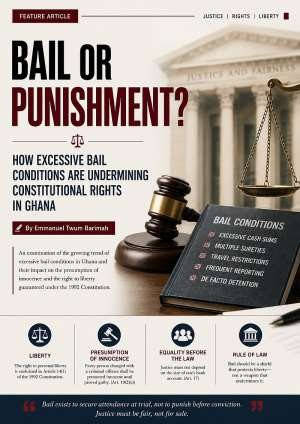
In every democracy governed by the rule of law, the presumption of innocence is meant to be more than a courtroom formality. It is supposed to be a lived reality — one that ensures accused persons retain their dignity and liberty until a court decides otherwise. In Ghana, a growing body of evidence suggests that this principle is being eroded, not by verdicts, but by bail.
A detailed analysis published this week examines how excessive bail conditions across Ghana’s courts are functioning less as a guarantee of appearance and more as a form of pre-trial punishment. The argument is straightforward: when bail is set at levels the accused cannot possibly meet, the effect is detention without trial — a practice that strikes at the heart of the 1992 Constitution’s protections.
Ghana’s Constitution is unambiguous. Article 14 guarantees the right to personal liberty, with narrow exceptions. Article 19 reinforces the presumption of innocence. Yet in practice, magistrates and judges routinely impose bail conditions — financial sureties, property requirements, and surety obligations — that place freedom beyond the reach of ordinary citizens.
The consequences are predictable and troubling. Accused persons who cannot meet bail languish in remand prisons, sometimes for months or years, awaiting trial for offences they have not been convicted of. Ghana’s prisons, already overcrowded at roughly 150 per cent of capacity, absorb the overflow. Families lose breadwinners. Communities lose members. And the justice system loses credibility.
The problem is not new, but its scale has grown. Legal aid organisations have documented cases where bail conditions bear no reasonable relationship to the offence alleged or the accused’s financial circumstances. A market trader charged with a minor offence may face the same bail requirements as a corporate executive facing serious fraud charges. The result is a two-tier system: those with means walk free pending trial; those without do not.
Judicial discretion plays a role, and it is not always exercised with equity in mind. Some magistrates set bail high as a matter of routine, citing the seriousness of the offence without considering proportionality. Others impose conditions — such as reporting requirements or travel restrictions — that, while not financially burdensome, effectively prevent the accused from working or supporting their families.
Reform proposals have circulated for years. Legal scholars and civil society organisations have called for statutory guidelines that tie bail amounts to the accused’s verified income and assets. Others have proposed a graduated system in which minor offences attract minimal financial requirements, with proportionate increases for more serious charges. The judiciary has acknowledged the problem but moved slowly.
The stakes are higher than individual cases. When citizens perceive that justice is available only to those who can afford it, trust in the legal system erodes. That erosion has consequences — for social cohesion, for political stability, and for the legitimacy of the courts themselves. Ghana’s Constitution was designed to protect the weak against the strong. Excessive bail conditions invert that promise.
Image Source: GHANAMMA