Czech Tennis Star Mensik Collapses on Court as French Open Heatwave Tests Players to the Limit
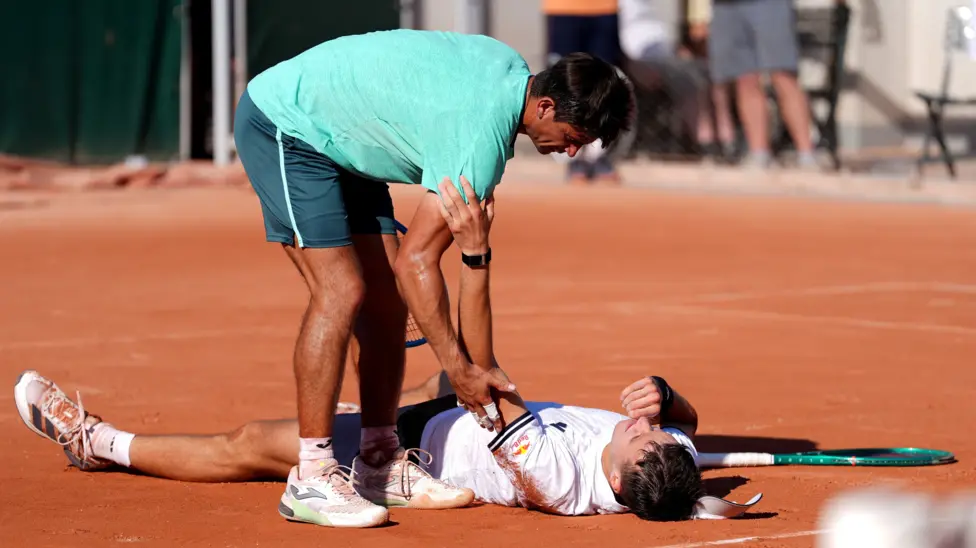
Jakub Mensik said his body “just turned off” as he collapsed on court following a gruelling second-round win in sweltering conditions at the French Open, laying bare the extreme physical toll that record-breaking heat is taking on athletes at Roland Garros.
Temperatures reached the mid-30s Celsius as a relentless heatwave continued to grip France, turning the famed clay courts into furnaces that have left players struggling to survive, let alone compete. Mensik, the 20-year-old Czech 26th seed, was overcome with emotion and cramp as he fell to the floor after beating Argentina’s Mariano Navone 6-3 2-6 6-4 1-6 7-6 (13-11) in a marathon encounter lasting four hours and 41 minutes.
The young Czech, whose flashes of brilliance have been beset by injury throughout his career, was struggling to move and needed eight match points to close out victory. When he finally hit the last winner, the dam broke. Opponent Navone crossed the net to congratulate him and help him to his feet, but Mensik was unable to move. He lay on the court for several minutes as medical staff placed ice packs on his head, neck, and chest. An ice pack was laid on the floor for him to rest his head on like a pillow.
Eventually, Mensik was helped upright and walked off court, only to struggle again as he headed towards the locker room. He was placed in a wheelchair and taken away for treatment. Speaking to media afterwards, he revealed he had endured an ice bath and completed a recovery session in the gym as he began preparations for a third-round meeting with eighth seed Alex de Minaur on Friday.
“When I hit the last winner, the emotions went out and my body just turned off,” Mensik said. “It’s insane to play in this weather and especially in front of the sun, to be there for more than four and a half hours is just insane.”
His frustration extended beyond the heat itself. Competing on one of Roland Garros’ outer courts, which offer no shade, Mensik expressed anger at being penalised for taking too long between points, losing his first serve twice as punishment. He pointed to the limited break time available, noting that ball kids cannot bring towels and changeovers last only one minute. “Before you sit it’s already 30 seconds and there’s not that much time to cool yourself down,” he said.
The conditions have drawn sharp criticism from multiple players. Three-time former champion Novak Djokovic, who played on the roofed Court Philippe Chatrier, suggested scheduling matches later in the evening could be “something to consider” when extreme heat is forecast. The 39-year-old Serb needed three hours and 44 minutes to overcome Frenchman Valentin Royer, winning 6-3 6-2 6-7 (7-9) 6-3.
On Monday, former finalist Casper Ruud described feeling like he was “walking around like a zombie” after struggling with cramping in 33C temperatures, admitting he feared he had suffered heat stroke. Women’s 15th seed Marta Kostyuk said the conditions were not quite as brutal as those she experienced during the 2024 Olympics at the same venue, but added: “It’s still hot and it’s very dry. I always felt like I needed to drink, I want to drink more and more.”
French Open organisers monitor conditions through two wet bulb sensors, one on Chatrier and another on Court 14. If thresholds are reached, a 10-minute break may be introduced after the second set of women’s matches and the third set of men’s matches. Should temperatures continue climbing, matches can be suspended entirely. Yet no French Open match has ever been halted because of extreme heat — a record that some players believe may need to change.
One player who escaped the worst of the conditions was men’s second seed Alexander Zverev, who played in the night session when temperatures had dropped to about 18C. The 2024 runner-up dominated Czech player Tomas Machac 6-4 6-2 6-2 in just one hour and 48 minutes to continue his pursuit of a maiden Grand Slam title.
As climate change drives increasingly extreme weather patterns across Europe, the scenes at Roland Garros raise uncomfortable questions about the future of professional tennis and the duty of care owed to athletes competing in conditions that push the human body to its absolute limits.
Image Source: MYJOYONLINE