NITA Bill Ghana Threatens Tech Industry: 7 Dangerous Provisions That Must Be Scrapped
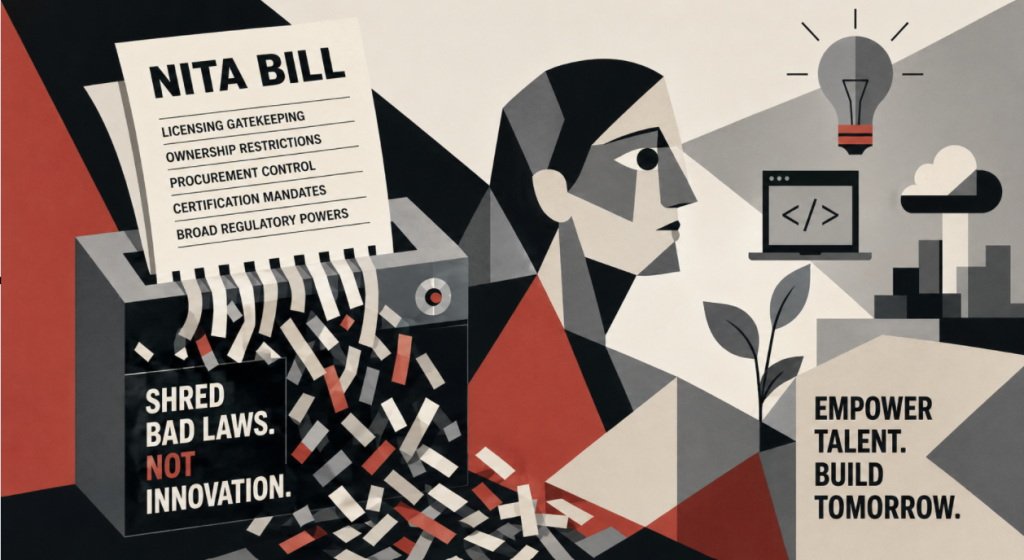
The NITA Bill Ghana debate has intensified sharply after veteran analyst Bright Simons delivered a scathing critique of proposed legislation that would transform the National Information Technology Agency into a sweeping digital-sector regulator with unprecedented powers over everything from cloud computing to professional certification.
Writing in The SCARAB, Simons argues that the draft bill represents a dangerous overreach that could stifle innovation, raise costs for consumers, and push thousands of informal tech workers underground—all while failing to address the genuine problems plaguing Ghana’s digital infrastructure.
NITA Bill Ghana Would Create Sweeping Licensing Regime for All ICT Workers
At the heart of the controversy is Section 35 of the NITA Bill Ghana, which stipulates that no person may engage in business or related activity in the ICT sector unless granted a licence by NITA. The provision expressly covers installation of ICT infrastructure, development or provision of ICT products and services, and activities requiring licensing or certification.
Violators could face jail time or substantial fines—a prospect that has sent shockwaves through Ghana’s vibrant tech community. The bill’s reach extends far beyond software companies to encompass cloud hosting providers, SaaS operators, data centre managers, government digital services partners, and national digital platform operators.
“Is the government of Ghana going to insist on licensing every single person in Ghana who builds a website, uses Microsoft Power BI to create some charts for a company, or deploys mermaid to craft some flyers for an event organiser?” Simons wrote. “The whole idea is totally ridiculous.”
Why the NITA Bill Ghana Threatens to Cripple Tech Innovation
Perhaps the most economically explosive provision in the NITA Bill Ghana is Section 37, which requires that licence applicants must be adult Ghanaian citizens or entities “wholly owned by a citizen.” This citizen-only ownership clause could devastate Ghana’s startup ecosystem, which relies heavily on foreign venture capital, non-citizen co-founders, regional holding structures, and offshore investors.
Simons warns that this provision could effectively make it illegal to engage remote experts to work on systems deployed in Ghana, noting that “half the whiz kids in Silicon Valley would have been ineligible to build their genius gizmos had America had a law like this.”
The bill also proposes mandatory certification of ICT professionals under Section 46, which states that no person shall be appointed as an ICT professional in a public or private institution unless certified by NITA. Critics argue this contradicts the definitions section, which limits “certified professional” to the public sector, revealing what they see as hasty and poorly considered drafting.
Ghana’s tech sector has grown significantly in recent years, with the National Information Technology Agency playing a coordination role. However, industry observers argue that converting NITA into a full regulatory authority with enforcement powers—including the ability to close premises, seize equipment, and suspend businesses—represents a fundamental and potentially destructive shift in approach.
NITA Bill Ghana Contradicts Existing Regulatory Frameworks
A central criticism of the NITA Bill Ghana is that it duplicates and potentially contradicts existing legislation. The Cybersecurity Act already creates a targeted licensing and accreditation regime for cybersecurity service providers, professionals, and practitioners. The Data Protection Act regulates controllers and processors of personal data with registration requirements and security obligations.
The Engineering Council also possesses the legal infrastructure to create top-tier categories for software engineering, hardware engineering, and electronic engineering if it deems the time right. Simons characterizes the bill as an example of “katanomics”—the practice of piling laws upon laws without reviewing how current legislation is performing.
International comparisons paint a sobering picture. Nigeria’s Computer Professionals Registration Council, created under a 1993 law with broad mandate over computing professionals, has generated “nothing of clear value to the sector,” according to Simons. The United States attempted a software engineering professional-engineer exam pathway that was discontinued after 2019 due to insufficient candidate numbers.
Bright Simons, whose analysis was published on The SCARAB platform, argues that a more sensible approach would target only the most critical functions: critical public digital infrastructure management, financial services cybersecurity auditing, Tier II and III data centre operations, public hospital digital health network administration, and public ERP procurement readiness certification.
How the NITA Bill Ghana Ignores the AI Revolution in ICT
The NITA Bill Ghana faces an additional fundamental challenge: the rapid advancement of artificial intelligence is fundamentally transforming what constitutes “IT work.” In an AI-driven world, a founder can describe an app to a model, a non-technical employee can use AI to build internal workflows, and cloud platforms can assemble infrastructure through templates.
“Who is the ICT professional here?” Simons asks. “The geography graduate with a few hours on reddit and stackoverflow under her belt typing out prompts? The AI tool vendor? The person who clicks deploy?”
The bill’s impact on Ghana’s substantial informal tech economy could be equally devastating. The ICT sector encompasses laptop repairers, phone technicians, CCTV installers, router vendors, fibre contractors, school computer-lab maintainers, POS support agents, cybercafé operators, and church livestream technicians. Aggressive enforcement could raise repair costs, create opportunities for corruption, reduce access to affordable hardware support in rural areas, and increase electronic waste.
The MOC’s proposal to require NITA approval before any sale, transfer, merger, or alteration of an ICT service provider’s business under Section 49 adds another layer of regulatory burden that critics say has no precedent in comparable jurisdictions.
As the debate continues, industry stakeholders are calling for the Ministry of Communications, Digital Technology, and Innovations to engage a broader coalition of independent tech professionals rather than relying on what Simons characterizes as a narrow clique of advisors. The outcome will shape Ghana’s digital economy for decades to come.
Source: MyJoyOnline