Satellite Images Reveal Iran Damaged 20 US Military Sites Across the Middle East
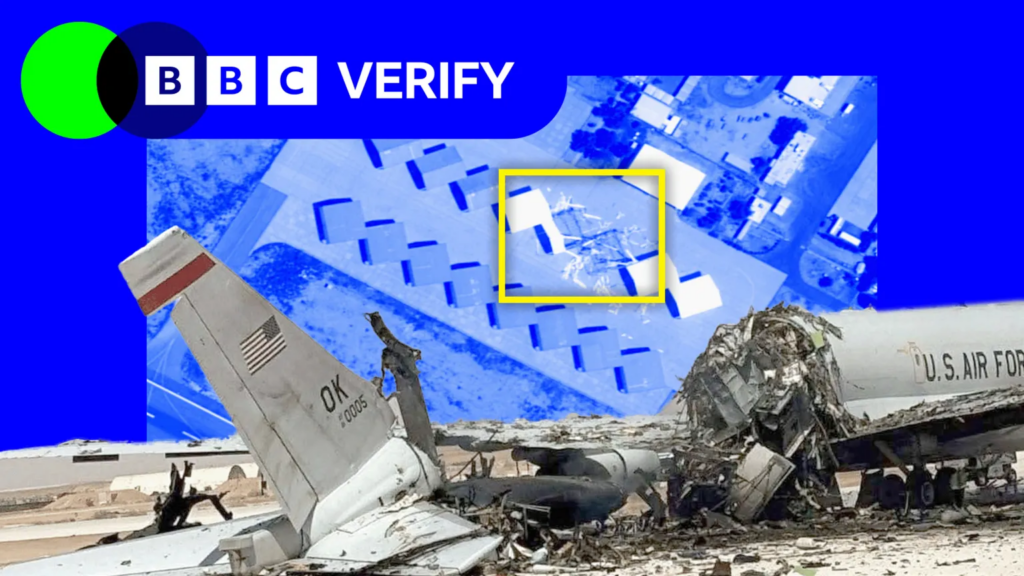
Satellite imagery and video analysis by BBC Verify have revealed that Iranian strikes have damaged at least 20 US military sites across eight countries in the Middle East since the end of February, a toll significantly more extensive than American officials have publicly acknowledged.
The findings paint a picture of a conflict in which Tehran’s counterattacks have proven more precise and costly than the Pentagon has conceded, even as the White House has repeatedly claimed that Iran’s military capacity has been largely neutralised.
Among the most significant losses are three Terminal High Altitude Area Defense (THAAD) anti-ballistic missile batteries struck at bases in the United Arab Emirates and Jordan. The United States is only known to operate eight such systems worldwide, each costing approximately one billion dollars to manufacture and requiring a crew of around 100 personnel. Each interceptor round fired by a THAAD battery costs roughly 12.7 million dollars.
Vice-Admiral Mark Mellett, the former head of the Irish Defence Forces, described the batteries as the backbone of a highly complex regional defence network that cannot be quickly or easily replaced.
The damage extends well beyond missile defence. At Prince Sultan Airbase in Saudi Arabia, satellite images show smoking craters and damaged aircraft, including what analysts identified as an E-3 Sentry surveillance plane, a platform that could cost up to 700 million dollars to replace. At Ali Al Salem Airbase and Camp Arifjan in Kuwait, analysts documented destroyed fuel storage bunkers, aircraft hangars, troop accommodation and satellite communications hardware.
The facilities hit span Saudi Arabia, the United Arab Emirates, Qatar, Kuwait, Iraq, Jordan, Bahrain and Oman. Some analysts place the number of bases struck as high as 28. The Pentagon’s own May estimate put the total cost of Operation Epic Fury at 29 billion dollars, with much of that figure attributed to repair or replacement of equipment. Democrats in Congress have argued the figure is likely an underestimate.
At least 42 aircraft, including F-15 and F-35 fighter jets, 24 MQ-9 Reaper drones and an A-10 attack plane, have been destroyed or damaged since the conflict began, according to the BBC Verify analysis.
What has emerged over the course of the war is a story of tactical evolution. Iran’s opening salvos relied on mass barrages designed to overwhelm air and missile defences through sheer volume. Within days, however, the strategy shifted to smaller, more precisely targeted strikes aimed at high-value assets.
“Iran’s opening salvos were optimised for volume, mass waves designed to overwhelm air and missile defences through sheer numbers,” said Dr Kelly Grieco, an analyst with the US-based Stimson Centre. “Within days, however, Iran had shifted to smaller, more precisely targeted salvos, conserving remaining missiles and drones for specific high-value targets and concentrating fire where even near-misses cause significant damage.”
An analyst at MAIAR, a defence intelligence firm, told BBC Verify that the US military appears to have been guilty of a degree of early-war complacency, failing to move aircraft out of range as Tehran’s tactics evolved. In the case of Prince Sultan Airbase, the facility had reportedly come under fire before the aircraft were ultimately destroyed.
The conflict has consumed US and partner air defence stocks at a significant rate, Dr Grieco warned, adding that there is no rapid path to replenishment. Should the fragile ceasefire between Washington and Tehran collapse, the existing damage to US bases suggests that facilities across the Gulf could be dangerously vulnerable.
A US defence official declined to comment on the findings, citing operational security reasons. The Pentagon has also sought to limit independent satellite analysis by requesting Planet, a major imagery provider, to impose an indefinite restriction on new images of Iran and most of the Middle East.
Image Source: MYJOYONLINE