Ghana's Future Threatened by Rising Political Insults
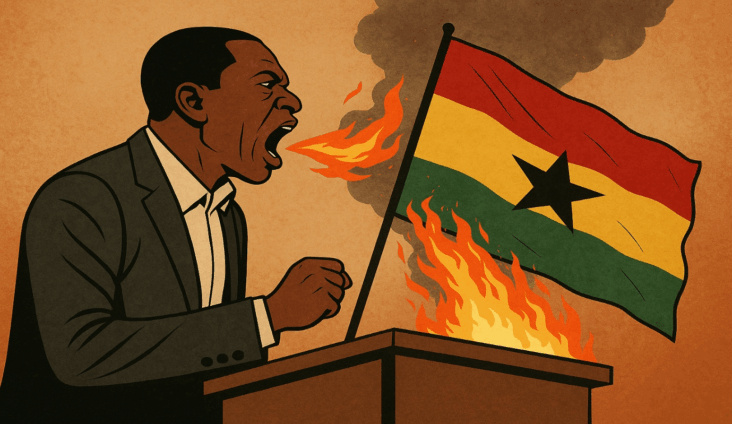
Ghana is not collapsing because of disagreement, but is rather suffering due to a loss of dignity in public discourse. The nation can withstand competitive elections and robust debate, but a public conversation dominated by humiliation, where insults are strategic and shame is content, threatens the foundations of family respect, community trust, and leadership’s moral authority.
Political insults, according to analysts, pose a national security risk – not by stifling speech, but by endangering social peace. A nation’s defense extends beyond its security forces; it relies on the norms that govern what we refrain from saying, applauding, or sharing.
The impact of these insults doesn’t remain confined to the political arena. They permeate society, traveling from radio studios to public transport, from social media to marketplaces, and ultimately becoming ingrained in our culture. Today, it’s sadly more common for young Ghanaians to recall a politician’s insult than their policy proposals, a worrying sign of moral confusion that prioritizes aggression over reasoned debate.
Data from the Media Foundation for West Africa (MFWA) supports these concerns. A report covering June 1, 2024, to February 28, 2025, documented 814 instances of indecent expression across 30 radio stations, with half of these (408 cases) linked to election-related issues. In July 2024 alone, 62 incidents were recorded, with Accra FM accounting for a significant 34 (approximately 55%) of those, primarily consisting of insulting and offensive comments.
Many Ghanaians dismiss these exchanges as “just talk,” but this overlooks the power of speech deeply embedded in our traditions. Historically, the okyeame (linguist) served as a guardian of peace, understanding that careless words could fracture communities and ignite long-lasting feuds.
The National Peace Council has repeatedly warned against hate speech and indecent language, even issuing guidelines to promote more responsible broadcasting. This isn’t about suppressing free expression, but about ensuring safety and stability.
Experts highlight a dangerous progression: insult leads to polarization, which fuels intimidation and ultimately, violence. While not every insult results in violence, toxic language creates a mindset that dehumanizes opponents and fosters animosity. In October 2024, the National Peace Council identified 36 potential hotspots for electoral violence and increased engagement in those areas.
Political parties themselves acknowledged the problem, signing a code of conduct on vigilantism and election violence in July 2024, and establishing a monitoring commission to ensure compliance.
The consequences extend beyond the political realm, poisoning families and negatively influencing the youth. When leaders model disrespect, it normalizes such behavior in personal relationships. When insults become entertainment, empathy diminishes.
The question we must ask ourselves is: what kind of Ghana are we building – one that values debate or one that celebrates disgrace? Our children are observing, and the message they receive is that effective leadership is synonymous with skillful insults, potentially replacing competence with noise.
While the Constitution protects free speech, it doesn’t sanction a free market of degradation. The National Media Commission (NMC) has also cautioned media outlets about offensive content, signaling a willingness to impose penalties. In October 2024, the NMC cited 44 TV stations for broadcasting unethical and indecent content.
A free press is vital for democracy, but when platforms amplify humiliation, they undermine their democratic function. A national reset is needed, one that is simple, enforceable, and rooted in our cultural values.
This reset requires several key steps: political parties must treat insults as misconduct, media houses must enforce zero-tolerance policies for hate speech, citizens must refuse to amplify disrespect, traditional and religious leaders must actively promote decency, and schools must reintroduce civic debating skills.
Ultimately, the patriotic test for Ghana is whether we can oppose ideas without poisoning relationships. Criticism should not descend into personal attacks. Ghana is too valuable to be reduced to a nation of insults. We must prioritize persuasion, evidence, and vision in our political discourse.
Image Source: MYJOYONLINE