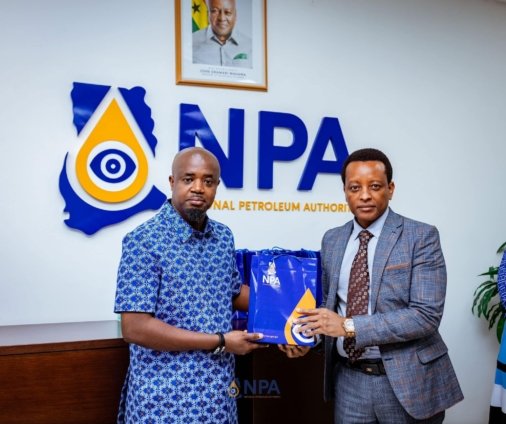
The National Petroleum Authority (NPA) on Thursday, December 11, hosted a delegation from Namibia’s National Assembly, who were in Ghana for a study visit aimed at bolstering petroleum governance.
The Namibian team, comprising members of the Standing Committee on Natural Resources, was received by NPA Chief Executive, Mr Godwin Tameklo (Esq.), at the Authority’s headquarters in Accra.
A key highlight of the visit was a tour of the National Fuel Monitoring Command Centre. The delegation received a comprehensive briefing on Ghana’s real-time fuel quality, distribution, and compliance monitoring systems.
Mr. Tameklo emphasized the Centre’s crucial role in Ghana’s petroleum regulation. “Our monitoring systems are built to ensure transparency, protect consumers and support a fair and efficient downstream sector,” he explained.
Discussions broadened to encompass Ghana’s overall petroleum governance framework, focusing on the structures and systems designed to enhance efficiency and regulatory effectiveness. Officials highlighted the importance of data-driven oversight, accountability, and stakeholder collaboration.
“We believe that strong institutions are the backbone of any successful petroleum industry,” Mr Tameklo stated.
The Namibian delegation expressed gratitude for the opportunity to learn from Ghana’s experiences, underscoring the significance of regional cooperation in Africa’s natural resource development. They particularly praised the NPA’s innovative approaches to fuel monitoring, licensing, and enforcement.
“Ghana’s systems give us a clear picture of what effective regulation looks like, and we are eager to adapt some of these lessons to our own context,” a member of the visiting committee remarked.
The visit is part of broader efforts to strengthen energy sector ties between Ghana and Namibia. The NPA reiterated its commitment to knowledge sharing and supporting regulatory capacity building across the African continent.
“We are always ready to share knowledge and work with our African partners to advance best practices in the petroleum industry,” Mr Tameklo concluded.
Image Source: MYJOYONLINE