Ghana Leads Global Push for Sovereign Health Reform at Geneva Dialogue
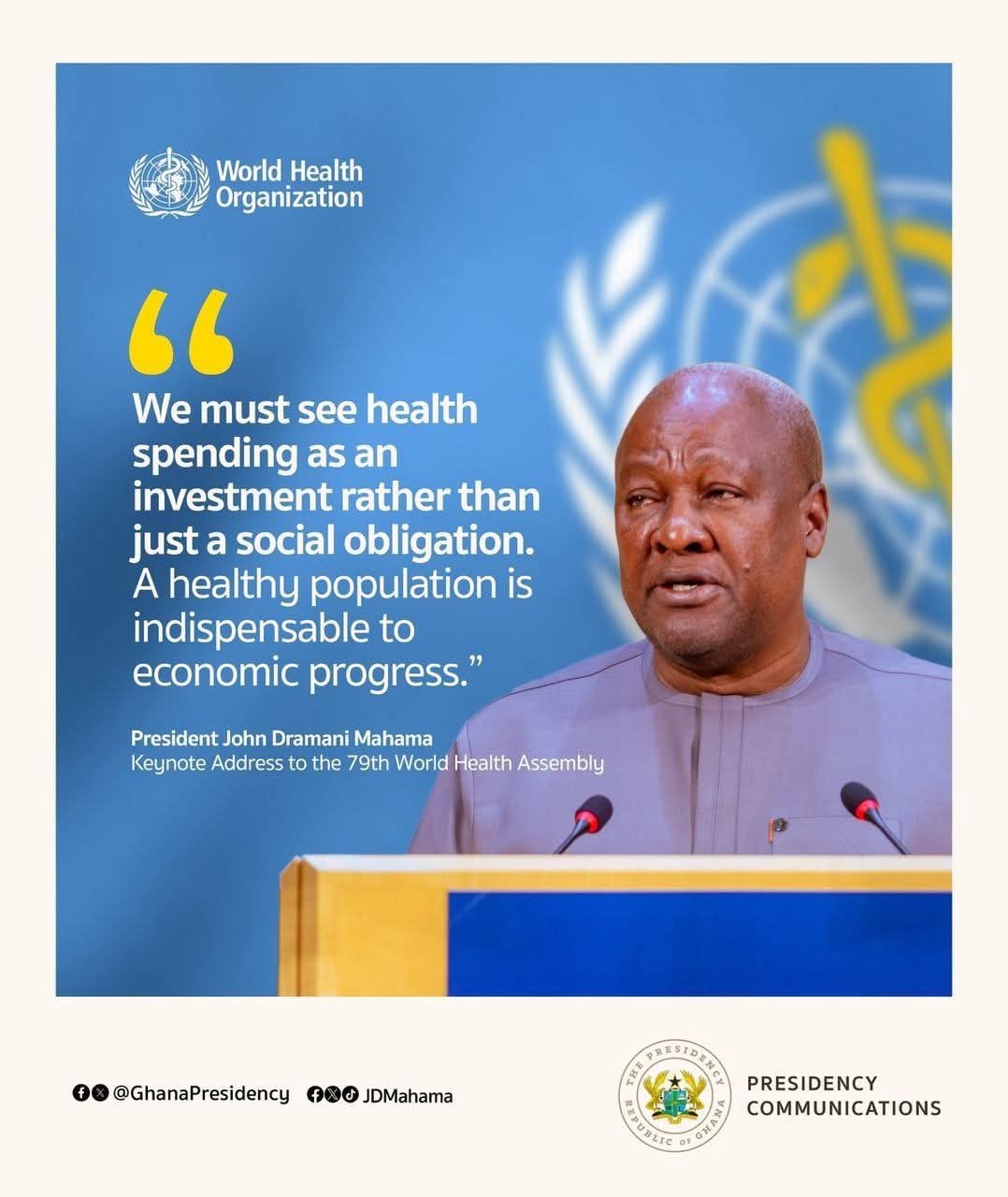
Ghana sovereign health reform is reshaping the global conversation on healthcare delivery after world leaders gathered at the Global Health Campus in Geneva for the Accra Reset High-Level Dialogue. The event, held on the margins of the 79th World Health Assembly, brought together more than 250 participants including heads of state, health ministers, philanthropic leaders, and global health experts to chart a new path forward for country-led health systems.
Ghana Sovereign Health Reform Gains International Momentum
The Accra Reset, a head-of-state-led initiative launched by President John Dramani Mahama during the 2025 United Nations General Assembly, is rapidly becoming an international reform movement. The initiative seeks to advance a new architecture for development and global health grounded in sovereignty, coordinated execution, domestic capacity, and regional collaboration.
At the Geneva dialogue titled “Geneva Clarion Call: Rethinking Power, Financing and Global Health Delivery,” President Mahama outlined the next phase of the Accra Reset agenda. This includes the work of the High-Level Panel on Global Health Architecture and Governance, the Reform Observatory, and the HINGE mechanism designed to drive investments into transformative local-led health delivery.
“If the Accra Reset can move health commitments into working programmes, it can do so for any sector,” President Mahama said. “Health is the vanguard, the proof of concept, and the moral imperative.”
How Ghana Sovereign Health Reform Builds on African Leadership
The dialogue featured senior leaders from across the Global South, reflecting a growing consensus that health systems must be designed and governed by the countries they serve. Health ministers from Indonesia, Brazil, Kenya, and Ghana shared national reform experiences during the ministerial session.
“Countries of the Global South must play a central role in shaping global decisions,” said Dr. Alexandre Padilha, Brazil’s Minister of Health. “Sovereignty is not merely an aspiration or a rhetorical concept, but an executable agenda grounded in stronger national health systems, sustainable financing, and local and regional production capacities.”
Kenya’s Health Minister Aden Duale highlighted practical progress in East Africa. “Kenya and Ghana are leading in terms of creating practical health sovereignty,” he said. “In eighteen months, we have mobilized domestically to fund our health care and universal health coverage.”
This African leadership in health reform echoes broader continental momentum, including Ghana’s push for local vaccine production, where 71 percent of citizens have expressed readiness to embrace domestically manufactured vaccines.
Global Health Institutions Back Ghana Sovereign Health Reform Vision
Leaders from major global health financing institutions used the Geneva dialogue to signal their support for country-owned approaches. Peter Sands, Executive Director of the Global Fund, said the organization is evolving its partnerships to support national and regional leadership while strengthening systems, workforce, and supply chains.
Dr. Sania Nishtar, CEO of Gavi, the Vaccine Alliance, described how the organization’s Gavi Leap reform programme is demonstrating that radical change at scale is possible. “Advancing country sovereignty and freeing up resources for frontline delivery in parallel,” she said.
Dr. Priya Basu, Executive Head of the Pandemic Fund, linked the Accra Reset to broader health security goals. “The future of global health security will be defined by countries’ capacity to build, finance, and sustain resilient health systems,” she said. “The Accra Reset embodies this transformation.”
Dr. Kelechi Ohiri, Director General of Nigeria’s National Health Insurance Authority, shared how Nigeria’s Health Sector Blueprint became the foundation for coordinating health activities across the country. He noted that Nigeria has begun integrating HIV, TB, and malaria programs into health insurance systems.
What Ghana Sovereign Health Reform Means for Global Health Delivery
Dr. Vanessa Kerry, CEO of Seed Global Health, presented new analysis mapping more than 11 major global health reform efforts worldwide. She highlighted a striking level of consensus around country-led reform but warned that overlapping initiatives could deepen fragmentation without clear implementation roadmaps.
“While the sector is increasingly aligned on what needs to change, there is not yet enough agreement on how reforms are to be carried out,” Dr. Kerry said. “The next phase of reform must be a coherent implementation roadmap.”
Professor Mohamed Yakub Janabi, WHO Regional Director for Africa, urged that reforms be judged by their impact on people’s lives. “We must move from promises to progress, from commitment to impact,” he said. “This means aligning financing with national priorities and advancing governance and financing together to build a system that works with countries, not around them.”
Ghana’s leadership in this initiative positions the country at the forefront of a global shift toward health sovereignty. The Accra Reset has expanded from a presidential initiative to a multi-stakeholder movement backed by governments, multilateral agencies, and philanthropic organizations worldwide.
Related developments on African health governance include Ghana’s recent e-Visa portal launch, which is strengthening continental connectivity alongside health cooperation frameworks.
Source: Ghanamma.com
Image Source: GHANAMMA