Ghana and Côte d'Ivoire Align Cocoa Prices in Landmark Bid to Lift Farmer Incomes
Ghana and Côte d’Ivoire, which together produce roughly 60 per cent of the world’s cocoa, have agreed to harmonise their farm-gate pricing policies in a move designed to improve livelihoods for millions of farmers and strengthen their collective bargaining power on the global stage.
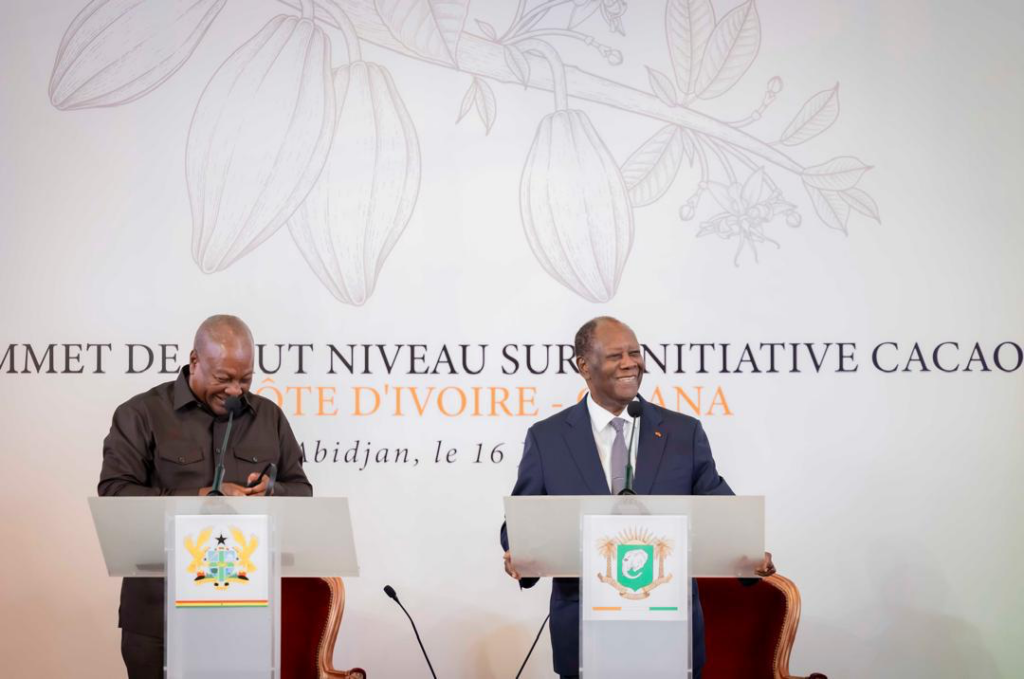
The agreement, announced in a joint declaration following the Côte d’Ivoire-Ghana High-Level Summit on the Future of the Cocoa Economy in Abidjan, commits the two nations to aligning cocoa premiums, synchronising crop-season calendars, and coordinating market oversight to curb the cross-border smuggling and price undercutting that have long distorted the sector.
“Fair compensation for cocoa farmers remains central to the sector’s long-term sustainability and essential to promoting economic justice and social stability in cocoa-growing communities,” the declaration stated. The language is careful, but the intent is not: the two largest cocoa producers are signalling that they will no longer allow global commodity markets and multinational buyers to set the terms unilaterally.
The initiative builds on the Côte d’Ivoire-Ghana Cocoa Initiative, known as CIGCI, which was established to give the two countries a coordinated voice in negotiations with chocolate manufacturers and trading houses. Under the new agreement, the CIGCI’s reach will be extended to other African cocoa-producing nations, broadening the coalition and increasing its leverage.
Beyond pricing, the summit produced commitments on several fronts. Joint scientific research will target cocoa diseases, particularly the Cocoa Swollen Shoot Virus Disease, which has devastated plantations in both countries. New programmes will promote cocoa processing within Africa rather than exporting raw beans for refinement elsewhere, a shift that could capture significantly more value from the supply chain. Domestic consumption campaigns will also be launched to build local demand for cocoa products.
The stakes are high. Volatile global cocoa prices remain the single greatest risk to farmer incomes, and neither country has the financial reserves to sustain prolonged price floors without international cooperation. Illegal mining—known locally as galamsey—continues to encroach on cocoa-growing land in Ghana, degrading soil and water systems essential for cultivation. Climate change is altering rainfall patterns and temperatures in ways that threaten yields across West Africa’s cocoa belt. And the emergence of cocoa substitutes, driven by sustainability concerns and cost pressures in European confectionery markets, could erode demand over the coming decade.
Stricter international sustainability standards present both a challenge and an opportunity. Compliance requires investment that many smallholder farmers cannot afford on their own, but meeting those standards also opens doors to premium markets where consumers are willing to pay more for ethically sourced chocolate. The question is whether the price alignment agreement can generate enough additional income at the farm level to fund that transition.
For Ghana, the timing is significant. The country has spent recent years grappling with macroeconomic instability, and the cocoa sector remains one of its most reliable sources of foreign exchange. A coordinated pricing strategy with Côte d’Ivoire could provide a measure of stability that unilateral policy cannot. It also sends a message to international buyers: the days of playing one producer against the other to drive down prices may be numbered.
The agreement will be judged not by the language of its declaration but by its implementation. If the two governments can follow through on harmonising prices, reducing smuggling, and expanding processing capacity, the Abidjan summit may be remembered as the moment Africa’s cocoa producers began to act as a bloc rather than as competitors. If commitments falter, it will join a long list of well-intentioned declarations that changed little on the ground.
Image Source: MYJOYONLINE