EU Backs Ghana Forest Restoration Drive to Reclaim 14,000 Hectares of Degraded Land
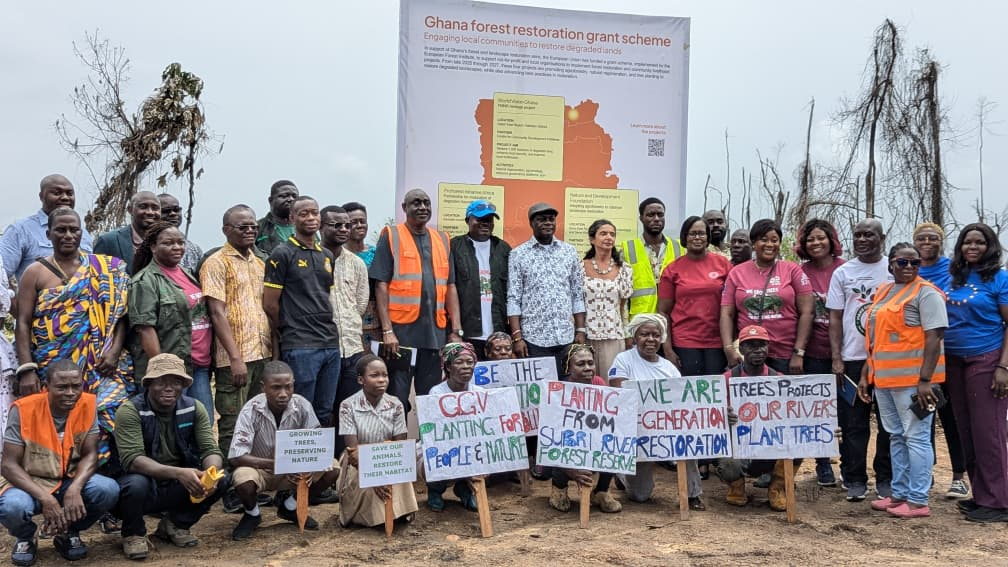
The European Union has committed significant funding to restore more than 14,000 hectares of degraded forest and savanna land across Ghana, in what officials describe as one of the most ambitious community-led ecological restoration programmes in West Africa.
The initiative, known as the Ghana Forest Restoration Grant Scheme, falls under the EU Sustainable Forest and Cocoa Programme — a €6 million (GH₵80 million) effort designed to promote deforestation-free cocoa production, sustainable land use, and climate resilience across the country’s High Forest and Savanna ecological zones.
Silvia Severi, Head of Cooperation at the EU Delegation in Ghana, said the bloc’s support reflects a deep commitment to environmental sustainability in partnership with Ghanaian communities. “The European Union is proud to stand alongside Ghana in this effort, not just as a partner, but as a firm believer in the power of community-led restoration to transform landscapes and lives,” she said at a progress event held at the Subri River Forest Reserve.
The scheme is being implemented by the European Forest Institute through four lead non-governmental organisations: Goshen Global Vision, the Nature and Development Foundation, Proforest, and World Vision Ghana. Each partner works with community-based organisations to deliver on-the-ground activities including agroforestry, natural regeneration, tree planting, and livelihood programmes such as beekeeping and seedling nurseries.
Capacity building lies at the heart of the project, with 20,000 farmers and rural residents targeted for training and support across all 16 regions. Officials have placed particular emphasis on the inclusion of women and young people, recognising that lasting restoration depends on broad community ownership.
Joseph Nelson, the Western Regional Minister, said the projects go beyond environmental recovery. “These projects are not only restoring landscapes, but they are also supporting communities to build sustainable futures. By creating new livelihood opportunities and strengthening local capacities, this will ensure that restoration efforts deliver lasting benefits on the ground,” he said.
The programme runs through 2027, with pilot phases and community mobilisation taking place through 2026 before full-scale restoration and monitoring begin in the following year. It aligns closely with Ghana’s national Tree for Life initiative, led by the Ministry of Lands and Natural Resources in partnership with the Forestry Commission, and builds on momentum from the annual Green Ghana Day tree-planting exercise.
The initiative also arrives at a moment when Ghana faces mounting pressure to address illegal mining and deforestation that have stripped large tracts of forest cover. The country has deployed military support to reclaim forest reserves from illegal miners, underscoring the urgency of coordinated environmental action.
Mary Perpetua Kwakuyi, Executive Director of Goshen Global Vision, emphasised that success requires partnership across sectors. “These projects are proof that sustainable, resilient forests can only be built through collective action, bringing together government, civil society and local communities united by this common goal,” she said.
With Africa increasingly vocal on the global stage about the need for predictable climate financing, the EU-Ghana partnership offers a working model of how international support can translate into tangible ecological and economic outcomes at the community level.
Image Source: MYJOYONLINE