Beyond Drains: Susan Adu-Amankwah Prescribes Lasting Solution to Accra Floods
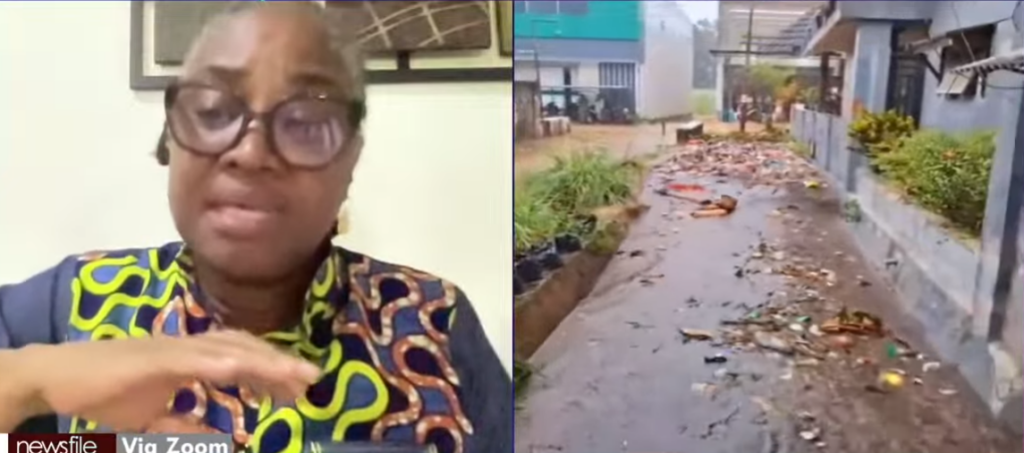
As Accra grapples with increasingly severe flooding, Susan Adu-Amankwah, Executive Secretary of the National Interest Movement, is challenging conventional approaches to flood mitigation by arguing that engineering solutions alone cannot solve the city’s perennial water crisis.
Speaking on JoyNews’ Newsfile program, Adu-Amankwah contended that Accra’s flood crisis stems not just from inadequate drainage infrastructure but from deeper systemic failures in policy, land tenure systems, and enforcement of planning regulations. Her perspective echoes concerns raised in previous discussions where she warned that “successive governments have failed to address flooding crisis” through fragmented approaches that neglect the interconnected nature of urban challenges.
“Apart from the engineering controls, we must also have the policy controls,” she asserted, framing flood prevention as a multidimensional challenge requiring coordinated intervention across multiple sectors. This aligns with her earlier warnings about how environmental challenges like poor sanitation can have cascading effects, as she previously noted that “flood-related death toll could rise amid possible disease outbreak” when drainage systems fail during heavy rains.
Her critique zeroes in on Ghana’s land tenure system as a “deeply flawed and vulnerable to abuse” structure that enables unregulated development in flood-prone areas. She described the confusing overlay of family lands, stool lands, and government lands, compounded by corruption in land transactions, as creating conditions where construction proceeds in unsuitable locations with minimal accountability. “If we had a system where all the lands were probably under government and were probably democratised and people were not being corrupt and collecting all sorts of monies and whatever and the chiefs selling the lands 10 times, people probably would not be building anyhow,” she explained.
Adu-Amankwah advocates for a more sophisticated approach to urban engineering that accounts for real-world human behavior rather than idealized compliance. Drawing inspiration from international practices where planners observe natural human pathways before installing permanent infrastructure, she questioned whether Ghanaian engineers sufficiently consider how people actually interact with their environments when designing flood control systems. “We would want to see what the engineers are coming up with because we want to see proper living dynamic engineering that takes into consideration the type of people who are living there,” she said.
Beyond physical infrastructure, she emphasizes the need for robust policy frameworks including proper flood-risk mapping, disaster mapping, and early warning systems that could alert communities before rains become catastrophic. She also questioned the nation’s preparedness culture, asking pointedly, “I mean, how many times have we done just drills?”
Critically, Adu-Amankwah rejected the notion that residents of properly planned communities are insulated from flooding’s consequences, arguing that environmental challenges like poor sanitation and open defecation create interconnected problems that transcend neighborhood boundaries. “The people in Chorkor will probably get cholera not because they are the ones doing the open defecation, but maybe the open defecation coming from elsewhere is the one that is coming to give them the cholera there,” she explained, highlighting how environmental health issues cascade across communities.
Her perspective represents a growing recognition among urban planners that sustainable flood resilience requires addressing both hard infrastructure and the soft systems—governance, social norms, and enforcement mechanisms—that determine how cities actually function during extreme weather events.
Image Source: MYJOYONLINE