Audit Flags Irregularities in Heal Komfo Anokye Project Amid Dispute Over Control of Funds
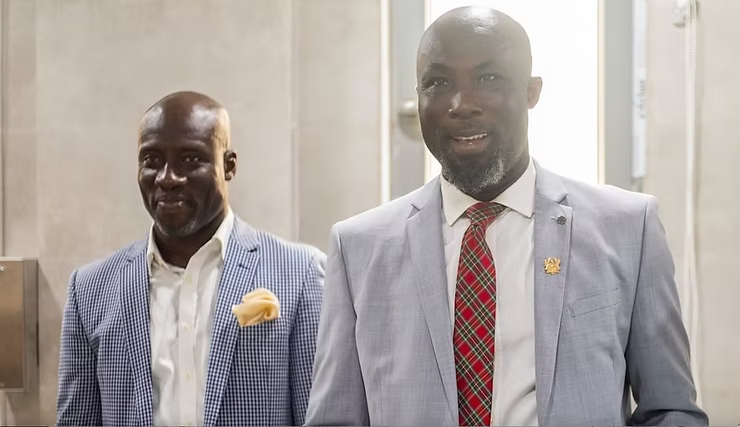
An audit of the Heal Komfo Anokye Project (HeKAP), the high-profile initiative launched by Asantehene Otumfuo Osei Tutu II to rehabilitate the Komfo Anokye Teaching Hospital, has uncovered a series of financial irregularities and governance concerns that raise troubling questions about how nearly GHS 50 million in public and corporate donations has been managed.
The investigation, reported by Manasseh Azure Awuni of MyJoyOnline, reveals that the project — conceived as a charitable effort to raise $10 million for the dilapidated hospital — was registered as a private company rather than a public trust, with two directors who have no formal connection to KATH and no Memorandum of Understanding governing their relationship with the hospital.
A Project Born of Good Intentions
When Otumfuo Osei Tutu II launched HeKAP in November 2023, it struck a chord across Ghana. The Komfo Anokye Teaching Hospital, one of the country’s two major referral facilities, had long suffered from crumbling infrastructure. Donations poured in from state agencies, corporations, Members of Parliament, government ministers, and ordinary citizens. The initiative raised approximately GHS 50 million — a remarkable sum that reflected both the stature of the Asantehene and the depth of public concern about the hospital’s condition.
Yet beneath the surface, the project’s legal and financial architecture was far more complicated than most donors realised.
The Ownership Dispute
The Heal Komfo Anokye Hospital Foundation was incorporated as a private company limited by guarantee on March 25, 2024 — four months after the project’s public launch. Its two directors are Samuel Adu Boakye, a journalist with Kessben FM, and Kojo Darko Asante, a chief architect at the Public Works Department.
Neither director holds any formal position at KATH, and critically, no Memorandum of Understanding was ever signed between the Foundation and the hospital. This raises fundamental questions about who authorised the collection of donations on KATH’s behalf and under what legal framework those funds were held.
Samuel Adu Boakye has maintained that the project was his initiative. He has argued that while he originated the concept, the CEO of KATH was expected to take ownership under corporate governance norms. When pressed on whether he would account for or hand over the funds to KATH, his response was unequivocal: the Foundation would neither account for nor hand over the money.
Audit Findings
The auditors flagged several concerns, including incomplete financial records and transactions that could not be fully verified. They recommended further investigation, particularly into documentation that was not completely filled out. Approximately GHS 13 million remains owed to contractors, though this figure has not been independently validated.
Former KATH CEO Professor Addai-Mensah, who oversaw the hospital during the project’s early stages, repeatedly declined to characterise the donations as either public or private funds when questioned. He maintained that the project operated under the auspices of Manhyia Palace and was registered as a charity foundation limited by guarantee.
A source close to Manhyia Palace has indicated that Otumfuo himself requested the audit of HeKAP’s operations — a signal that the Asantehene shares the public’s concern about accountability.
A Pattern of Opacity
The HeKAP controversy fits a broader pattern of opacity in the management of public-interest funds in Ghana. The Media Foundation for West Africa’s recent demand for full disclosure of over 1,000 road contracts from the Ministry of Roads and Highways reflects a similar frustration: well-intentioned public projects too often operate without the transparency that their donors and beneficiaries deserve.
Samuel Adu Boakye has pushed back against suggestions of wrongdoing. He described the audit findings as administrative errors rather than malfeasance, adding that such issues are typical of any audit process.
But for the many Ghanaians who contributed their hard-earned money to a cause championed by the Asantehene, administrative errors are not a sufficient explanation. The question now is whether the authorities will act on the audit’s recommendations — and whether the donors who made HeKAP possible will finally receive the accountability they were promised.
Image Source: MYJOYONLINE