Democracy Remains Ghana's Greatest Strategic Asset, Mahama Tells Chatham House
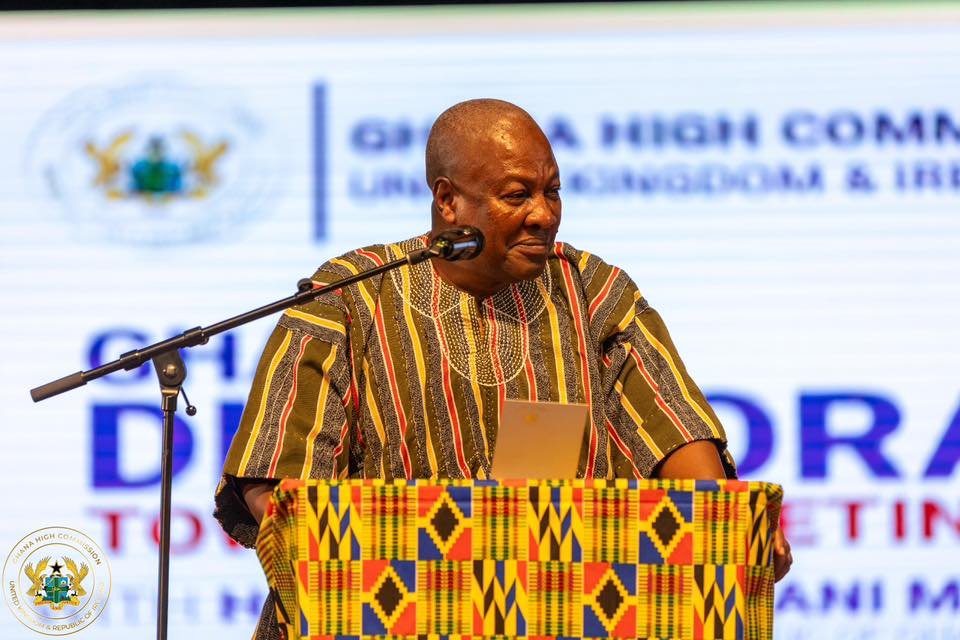
President John Dramani Mahama has mounted a robust defence of democratic governance as a cornerstone of Ghana’s national identity and international standing, telling an audience at Chatham House in London that the country’s democratic tradition is not merely a political ideal but a tangible economic asset.
Speaking on Ghana’s position in an increasingly complex and competitive global environment, President Mahama argued that the nation’s ability to exert influence on the world stage ultimately depends on the strength of its domestic institutions, the quality of its economic governance, its productive capacity, and the calibre of its human capital.
“Ghana’s capacity to navigate a changing global order is closely linked to the health of its democratic institutions and the effectiveness of its governance systems,” Mahama said. “Ghana’s democratic tradition remains one of our greatest strategic assets.”
The President’s remarks come at a time when democratic systems across the globe are facing growing headwinds — from the resurgence of authoritarian populism in parts of Europe and the Americas to the outright military coups that have toppled elected governments in West Africa. Against this backdrop, Mahama positioned Ghana as a beacon of constitutional governance in a region where democratic norms are under increasing strain.
He pointed to the country’s record of political pluralism, respect for the rule of law, and peaceful transfers of power as principles that remain essential foundations for long-term stability, sustainable development, and national progress.
“Democracy is not merely a political ideal. For us, it is also an economic asset,” Mahama added, drawing a direct line between the quality of governance and the health of the economy.
The President explained that democratic governance strengthens investor confidence, enhances the credibility of state institutions, promotes social cohesion, and creates the predictability required for long-term investment and economic development. It is an argument that echoes themes he has struck on previous international engagements. In recent remarks, Mahama has consistently called for deeper African unity and regional economic integration, warning that no nation on the continent can afford to face global challenges in isolation.
He noted that countries seeking sustainable growth must prioritise strong institutions and accountable governance, since investors are far more likely to commit resources in environments characterised by stability, transparency, and respect for the rule of law. This position aligns with the broader message the government has been delivering to international audiences. At the Ghana-UK Investment Summit earlier this year, the Finance Minister told the London diaspora that Ghana is open for business, framing the country’s democratic stability as a competitive advantage in attracting foreign direct investment.
Mahama’s Chatham House address appears designed to reframe the conversation about Ghana — not as a country seeking aid, but as a democratic partner offering predictability and rule of law in a world where both are increasingly scarce. For a government that has staked its economic recovery on attracting investment and deepening trade partnerships, the argument that democracy is Ghana’s greatest strategic asset is both a philosophical position and a practical sales pitch.
Whether investors and international partners will be persuaded by the pitch will depend, in part, on whether the government can deliver on the institutional reforms and economic governance improvements that underpin the President’s argument.
Image Source: MYJOYONLINE