South Africa's Anti-Migrant Protests Expose Fragile Social Contract Amid Economic Strain
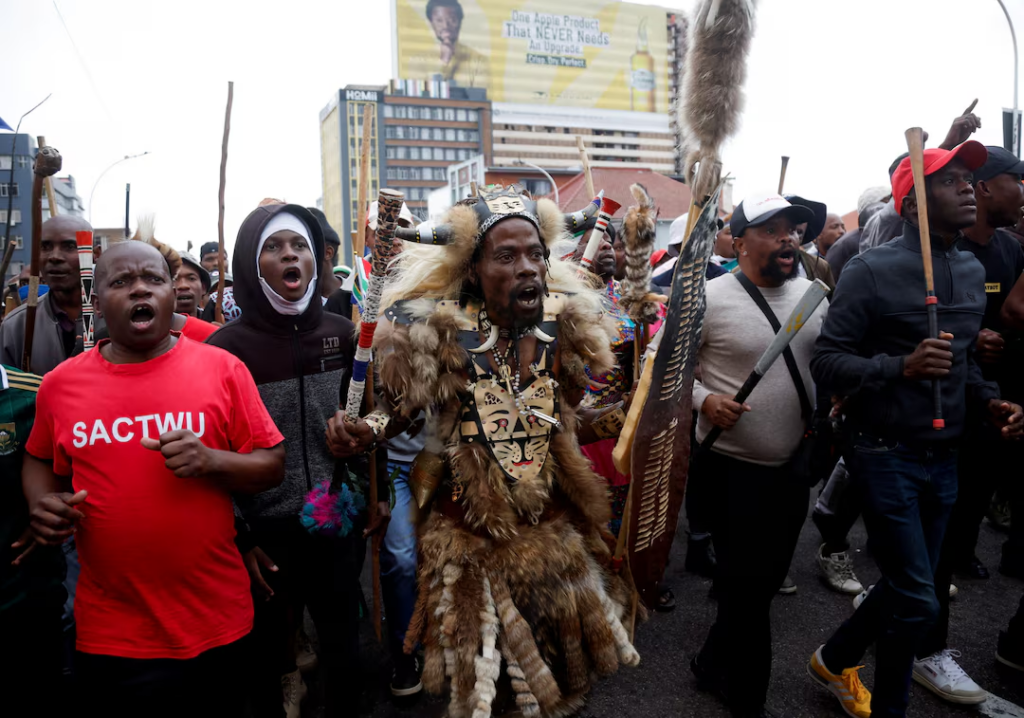
JOHANNESBURG — The sight of protesters marching through South African cities waving national flags and carrying wooden weapons has become increasingly common in recent months, but Tuesday’s demonstrations carried a particular urgency as they marked a self-imposed deadline for undocumented migrants to leave the country. What began as a series of localized gatherings has evolved into a nationwide movement that lays bare the tensions between South Africa’s constitutional ideals and the economic anxieties of its citizens.
The March and March organization, which spearheaded the protests, had designated June 30 as the date by which foreign nationals without proper documentation should depart South Africa. In the aftermath of the deadline, authorities reported at least four fatalities connected to the demonstrations, with thousands of foreign nationals describing experiences of intimidation, displacement from their homes, and property damage. These figures likely underestimate the full human toll, as many incidents go unreported due to fear of retaliation or distrust in law enforcement.
The protests have not been confined to any single city. Demonstrations were reported in Johannesburg, Durban, Pietermaritzburg, and other urban centers, with varying degrees of intensity. In some locations, marches proceeded peacefully as participants chanted slogons and carried handmade signs. In others, the atmosphere turned hostile, with reports of stone-throwing, property vandalism, and sporadic gunfire. Police responses have ranged from restrained monitoring to the deployment of tactical units and, in isolated cases, the use of live ammunition.
At the forefront of the movement is Jacinta Ngobese, whose March and March group has framed the protests as a necessary response to perceived economic injustice. In interviews, Ngobese has articulated a vision in which state resources would be systematically employed to remove undocumented migrants from the country, building by building. This rhetoric resonates with a significant segment of the population that views foreign nationals as unfair competitors in a struggling job market.
Official unemployment figures in South Africa remain stubbornly high, with approximately 32% of the workforce unable to find employment. For many citizens, particularly those in economically marginalized communities, the presence of foreign workers — whether documented or not — represents a tangible threat to their livelihoods. This perception persists despite studies indicating that migrants often fill labor shortages in sectors that struggle to attract local workers and generally contribute more to the economy through taxation and consumption than they consume in public services.
“This is not fair,” explained Silindile Xaba, 31, who joined protesters in Durban. “People are not working, the jobs are being taken by illegal foreigners.” Her sentiment reflects a widespread belief that immigration policy has failed to protect South African workers, though economists note that the relationship between migration and employment is considerably more complex than such assertions suggest.
The violence that accompanied some protests has drawn particular concern from human rights observers. In Thembisa, a densely populated area north of Johannesburg, confrontations between protesters and suspected migrants escalated to stone-throwing and reports of gunfire. Similar scenes unfolded in Benoni, where police reported deploying armored vehicles and firing warning shots after facing what they described as threats from approximately 500 demonstrators. In Pietermaritzburg, authorities used rubber bullets to disperse crowds, while in Soweto, there were allegations of looting targeting businesses owned by foreign nationals.
South African officials have attempted to balance acknowledgment of public concern with condemnation of unlawful behavior. Deputy National Commissioner for Policing Tebello Mosikili revealed that law enforcement had opened 103 criminal cases against anti-foreigner vigilantes since March, indicating a recognition that some participants have crossed the line from peaceful protest to criminal activity. President Cyril Ramaphosa sought to strike a similar balance in a recent statement, validating citizens’ anxieties about immigration while emphasizing that constitutional rights do not extend to violence or intimidation.
“South Africans’ … deep concerns about illegal immigration … are real, and they deserve to be heard,” Ramaphosa stated. “But the right to protest … does not allow people to threaten or intimidate others, or to engage in acts of vandalism or violence.”
The current unrest represents more than a spontaneous outbreak of hostility; it reflects long-standing questions about South Africa’s identity in post-apartheid Africa. Since the transition to majority rule in 1994, the country has positioned itself as a beacon of constitutional democracy and human rights on the continent. Yet the recurring outbreaks of xenophobic violence — documented incidents date back at least to 2008 — challenge this self-image and raise difficult questions about the durability of social cohesion in a nation still grappling with profound inequality.
Regional implications are also significant. South Africa’s actions regarding migrant populations reverberate throughout the Southern African Development Community and beyond. Neighboring countries, many of which rely on remittances from citizens working in South Africa, have expressed alarm at the treatment of their nationals. Diplomatic channels have seen increased activity as governments seek to protect their citizens while avoiding open confrontation with Africa’s largest economy.
The protests were organized by the March and March movement, which had set June 30 as the deadline for foreign nationals without proper documentation to depart South Africa — a deadline that has been analyzed as revealing troubling trends in state authority and cooperation across the continent.
The situation has particular relevance for Ghana, which has engaged diplomatically with South Africa over the treatment of its nationals amid the unrest, highlighting how national immigration policies become tests of regional solidarity.
Economic analysts note that South Africa’s immigrant population, estimated at approximately 3 million people or 4% of the total population, represents a modest share by international standards. Countries such as Australia, Canada, and several European nations host significantly higher proportions of foreign-born residents. Yet in South Africa, where historical legacies of exclusion and dispossession run deep, even a relatively small immigrant population can become a focal point for broader societal frustrations.
As the immediate protests subside, the underlying issues they exposed remain unresolved. The country continues to face stark economic disparities, with wealth concentrated in the hands of a minority while millions struggle to access basic opportunities. Until these fundamental challenges are addressed, the potential for similar outbreaks of violence will persist, testing South Africa’s commitment to the non-racial, democratic ideals enshrined in its post-apartheid constitution.
Image Source: MYJOYONLINE